
Happiness in marriage is a subjective concept.
Data from a national survey have revealed the numbers behind marriage satisfaction, the reasons some couples struggle, and whether the notion of lifelong happiness in marriage remains valid today.
TL;DR
- Married adults ages 25 to 50 are 17 percentage points more likely to be thriving than those who never married, per Gallup data.
- Across U.S. metros with at least 500,000 residents, areas with higher marriage rates tend to have higher well-being, though the relationship is not perfectly uniform.
- The top-10 metros by marriage rate average 56.4% thriving, compared to 52.6% for the bottom 10.
The data for this explainer comes from the 2024 Marriage and Well-Being Report by the Institute for Family Studies and Gallup.
From 2008 to 2020, Gallup collected data from 2.5 million U.S. adults, primarily via phone surveys. Additionally, from March 2020 to November 2023, Gallup collected an additional 56,653 responses through the web.
The report surveyed thousands of married U.S. adults on their relationship satisfaction.
In this context, “bothered” refers to feelings of dissatisfaction, strain, or emotional discomfort within the marriage.
Marriage vs Well-Being Across U.S. Metro Cities
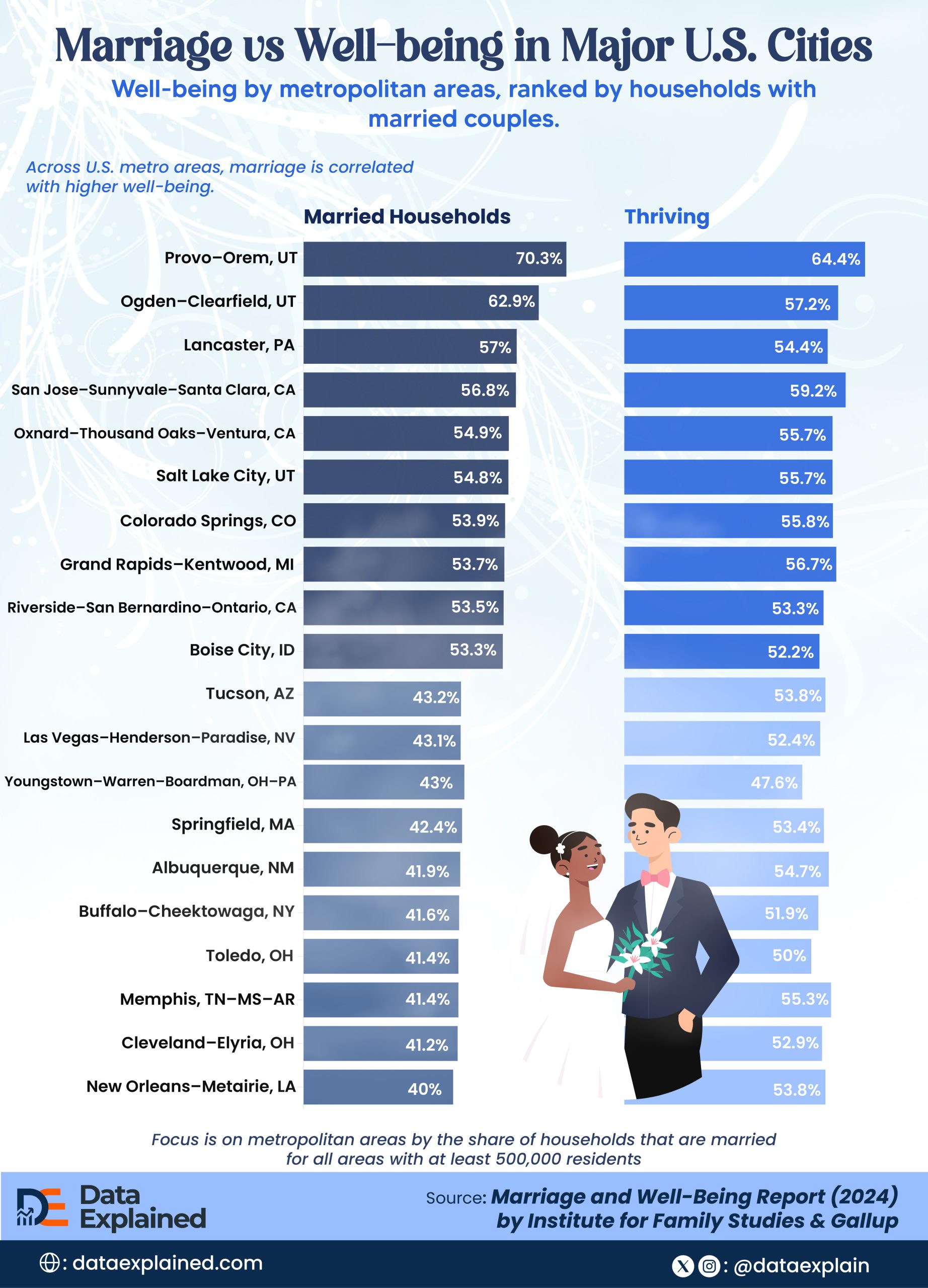
The table below compares the top 10 and bottom 10 regions by share of married households.
The data ranks metropolitan areas by the share of households that are married for all areas with at least 500,000 residents
| wdt_ID | wdt_created_by | wdt_created_at | wdt_last_edited_by | wdt_last_edited_at | Metro Area | Married Households (%) | Thriving (%) |
|---|---|---|---|---|---|---|---|
| 1 | Monica Ebunoluwa | 17/04/2026 01:45 PM | Monica Ebunoluwa | 17/04/2026 01:45 PM | Provo–Orem, UT | 70.3 | 64.4 |
| 2 | Monica Ebunoluwa | 17/04/2026 01:45 PM | Monica Ebunoluwa | 17/04/2026 01:45 PM | Ogden–Clearfield, UT | 62.9 | 57.2 |
| 3 | Monica Ebunoluwa | 17/04/2026 01:45 PM | Monica Ebunoluwa | 17/04/2026 01:45 PM | Lancaster, PA | 57.0 | 54.4 |
| 4 | Monica Ebunoluwa | 17/04/2026 01:45 PM | Monica Ebunoluwa | 17/04/2026 01:45 PM | San Jose–Sunnyvale–Santa Clara, CA | 56.8 | 59.2 |
| 5 | Monica Ebunoluwa | 17/04/2026 01:45 PM | Monica Ebunoluwa | 17/04/2026 01:45 PM | Oxnard–Thousand Oaks–Ventura, CA | 54.9 | 55.7 |
| 6 | Monica Ebunoluwa | 17/04/2026 01:45 PM | Monica Ebunoluwa | 17/04/2026 01:45 PM | Salt Lake City, UT | 54.8 | 55.7 |
| 7 | Monica Ebunoluwa | 17/04/2026 01:45 PM | Monica Ebunoluwa | 17/04/2026 01:45 PM | Colorado Springs, CO | 53.9 | 55.8 |
| 8 | Monica Ebunoluwa | 17/04/2026 01:45 PM | Monica Ebunoluwa | 17/04/2026 01:45 PM | Grand Rapids–Kentwood, MI | 53.7 | 56.7 |
| 9 | Monica Ebunoluwa | 17/04/2026 01:45 PM | Monica Ebunoluwa | 17/04/2026 01:45 PM | Riverside–San Bernardino–Ontario, CA | 53.5 | 53.3 |
| 10 | Monica Ebunoluwa | 17/04/2026 01:45 PM | Monica Ebunoluwa | 17/04/2026 01:45 PM | Boise City, ID | 53.3 | 52.2 |
Source: Page 7, 2024 Marriage and Well-Being Report by the Institute for Family Studies and Gallup.
In the top ten metro areas, marriage finds a steadier rhythm.
Down in the bottom ten, fewer people are married, and even fewer feel that sense of thriving.
Key Drivers of Marital Dissatisfaction
Despite rising “thriving” rates, some marriages quietly unravel around four familiar triggers.
Harvard Scholar notes that couples with more wealth are less likely to divorce, suggesting financial stress (or lack of financial resources) plays a stabilizing role.
When paychecks shrink, or debt grows, affection often fades.
Many women, tasked with managing both emotions and expenses, report feeling overwhelmed, turning what should be teamwork into crisis management.
Unequal domestic load and mismatched expectations deepen the strain. A 2021 YouGov survey found that 6 in 10 women do all or most of the chores in their home.
Also, emotional or physical intimacy.
A YouGov poll and study shows that one-third of partnered men wish they were having more sex, with 39% of men saying they want more sex. The lack of sexual satisfaction adds to the overall satisfaction in a marriage.
The Caveat…
Marital dynamics differ across cultures, socioeconomic classes, and gender norms.
In some societies, financial control has traditionally been male-dominated, while domestic responsibilities are often centered on females.
Moreover, factors such as self-reporting bias, societal expectations, and cultural silence surrounding marital strain can subtly distort the results.
These findings, therefore, should be read as meaningful indicators, not verdicts, of how modern relationships navigate the shifting terrain of love and duty.
Sources: