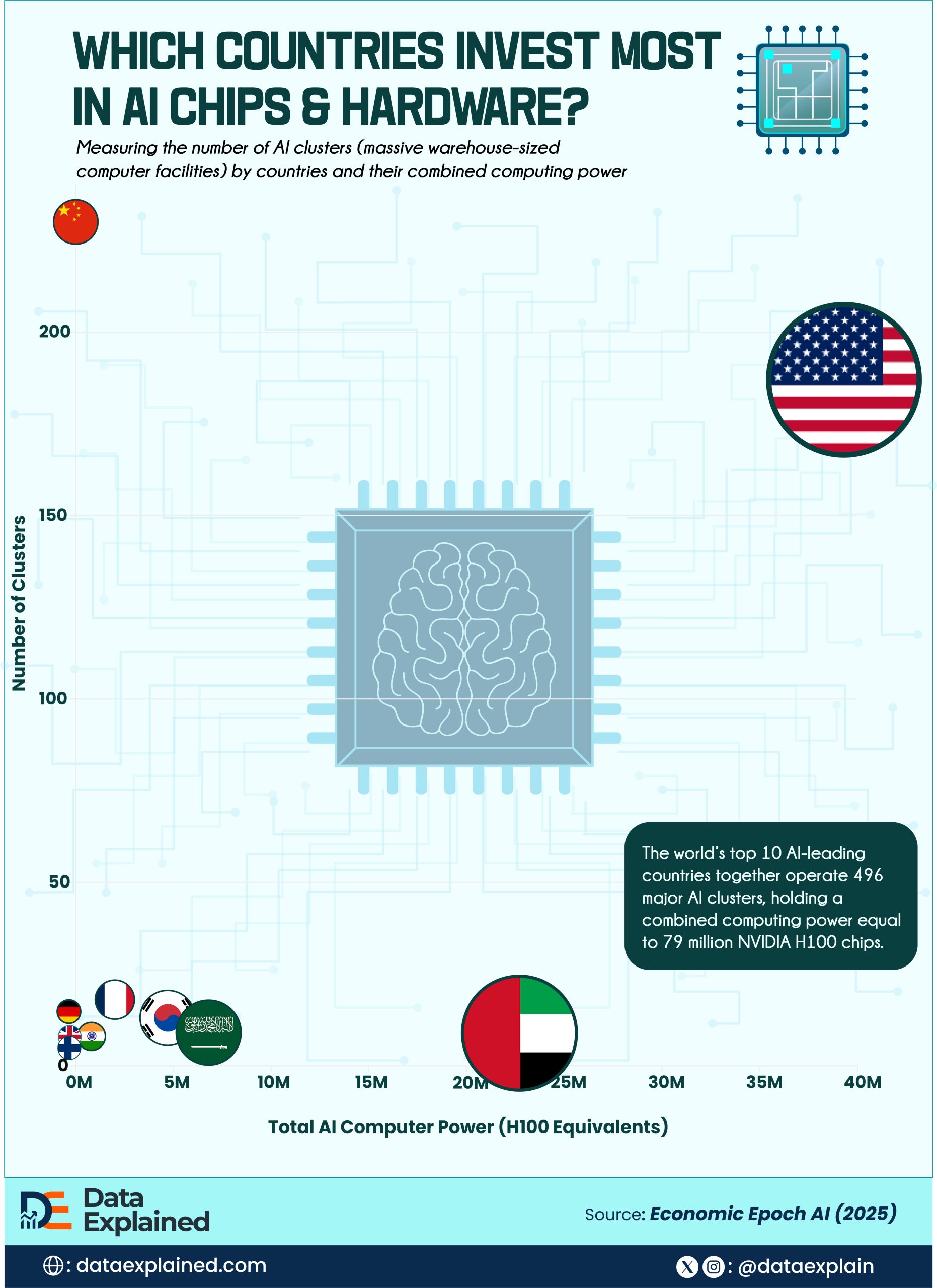
The world’s top 10 AI-leading countries together operate 496 major AI clusters, holding a combined computing power equal to 79 million NVIDIA H100 chips.
The estimate comes from the Epoch AI dataset, one of the most detailed trackers of global AI infrastructure.
TL;DR
- The United States leads with 39.7M in computing power and energy capacity to run AI systems.
- Korea, France, and Germany don’t have the largest computing power, but they have more workers who are either using or building AI.
- Chip manufacturers, foundries, and equipment vendors benefit the most from this trend.
Countries That Invest Most in AI Chips and Hardware
The table below shows how countries are building and using AI by examining the number of AI clusters, the computing power they own, and the electricity available for AI.
These numbers serve as a guide to who is leading in AI and how each country relates to it.
| wdt_ID | wdt_created_by | wdt_created_at | wdt_last_edited_by | wdt_last_edited_at | Country | Number of Clusters | Total AI Computer Power (H100 Equivalents) | Total Power Capacity (MW) |
|---|---|---|---|---|---|---|---|---|
| 1 | emmanuel-ashemiriogwa | 13/03/2026 02:27 PM | emmanuel-ashemiriogwa | 13/03/2026 02:27 PM | United States of America | 187 | 39.7M | 19.8K |
| 2 | emmanuel-ashemiriogwa | 13/03/2026 02:27 PM | emmanuel-ashemiriogwa | 13/03/2026 02:27 PM | United Arab Emirates | 8 | 23.1M | 6.4K |
| 3 | emmanuel-ashemiriogwa | 13/03/2026 02:27 PM | emmanuel-ashemiriogwa | 13/03/2026 02:27 PM | Saudi Arabia | 9 | 7.2M | 2.4K |
| 4 | emmanuel-ashemiriogwa | 13/03/2026 02:27 PM | emmanuel-ashemiriogwa | 13/03/2026 02:27 PM | Korea (Republic of) | 13 | 5.1M | 3K |
| 5 | emmanuel-ashemiriogwa | 13/03/2026 02:27 PM | emmanuel-ashemiriogwa | 13/03/2026 02:27 PM | France | 18 | 2.4M | 2K |
| 6 | emmanuel-ashemiriogwa | 13/03/2026 02:27 PM | emmanuel-ashemiriogwa | 13/03/2026 02:27 PM | India | 8 | 1.2M | 1.1K |
| 7 | emmanuel-ashemiriogwa | 13/03/2026 02:27 PM | emmanuel-ashemiriogwa | 13/03/2026 02:27 PM | China | 230 | 0.4M | 0.29K |
| 8 | emmanuel-ashemiriogwa | 13/03/2026 02:27 PM | emmanuel-ashemiriogwa | 13/03/2026 02:27 PM | UK and Northern Ireland | 6 | 0.12M | 0.99K |
| 9 | emmanuel-ashemiriogwa | 13/03/2026 02:27 PM | emmanuel-ashemiriogwa | 13/03/2026 02:27 PM | Finland | 5 | 0.072M | 0.11K |
| 10 | emmanuel-ashemiriogwa | 13/03/2026 02:27 PM | emmanuel-ashemiriogwa | 13/03/2026 02:27 PM | Germany | 12 | 0.051M | 0.2K |
The United States is leading with enormous computing power and energy capacity to run AI systems.
It also has a large share of workers involved in AI. According to TRG Datacenters,
10.40% of total employment in the U.S is for AI-related roles.
The UAE and Saudi Arabia don’t have many clusters, but the ones they do have are powerful. This simply means they invest in high-end AI supercomputers. They are rapidly becoming major AI hubs.
Some nations like Korea, France, and Germany don’t have the largest computing power, but they have high percentages of workers who are either using or building AI.
This shows that they focus more on talent, research, and everyday AI use, not only on giant data centers.
However, China and India show the opposite pattern.
They have many clusters (especially China), but their total compute power and AI workforce share are low.
This means older hardware, early-stage growth, or slower adoption among workers.
Smaller countries such as Finland and the UK have moderate computing power but good participation in AI-related jobs, showing they rely more on skills than on AI infrastructure.
Key Drivers Of Hardware Investment By Country
National security concerns often drive heavy investment in AI hardware.
Advanced AI systems can offer tough cyber defense, intelligence analysis, and military planning.
In July, the U.S Pentagon invested $1 billion in commercial AI for national security missions.
High-end computing power is seen as a way to build powerful clusters and secure access to cutting-edge chips.
Another major driver is supply-chain resilience.
Some countries may not want to depend on foreign chipmakers or data-center operators. They can reduce the risk of shortages, export controls, or geopolitical disruptions by building their own infrastructure.
Meanwhile, demand for AI cloud and data center services is pushing nations to expand compute capacity.
As businesses adopt AI tools, regions would need larger, more efficient data centers to power chatbots and autonomous systems.
This rising demand is a significant reason countries like the UAE and Saudi Arabia are rapidly scaling up their AI hardware infrastructure.
What This Means for Global Semiconductor, Hardware Ecosystem
The surge in AI hardware investment directly benefits chip manufacturers, foundries, and equipment vendors.
Companies that make GPUs, advanced semiconductors, cooling systems, and data-center equipment experience increasing demand as countries move to build large AI clusters.
This brings growth for firms like NVIDIA, TSMC, ASML, and other suppliers.
In 2024, Nvidia’s annual revenue was approximately $124.4 billion, TSMC’s was $88.3 billion, and ASML’s was $29 billion.
These investments also shift the global trade dynamics.
Countries with strong chip manufacturing, such as Taiwan, South Korea, and the U.S, get economic leverage, while others depend solely on imports.
Export controls, such as restrictions on high-end AI chips, serve as tools of geopolitical influence and competition.
Countries that secure the best chips and infrastructure position themselves as leaders in the next era of technology, while those who fall behind risk becoming dependent on foreign suppliers.
ELI5: Countries’ Investment in AI Chips and Hardware
AI clusters are like massive warehouse-sized computer facilities specifically built to train and run AI systems. They’re packed with thousands of specialised chips working together.
The NVIDIA H100 chip is currently one of the most powerful chips for AI work (think of it as the “sports car engine” of AI computing). Each one costs around $25,000 to $40,000.
The world’s top 10 AI-leading countries together operate 496 major AI clusters, holding a combined computing power equal to 79 million NVIDIA H100 chips.
Imagine if you stacked 79 million of these high-performance chips together. That’s the total computing muscle these 496 facilities have combined.
To put it in perspective:
- Training a large AI model like GPT-4 reportedly used something like 25,000 H100-equivalent chips running for months
- With 79 million chips worth of power, you could theoretically train over 3,000 models the size of GPT-4 simultaneously
- Or run millions of smaller AI applications at once
This shows that the world’s leading countries have built enormous infrastructure for AI development (like how countries once competed to build the most highways or power plants).
Source: