Japan recorded just 705,809 births in 2025, the lowest since 1899, and the tenth consecutive annual decline.
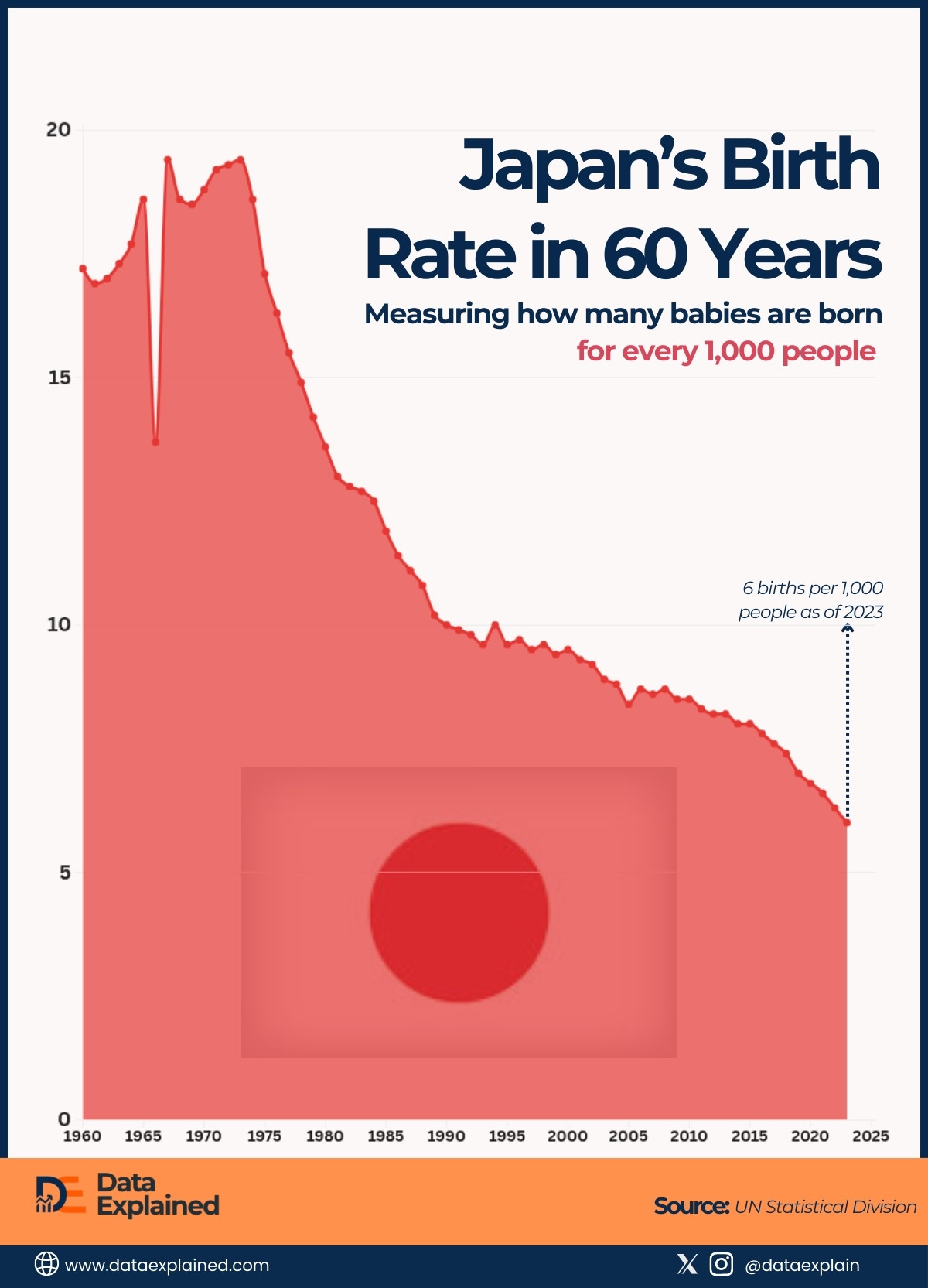
Today’s visualization shows a six-decade chart that reveals the relentless collapse of Japanese fertility from a 1970s peak of approximately 19 births per 1,000 people to 2023’s 6 per 1,000.
The preliminary health ministry data showed births down 2.1% from 2024, and when contextualized against Japan’s 124 million population, the 705,809 figure translates to roughly 5.7 births per 1,000.
TL;DR
- Japan recorded 705,809 births in 2025, the lowest annual total since record-keeping began in 1899.
- The national birth rate has fallen from roughly 19 per 1,000 people in the early 1970s to about 5.7 per 1,000 in 2025.
- The sharpest single-year drop occurred in 1966 during the Fire Horse year, when superstition led many couples to delay childbirth.
Our graphics today are based on data from the UN Statistical Division and accessed via the World Bank.
It exposes how Japan’s demographic crisis began with the sharp decline in births from 19 to 15 per 1,000 between 1973 and 1978, a cliff Japan never recovered from, despite decades of pro-natalist policies and hundreds of billions in family support spending.
| wdt_ID | wdt_created_by | wdt_created_at | wdt_last_edited_by | wdt_last_edited_at | Year | Births per 1,000 |
|---|---|---|---|---|---|---|
| 1 | emmanuel-ashemiriogwa | 05/03/2026 04:54 PM | emmanuel-ashemiriogwa | 05/03/2026 04:54 PM | 1960 | 17.20 |
| 2 | emmanuel-ashemiriogwa | 05/03/2026 04:54 PM | emmanuel-ashemiriogwa | 05/03/2026 04:54 PM | 1961 | 16.90 |
| 3 | emmanuel-ashemiriogwa | 05/03/2026 04:54 PM | emmanuel-ashemiriogwa | 05/03/2026 04:54 PM | 1962 | 17.00 |
| 4 | emmanuel-ashemiriogwa | 05/03/2026 04:54 PM | emmanuel-ashemiriogwa | 05/03/2026 04:54 PM | 1963 | 17.30 |
| 5 | emmanuel-ashemiriogwa | 05/03/2026 04:54 PM | emmanuel-ashemiriogwa | 05/03/2026 04:54 PM | 1964 | 17.70 |
| 6 | emmanuel-ashemiriogwa | 05/03/2026 04:54 PM | emmanuel-ashemiriogwa | 05/03/2026 04:54 PM | 1965 | 18.60 |
| 7 | emmanuel-ashemiriogwa | 05/03/2026 04:54 PM | emmanuel-ashemiriogwa | 05/03/2026 04:54 PM | 1966 | 13.70 |
| 8 | emmanuel-ashemiriogwa | 05/03/2026 04:54 PM | emmanuel-ashemiriogwa | 05/03/2026 04:54 PM | 1967 | 19.40 |
| 9 | emmanuel-ashemiriogwa | 05/03/2026 04:54 PM | emmanuel-ashemiriogwa | 05/03/2026 04:54 PM | 1968 | 18.60 |
| 10 | emmanuel-ashemiriogwa | 05/03/2026 04:54 PM | emmanuel-ashemiriogwa | 05/03/2026 04:54 PM | 1969 | 18.50 |
The 60-Year Chart Reveals Relentless Collapse
Japan’s birth rate has experienced a dramatic and sustained decline over the past six decades.
In the early 1970s, the country recorded a peak of roughly 19 births per 1,000 people, reflecting a robust post-war demographic boom.
However, by 2023, this figure had plummeted to around 7 per 1,000, a staggering 63% decline.
The decline accelerated after the 1973–1978 oil crisis, when births fell from 19 to 15 per 1,000, initiating a downward trajectory that has persisted for nearly half a century.
The 1966 Superstition Anomaly
The long downward arc of Japan’s fertility chart contains few sudden shocks.
But the most dramatic interruption came in 1966.
That year coincided with Hinoe‑Uma, the “Fire Horse” in the traditional sexagenary (60‑year) zodiac cycle.
It was a folklore held to be a deeply unlucky sign for girls.
According to historical vital statistics, live births in 1966 plunged to around 1,360,974, roughly 25–26 % lower than both 1965 and 1967.
This created one of the largest one‑year swings in Japan’s demographic charts that cannot be explained by disease, disaster, or economic collapse alone.
The superstition held that girls born in a Fire Horse year would grow up to be fiercely independent, domineering, and destined to bring misfortune to their husbands.
The Bigger Picture
The 2025 total of 705,809 births really represents a catastrophically low level of fertility, the lowest in 126 years of Japanese record-keeping.
This number is lower than any recorded during wars, natural disasters, or economic crises in modern Japan.
When contextualized against Japan’s population of roughly 124 million, the figure equates to 5.7 births per 1,000 people.
The societal implications are profound.
- Are schools across rural prefectures closing as child populations shrink?
- Is the workforce continuing to age, straining pension systems, healthcare, and social security?
- Can Tokyo, with its slight rebound in births, counterbalance the nationwide decline?
The collapse is self-reinforcing, as fewer children today lead to fewer adults tomorrow, making recovery increasingly difficult without radical policy intervention.
As Japan faces this demographic reality, the key question emerges: Is recovery even possible, or has the nation entered a long-term population spiral?
ELI5
Japan’s babies are disappearing. In 2025, only about 706,000 kids were born—the lowest in 126 years.
Even after decades of government programs and economic growth, people are still having fewer kids. Some years dropped off quickly because of things like superstition (1966’s Fire Horse year), and overall, fewer kids now means even fewer in the future.
Sources:
Cambridge University Press & Assessment | Nippon | PubMed | Japan Times