Can you compare the number of wedding invitations you’ve been receiving lately? If it’s less, then it’s a reflection of the global trend.
The proportion of people getting married is declining in many countries worldwide.
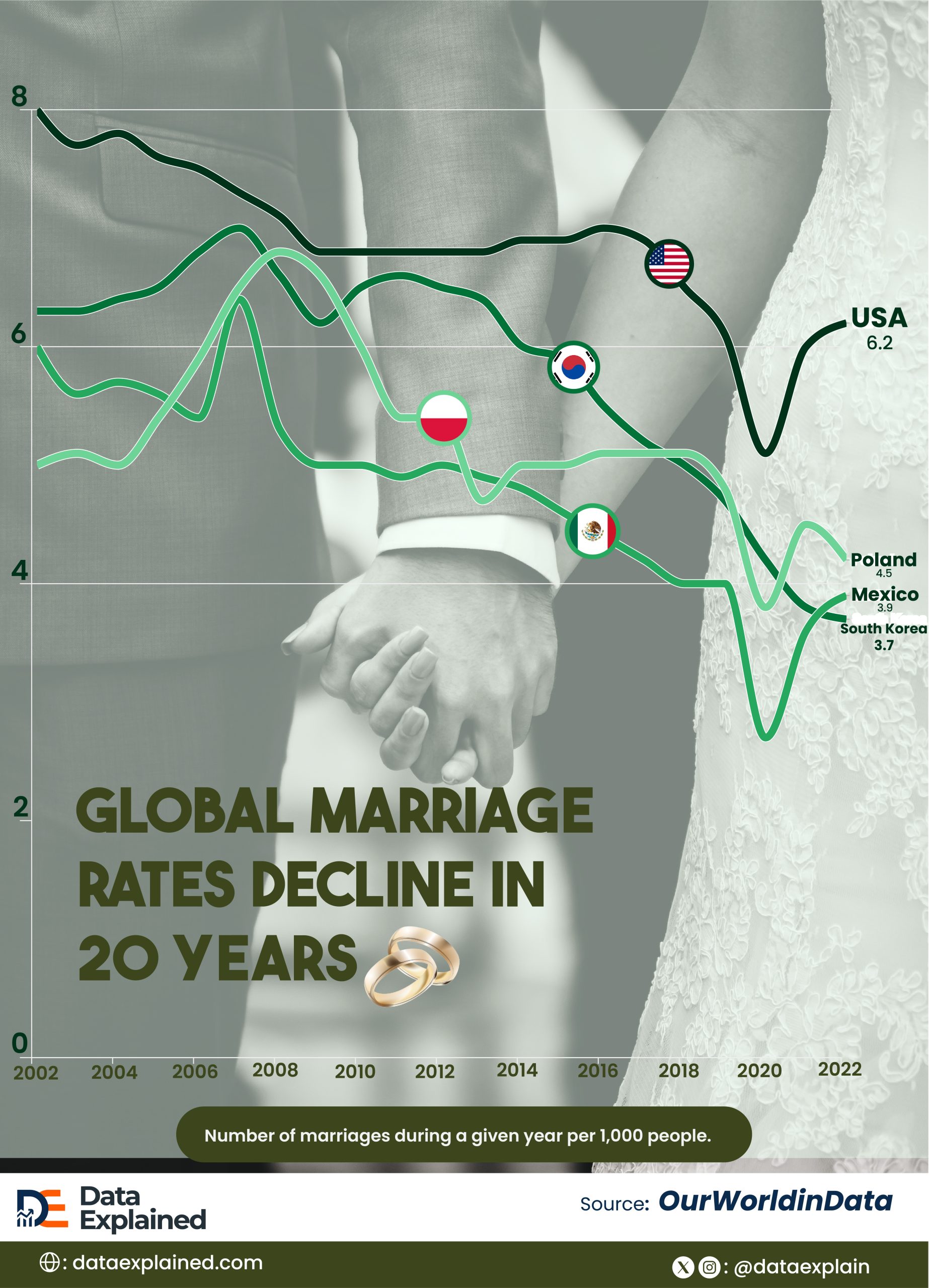
Today’s visualisation shows the trajectory of the global marriage rate from 2002 to 2022, based on data from Our World in Data.
TL;DR
- The UK experienced the most catastrophic decline, from about 5 marriages per 1,000 people (2002) to 1.5 (2022), a 70% drop.
- Spain, Sweden, and Italy often marry in their early to mid-30s, making them among the latest-marriage populations worldwide.
The marriage rate focuses on five developed countries (the U.S., Poland, Mexico, South Korea, and the UK) and monitors the number of marriages per 1,000 people in a given year.
| wdt_ID | wdt_created_by | wdt_created_at | wdt_last_edited_by | wdt_last_edited_at | Year | USA | South Korea | Mexico | Poland | U.K |
|---|---|---|---|---|---|---|---|---|---|---|
| 1 | emmanuel-ashemiriogwa | 03/03/2026 11:17 PM | emmanuel-ashemiriogwa | 03/03/2026 11:17 PM | 2002 | 8.00 | 6.30 | 6.00 | 5.00 | 4.9 |
| 2 | emmanuel-ashemiriogwa | 03/03/2026 11:17 PM | emmanuel-ashemiriogwa | 03/03/2026 11:17 PM | 2003 | 7.70 | 6.30 | 5.60 | 5.10 | 5.2 |
| 3 | emmanuel-ashemiriogwa | 03/03/2026 11:17 PM | emmanuel-ashemiriogwa | 03/03/2026 11:17 PM | 2004 | 7.80 | 6.40 | 5.70 | 5.00 | No data |
| 4 | emmanuel-ashemiriogwa | 03/03/2026 11:17 PM | emmanuel-ashemiriogwa | 03/03/2026 11:17 PM | 2005 | 7.60 | 6.50 | 5.60 | 5.40 | No data |
| 5 | emmanuel-ashemiriogwa | 03/03/2026 11:17 PM | emmanuel-ashemiriogwa | 03/03/2026 11:17 PM | 2006 | 7.50 | 6.80 | 5.40 | 5.90 | No data |
| 6 | emmanuel-ashemiriogwa | 03/03/2026 11:17 PM | emmanuel-ashemiriogwa | 03/03/2026 11:17 PM | 2007 | 7.30 | 7.00 | 6.40 | 6.50 | 4.5 |
| 7 | emmanuel-ashemiriogwa | 03/03/2026 11:17 PM | emmanuel-ashemiriogwa | 03/03/2026 11:17 PM | 2008 | 7.10 | 6.60 | 5.30 | 6.80 | 4.4 |
| 8 | emmanuel-ashemiriogwa | 03/03/2026 11:17 PM | emmanuel-ashemiriogwa | 03/03/2026 11:17 PM | 2009 | 6.80 | 6.20 | 5.00 | 6.60 | 4.3 |
| 9 | emmanuel-ashemiriogwa | 03/03/2026 11:17 PM | emmanuel-ashemiriogwa | 03/03/2026 11:17 PM | 2010 | 6.80 | 6.50 | 5.00 | 6.00 | 4.4 |
| 10 | emmanuel-ashemiriogwa | 03/03/2026 11:17 PM | emmanuel-ashemiriogwa | 03/03/2026 11:17 PM | 2011 | 6.80 | 6.60 | 4.90 | 5.40 | 4.4 |
As you can see, the UK experienced the most catastrophic decline, from ~5 marriages per 1,000 people (2002) to ~1.5 (2022), a 70% drop.
By 2022, the UK had the lowest marriage rate among developed nations.
This implies widespread cohabitation replacing marriage, declining religious influence, and possibly economic barriers, making formal marriage seem unnecessary or unaffordable.
The COVID Cliff
All countries show a sharp dip around 2020 (due to pandemic lockdowns), followed by a partial recovery in 2021-2022.
But notably, none recovered to pre-pandemic levels.
This suggests that COVID accelerated an already existing trend rather than causing it.
The “wedding boom” people predicted never materialized.
Average Age of Women at Marriage
In many countries, the average age at first marriage for women has dropped sharply over the past few decades.
Most OECD nations now average around 31 years for women’s first marriage.
For example, women in Spain, Sweden, and Italy often marry in their early to mid-30s, making them among the latest-marriage populations worldwide.
Countries like Japan and South Korea also show this pattern, with women frequently marrying around 30–33 years old.
The main reasons are long education paths, demanding job markets, and shifting cultural expectations.
In contrast, countries where early marriage remains common tend to see women marrying in their mid- to late 20s, often influenced by cultural norms, economic factors, or lower average years of education.
Trend Behind Children Born Outside of Marriage
There’s also a growing share of children born to parents who are not legally married globally.
But it’s most common in Chile.
| wdt_ID | wdt_created_by | wdt_created_at | wdt_last_edited_by | wdt_last_edited_at | Country | Percentage of births outside marriage (2020) |
|---|---|---|---|---|---|---|
| 1 | Monica Ebunoluwa | 27/02/2026 12:11 PM | Monica Ebunoluwa | 27/02/2026 12:11 PM | Chile | 75% |
| 2 | Monica Ebunoluwa | 27/02/2026 12:11 PM | Monica Ebunoluwa | 27/02/2026 12:11 PM | Mexico | 70% |
| 3 | Monica Ebunoluwa | 27/02/2026 12:11 PM | Monica Ebunoluwa | 27/02/2026 12:11 PM | France | 62% |
| 4 | Monica Ebunoluwa | 27/02/2026 12:11 PM | Monica Ebunoluwa | 27/02/2026 12:11 PM | Sweden | 55% |
| 5 | Monica Ebunoluwa | 27/02/2026 12:11 PM | Monica Ebunoluwa | 27/02/2026 12:11 PM | Japan | 3% |
| 6 | Monica Ebunoluwa | 27/02/2026 12:11 PM | Monica Ebunoluwa | 27/02/2026 12:11 PM | South Korea | 4% |
In places such as Sweden, France, and Chile, where traditional marriage is the norm for starting a family, and where it was once assumed that children would come after a formal wedding, many couples now have children while cohabiting or without marrying at all.
ELI5: Marriage Rate Decline
People today are choosing to marry later in life because they spend more time in school, build careers first, or simply don’t feel the pressure to marry early anymore.
In many places, having kids is no longer tied to marriage, so more children are being born to unmarried parents, as living together or co-parenting becomes more common.
Sources:
OECD (2025) | OurWorldinData |