Jimmy Lai, Hong Kong’s pro-democracy media tycoon, has been jailed for 20 years for colluding with foreign forces under the city’s controversial national security law.
Rights groups called it a death sentence for the 78-year-old, whose family has raised concerns about his health, but Hong Kong’s leader said it was “deeply gratifying”.
In light of that, today’s visualization shows how Hong Kong performs on press freedom and other Civil Liberties. It is based on a rating from Freedom House.
TL;DR
- Hong Kong scores 40/100 in overall freedom, with political rights at 9/40 and civil liberties at 31/60, placing it in the partly free category.
- Press freedom for media workers declined by roughly 40%, from 42 in 2013 to 25 in 2023, while public scores declined by about 15%, from 49.4 to 42.2.
For context, Freedom House, the source of this data, is an independent watchdog organization dedicated to expanding freedom and democracy worldwide.
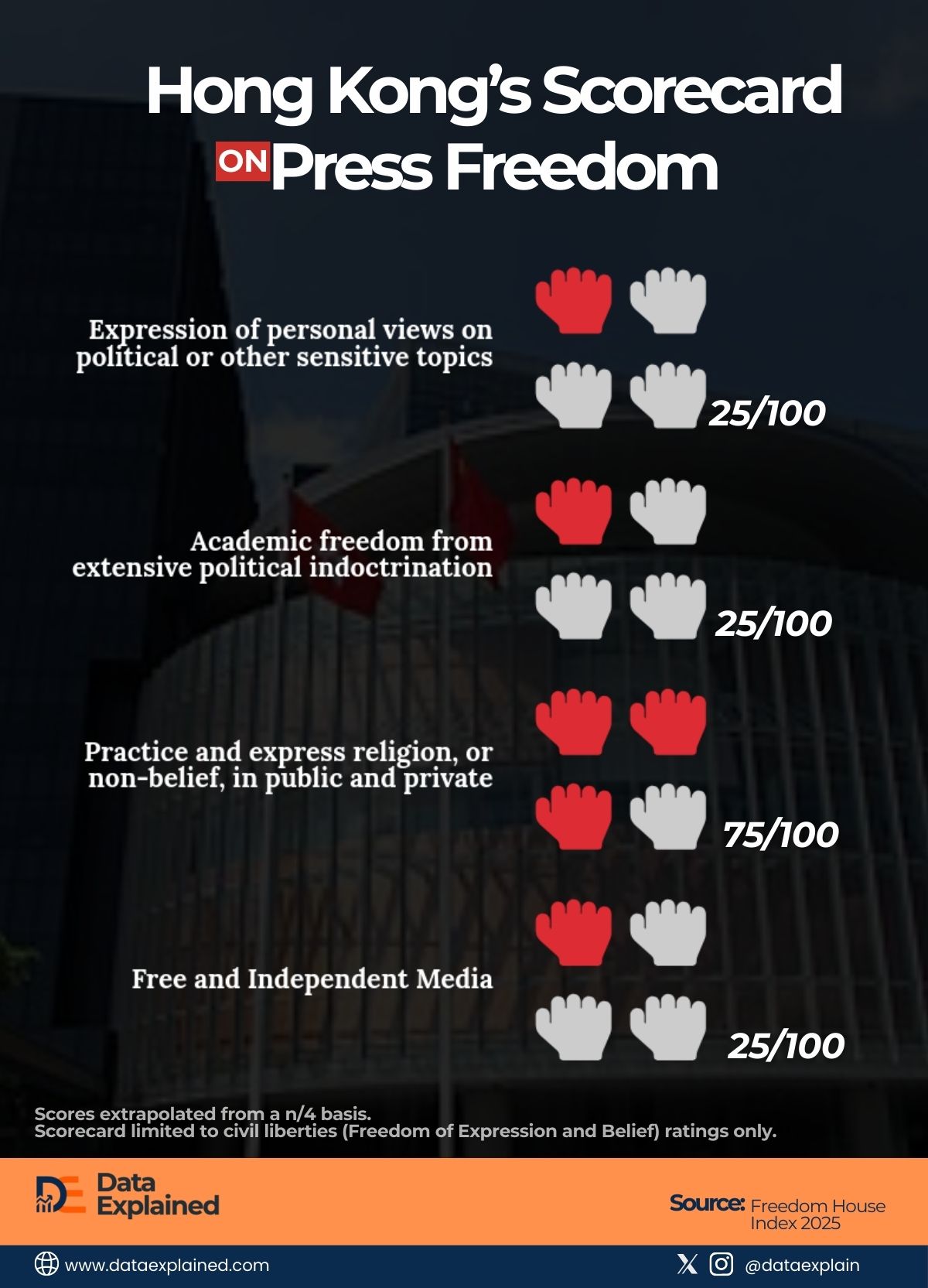
Freedom of Expression and Belief: Scorecard
| wdt_ID | wdt_created_by | wdt_created_at | wdt_last_edited_by | wdt_last_edited_at | Metric | Score |
|---|---|---|---|---|---|---|
| 1 | emmanuel-ashemiriogwa | 12/02/2026 12:38 PM | emmanuel-ashemiriogwa | 12/02/2026 12:38 PM | Are there free and independent media? | 1 / 4 |
| 2 | emmanuel-ashemiriogwa | 12/02/2026 12:38 PM | emmanuel-ashemiriogwa | 12/02/2026 12:38 PM | Are individuals free to practice and express their religion, or non-belief, in public and private? | 3 / 4 |
| 3 | emmanuel-ashemiriogwa | 12/02/2026 12:38 PM | emmanuel-ashemiriogwa | 12/02/2026 12:38 PM | Is there academic freedom, and is the educational system free from extensive political indoctrination? | 1 / 4 |
| 4 | emmanuel-ashemiriogwa | 12/02/2026 12:38 PM | emmanuel-ashemiriogwa | 12/02/2026 12:38 PM | Are individuals free to express their personal views on political or other sensitive topics without fear of surveillance or retribution? | 1 / 4 |
| 5 | emmanuel-ashemiriogwa | 12/02/2026 12:38 PM | emmanuel-ashemiriogwa | 12/02/2026 12:38 PM | Overall civil liberties score | 31/60 |
| 6 | emmanuel-ashemiriogwa | 12/02/2026 12:38 PM | emmanuel-ashemiriogwa | 12/02/2026 12:38 PM | Overall Freedom score | 40/100 |
What The Data Means
Hong Kong’s score of 40 out of 100 in Freedom House’s Freedom in the World 2025 report places the territory in the “Partly Free” category.
But the overall score is divided into two places:
- Political Rights: 9/40
- Civil Liberties: 31/60
Civil Liberties, which account for a larger share of the total score, are assessed across several categories, including freedom of expression and belief, associational rights, rule of law, and personal autonomy.
The focus of this explainer is the country’s rating on Freedom of Expression and Belief.
Each indicator within these categories is scored on a 0–4 scale, where higher scores indicate stronger protections.
Hong Kong’s civil liberties results show sharp contrasts: relatively higher marks for personal autonomy and property rights, but consistently low scores for media freedom, academic independence, assembly, and political expression.
The net result is a territory that retains pockets of personal freedom but in which core civic and expressive rights remain heavily constrained.
Trend of Press Freedom Index in Hong Kong
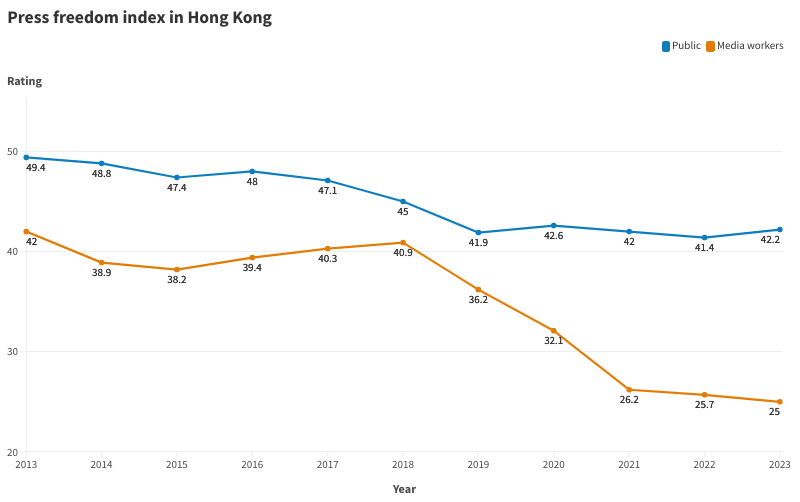
While Hong Kong continues to maintain pockets of civil liberties, the experiences of citizens and media workers tell very different stories over the past decade.
Civil liberties, which previously allowed a measure of free expression and political engagement, have come under increasing strain, most visibly for journalists and pro-democracy figures.
In this context, the press freedom index provides a lens to understand how access to information, the ability to publish, and the safety of reporting have evolved from 2013 to 2023.
In 2013, the index showed that the general public scored 49.4, while media workers scored 42.
At the time, citizens enjoyed relatively broad freedom to express opinions, post political commentary on social media, and engage in public discourse, albeit subject to certain legal constraints.
Journalists faced more constraints than the average citizen, yet the environment still permitted investigative reporting and diverse editorial perspectives.
Between 2016 and 2018, the media index briefly peaked at 40.9, reflecting a short-lived period of slightly greater latitude for journalists, while public scores remained relatively stable.
By 2023, the situation had sharply deteriorated. Media workers’ scores fell to 25, representing a roughly 40% decline, while the public index slipped to 42.2, a smaller but still significant drop.
Jimmy Lai’s Sentence
Jimmy Lai’s 20-year imprisonment under Hong Kong’s national security law makes the territory’s 40/100 freedom score and civil liberties 31/60 painfully real.
As a pro-democracy media tycoon, Lai used his outlets to advocate for free expression, operating in an environment where press freedom for journalists has declined by nearly 40% since 2013.
His conviction for meeting foreign officials during the 2019 protests illustrates how legal mechanisms enforce restrictions on independent journalism, while ordinary citizens face a shrinking space for online and public expression.
The sentence also highlights a stark contrast: rights groups call it “draconian,” a “death sentence for press freedom,” while Hong Kong authorities claim it upholds the rule of law.
ELI5
Hong Kong scores 40/100 in freedom, with civil liberties at 31/60, and very low marks for independent media and personal political expression.
Press freedom for journalists has declined by nearly 40% since 2013, while public freedom has also declined. Jimmy Lai, a pro-democracy media tycoon, was jailed for 20 years.
It shows the real-world impact of these declines and the shrinking space for free speech.
Sources:
Public Flourish Studio | BBC | Freedom House