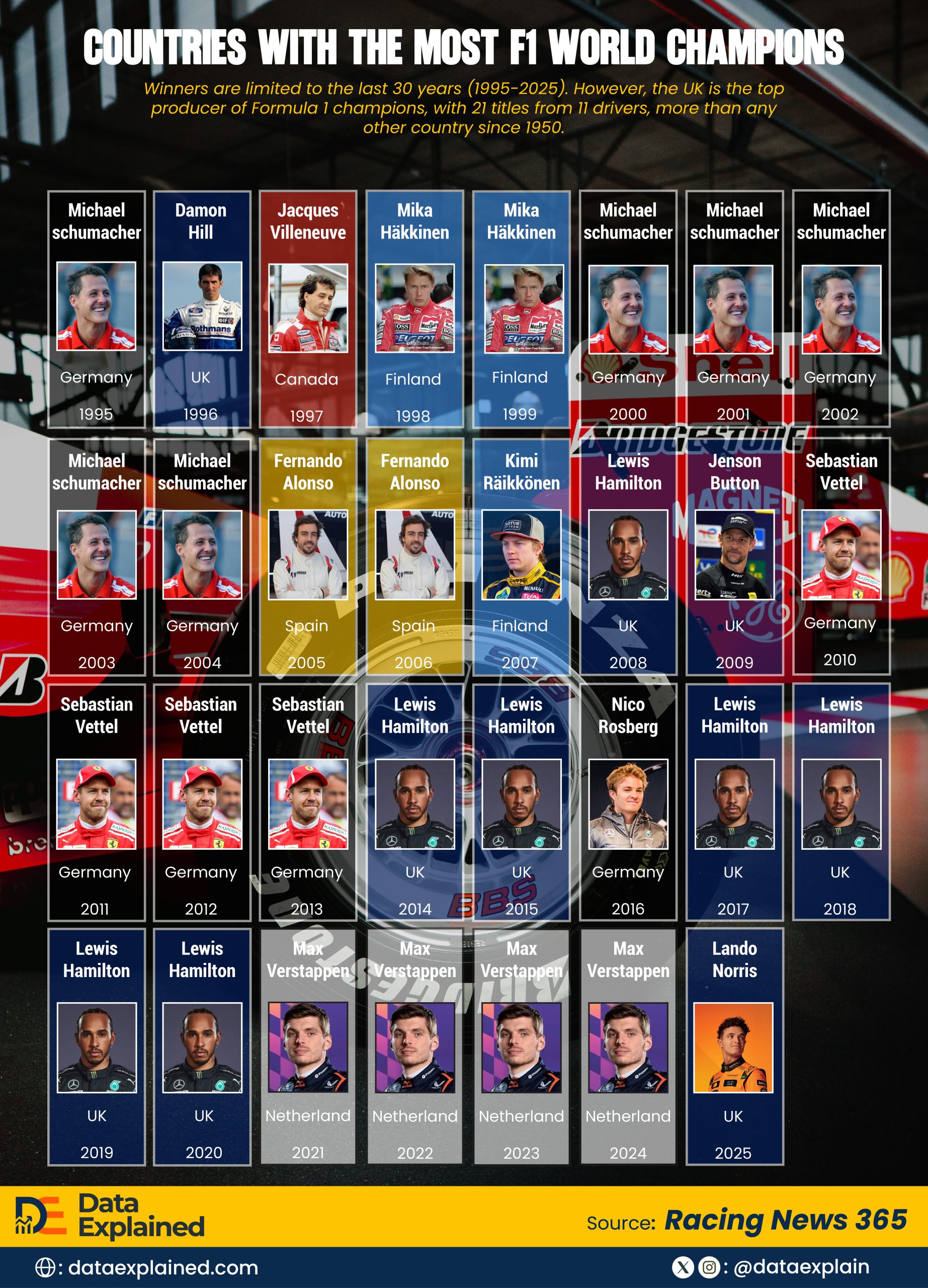
Lando Norris won the 2025 F1 World Championship at the Abu Dhabi GP on December 7, making him Britain’s 11th F1 champ.
This win adds to Britain’s F1 legacy, and in Formula 1, a country’s motorsport history, talent, and engineering influence its success.
Since 1950, 15 nations have produced 35 world champions.
This visualisation shows the countries that have produced the most F1 World Champions to date, based on data gathered by Racing News 365.
TL;DR
- Britain dominates F1 with 21 titles from 11 champs, showing its racing history.
- Countries like Finland and Germany excel in intense racing and engineering, whereas Italy and Brazil have experienced decline.
- Modern F1 is more global, with cost caps and academies helping drivers from the UK, Netherlands, and Spain compete.
As you can see in the table below, the UK is the top producer of Formula 1 champions, with 21 titles from 11 drivers, more than any other country.
Stars like Lewis Hamilton, with seven titles, and Jackie Stewart, with three, have made Britain famous in F1.
This success has endured for decades, as evidenced by Lando Norris’s recent wins. No other country comes close.
F1 World Champions by Country
| wdt_ID | wdt_created_by | wdt_created_at | wdt_last_edited_by | wdt_last_edited_at | Country Origin | Winner Name | Year Won |
|---|---|---|---|---|---|---|---|
| 1 | Monica Ebunoluwa | 16/02/2026 10:24 AM | Monica Ebunoluwa | 16/02/2026 10:24 AM | Italy | Giuseppe Farina | 1950 |
| 2 | Monica Ebunoluwa | 16/02/2026 10:24 AM | Monica Ebunoluwa | 16/02/2026 10:24 AM | Argentina | Juan Manuel Fangio | 1951 |
| 3 | Monica Ebunoluwa | 16/02/2026 10:24 AM | Monica Ebunoluwa | 16/02/2026 10:24 AM | Italy | Alberto Ascari | 1952 |
| 4 | Monica Ebunoluwa | 16/02/2026 10:24 AM | Monica Ebunoluwa | 16/02/2026 10:24 AM | Italy | Alberto Ascari | 1953 |
| 5 | Monica Ebunoluwa | 16/02/2026 10:24 AM | Monica Ebunoluwa | 16/02/2026 10:24 AM | Argentina | Juan Manuel Fangio | 1954 |
| 6 | Monica Ebunoluwa | 16/02/2026 10:24 AM | Monica Ebunoluwa | 16/02/2026 10:24 AM | Argentina | Juan Manuel Fangio | 1955 |
| 7 | Monica Ebunoluwa | 16/02/2026 10:24 AM | Monica Ebunoluwa | 16/02/2026 10:24 AM | Argentina | Juan Manuel Fangio | 1956 |
| 8 | Monica Ebunoluwa | 16/02/2026 10:24 AM | Monica Ebunoluwa | 16/02/2026 10:24 AM | Argentina | Juan Manuel Fangio | 1957 |
| 9 | Monica Ebunoluwa | 16/02/2026 10:24 AM | Monica Ebunoluwa | 16/02/2026 10:24 AM | United Kingdom | Mike Hawthorn | 1958 |
| 10 | Monica Ebunoluwa | 16/02/2026 10:24 AM | Monica Ebunoluwa | 16/02/2026 10:24 AM | Australia | Jack Brabham | 1959 |
The United Kingdom Dominates Historically
A country’s racing culture and support system are crucial, as evidenced by the UK’s numerous circuits and driver development programs.
Finland, a small but powerful force in rally racing, has four titles, thanks to skills that translate well to Formula 1.
Germany’s automotive industry and technological expertise have enabled it to win 12 titles, demonstrating how innovation drives success.
Countries with well-developed racing infrastructure, such as Britain and Germany, tend to perform better.
F1 wins by country change over time.
Italy’s love for Ferrari and F1 saw them lead in the 1950s, but they haven’t won since 1953.
Brazil was dominant in the 1970s and 1990s, with eight wins from icons like Senna and Piquet, but then declined.
The Netherlands returned to winning ways in 2021 with Max Verstappen, winning four titles. The US has only two wins but stays interested.
What this Means for Modern F1 Competitiveness
Lando Norris’ 2025 title solidifies Britain’s lead with 11 champions, showcasing its deep roots in motorsport.
This edge sparks intense rivalries, as seen in Norris’ two-point win over Verstappen.
It raises concerns about the focus on talent, limiting global diversity at the top.
Hence, F1 success these days benefits from national influence but demands broader participation for lasting thrill.
McLaren dominated 2025, securing 11 of 14 wins and twice as many points as its rivals, highlighting how innovation can create competitive imbalances.
This encourages teams to innovate more quickly, driving technological progress across the grid.
F1 globalization may end single-country dominance by developing emerging talents via academies and regulation.
Cost caps and even resources aim to level the playing field, attracting more countries to compete.
Looking Ahead…
The Netherlands may win more titles thanks to Max Verstappen’s strong performance under the new rules, while Spain is due for a comeback, with Sainz’s experience as a top contender.
These countries’ histories and talent suggest tough battles ahead.
New drivers like Ollie Bearman, now in his second year with Haas, are showing speed and maturity.
Brit Arvid Lindblad starts with Racing Bulls, expecting big things after F2 wins. Spain’s Pepe Marti, a Red Bull F2 driver, hopes to move to F1.
Dutch racer Richard Verschoor, experienced in F2, may secure an F1 seat if he continues to perform well.
ELI5: Countries With The Most F1 World Champions
Britain is the king of Formula 1, with 21 championships and 11 drivers’ titles.
Countries like Finland and Germany have solid racing skills, while Italy and Brazil used to dominate but do less now.
Currently, Formula 1 is becoming fairer with new rules, so we may soon see winners from the UK, the Netherlands, or Spain. Overall, the races stay exciting for everyone.
Sources:
Motorsport Mag | SelectCarLeasing | Formula 1 | BBC Sport | Forbes