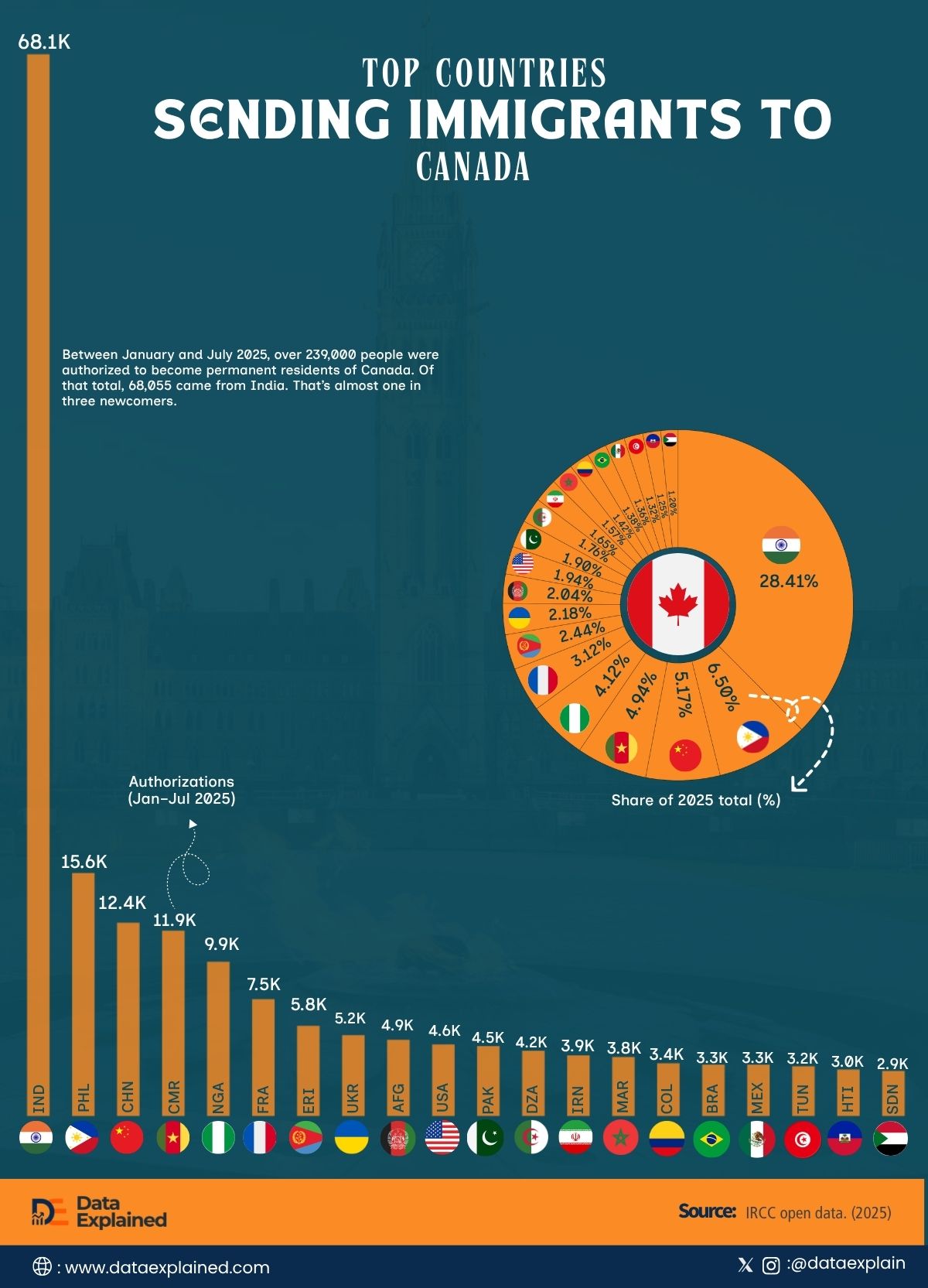
Between January and July 2025, over 239,000 people were authorized to become permanent residents of Canada. Of that total, 68,055 came from India.
That’s almost one in three newcomers.
Beyond that concentration, a handful of other countries (Philippines, China, Cameroon, Nigeria, France) make up most of the remaining flow.
TL;DR
- 239,540 permanent resident authorizations issued (Jan–Jul 2025).
- India leads with 68,055 people (28%). Philippines, China, Cameroon, and Nigeria round out the top five.
- Africa’s share of migration is climbing fast.
The data for the visualization above comes from Immigration, Refugees and Citizenship Canada’s (IRCC) open data.
Top Countries Sending Immigrants to Canada (Jan-Jul 2025)
| wdt_ID | wdt_created_by | wdt_created_at | wdt_last_edited_by | wdt_last_edited_at | Country | Authorizations (Jan–Jul 2025) | Share of 2025 total (%) |
|---|---|---|---|---|---|---|---|
| 1 | Monica Ebunoluwa | 03/08/2026 01:09 PM | Monica Ebunoluwa | 03/08/2026 01:09 PM | India | 68,055 | 28.41% |
| 2 | Monica Ebunoluwa | 03/08/2026 01:09 PM | Monica Ebunoluwa | 03/08/2026 01:09 PM | Philippines | 15,580 | 6.50% |
| 3 | Monica Ebunoluwa | 03/08/2026 01:09 PM | Monica Ebunoluwa | 03/08/2026 01:09 PM | China (People’s Republic) | 12,390 | 5.17% |
| 4 | Monica Ebunoluwa | 03/08/2026 01:09 PM | Monica Ebunoluwa | 03/08/2026 01:09 PM | Cameroon | 11,835 | 4.94% |
| 5 | Monica Ebunoluwa | 03/08/2026 01:09 PM | Monica Ebunoluwa | 03/08/2026 01:09 PM | Nigeria | 9,865 | 4.12% |
| 6 | Monica Ebunoluwa | 03/08/2026 01:09 PM | Monica Ebunoluwa | 03/08/2026 01:09 PM | France | 7,485 | 3.12% |
| 7 | Monica Ebunoluwa | 03/08/2026 01:09 PM | Monica Ebunoluwa | 03/08/2026 01:09 PM | Eritrea | 5,835 | 2.44% |
| 8 | Monica Ebunoluwa | 03/08/2026 01:09 PM | Monica Ebunoluwa | 03/08/2026 01:09 PM | Ukraine | 5,230 | 2.18% |
| 9 | Monica Ebunoluwa | 03/08/2026 01:09 PM | Monica Ebunoluwa | 03/08/2026 01:09 PM | Afghanistan | 4,880 | 2.04% |
| 10 | Monica Ebunoluwa | 03/08/2026 01:09 PM | Monica Ebunoluwa | 03/08/2026 01:09 PM | United States | 4,640 | 1.94% |
India has long been Canada’s largest source of immigrants, and 2025 continues the trend.
From software engineers heading to Ontario’s tech corridor to international students transitioning to permanent residency, India’s connection to Canada’s immigration system runs deep.
So far this year (January–July 2025), India accounts for about 28% of all new permanent residents, with 68,055 people approved.
That’s more than four times as many as the next-largest source, the Philippines, which sent 15,580 new residents (a healthy number, but still a distant second).
In third place is China (12,390), followed by Cameroon (11,835) and Nigeria (9,865).
Together, these five countries make up nearly half of all newcomers granted permanent residency in 2025.
What the Trends Show (2022–2025)
The longer trend line tells an even richer story:
| wdt_ID | wdt_created_by | wdt_created_at | wdt_last_edited_by | wdt_last_edited_at | Country | 2022 | 2023 | 2024 | 2025 (Jan–Jul) |
|---|---|---|---|---|---|---|---|---|---|
| 1 | Monica Ebunoluwa | 03/08/2026 12:57 PM | Monica Ebunoluwa | 03/08/2026 12:57 PM | India | 121,800 | 138,095 | 123,695 | 68,055 |
| 2 | Monica Ebunoluwa | 03/08/2026 12:57 PM | Monica Ebunoluwa | 03/08/2026 12:57 PM | Philippines | 21,455 | 27,230 | 33,400 | 15,580 |
| 3 | Monica Ebunoluwa | 03/08/2026 12:57 PM | Monica Ebunoluwa | 03/08/2026 12:57 PM | Cameroon | 7,210 | 13,085 | 22,375 | 11,835 |
| 4 | Monica Ebunoluwa | 03/08/2026 12:57 PM | Monica Ebunoluwa | 03/08/2026 12:57 PM | Nigeria | 23,960 | 17,545 | 20,225 | 9,865 |
| 5 | Monica Ebunoluwa | 03/08/2026 12:57 PM | Monica Ebunoluwa | 03/08/2026 12:57 PM | China | 31,605 | 31,670 | 28,675 | 12,390 |
You can see how Cameroon more than tripled between 2022 and 2024, while India maintained high, steady levels.
Philippines continues a clear upward trend (and that’s before factoring in the rest of 2025).
These steady increases show strong networks of migration and growing community roots.
Africa’s Rising Role
One of the most interesting trends buried in the data is the rise of African source countries.
Cameroon has quietly jumped into the top five, recording 11,835 approvals in just the first seven months of the year (almost doubling its numbers from two years ago).
Nigeria, Eritrea, Algeria, and Sudan also rank among the top 20.
These movements represent a growing wave of skilled professionals, students, and families finding opportunity in Canada’s education system, labor market, and diaspora networks.
In total, Africa now accounts for about one-fifth of all new permanent residents this year (a far cry from a decade ago when the region barely registered in double digits).
Challenges & Opportunities
Some of the significant challenges that present themselves in Canada’s permanent residency take the form of settlement patterns and cultural integration.
Immigrants cluster in Toronto and Vancouver, straining housing but boosting urban economies with diverse communities.
Language barriers create integration challenges, yet multicultural policies enhance social cohesion.
For opportunities, skilled immigrants fill 20% of tech and healthcare job gaps, contributing to 1.5% GDP growth; however, 30% initially face credential delays.
What to Expect Next?
By the time 2025 ends, Canada could see close to 400,000 new permanent residents again, and the story behind those numbers is as much about opportunity and ambition as it is about policy and planning.
Canada Immigration Levels Plan targeted 395,000 permanent residents for 2025 and 380,000 for 2026, with a focus on addressing humanitarian needs and labor shortages in sub-Saharan Africa and South Asia.
ELI5
India-to-Canada flows in 2025 so far are around 68,000 permanent resident authorizations (Jan–Jul), which is about 28% of the total in that period.
A single country supplying nearly a third of Canada’s PR authorizations in a seven-month span means policy or processing changes for India would move the needle a lot.
Meanwhile, flows are concentrated but diverse.
The Philippines, China, Cameroon and Nigeria are also major sources, while humanitarian-driven flows (Afghanistan, Ukraine, Haiti) remain visible.
Source: