Skywatchers in Antarctica and parts of South America observed the first solar eclipse of the year. It happened on Tuesday, February 17.
This celestial event marks a major moment for both atmospheric science and public engagement.
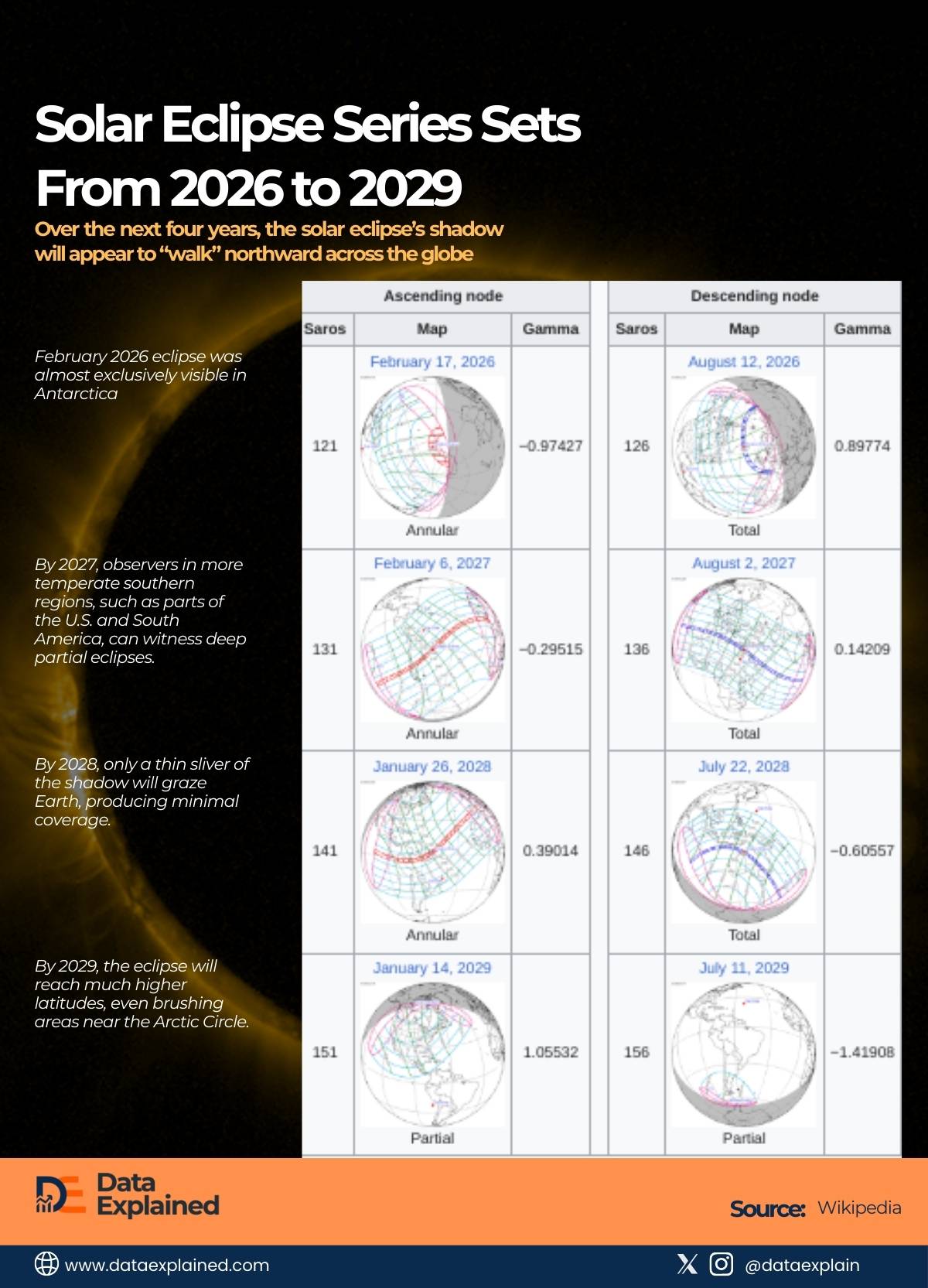
Today’s graphics show the Solar eclipse series from 2026 to 2029.
For context, Ascending Node means the moon moving north across the equator, while Descending Node means the moon moving south.
The “Gamma” column measures how close the center of the shadow is to the center of the Earth. A Gamma of 0.0 is a bullseye.
TL;DR
- The February 17, 2026, annular eclipse skimmed Antarctica with a Gamma of –0.97427 and was partially visible in southern South America.
- Between 2026 and 2028, three total eclipses will occur along the Descending Node, creating a rare triple crown within 24 months.
- In 2029, the central shadow will miss Earth with Gamma values over 1.0 or below –1,4 while the 2027 and 2028 eclipses remain nearly perfectly centered at –0.29 and 0.14.
The data for this explainer were drawn from Wikipedia and Weather.gov.
Date of Greatest Eclipse in Central Time Zone (2026–2029)
| wdt_ID | wdt_created_by | wdt_created_at | wdt_last_edited_by | wdt_last_edited_at | Date of Greatest Eclipse (Central Time Zone) | Overall Eclipse Duration | Totality Duration | Time of Greatest Eclipse | Fraction of Moon\'s Diameter Obscured | Notes |
|---|---|---|---|---|---|---|---|---|---|---|
| 1 | emmanuel-ashemiriogwa | 22/02/2026 08:25 AM | emmanuel-ashemiriogwa | 22/02/2026 08:25 AM | 01/03/2026 | 3 hrs 27 min | 0 hrs 58 min | 11:34 AM | 1 | Eclipse ongoing at Moonset/Sunrise for eastern U.S. |
| 2 | emmanuel-ashemiriogwa | 22/02/2026 08:25 AM | emmanuel-ashemiriogwa | 22/02/2026 08:25 AM | 3 hrs 18 min | – | 04:13 AM | 1 | Partial Eclipse (but near total), visible for all U.S. | |
| 3 | emmanuel-ashemiriogwa | 22/02/2026 08:25 AM | emmanuel-ashemiriogwa | 22/02/2026 08:25 AM | 01/11/2028 | 0 hrs 56 min | – | 04:13 AM | 0 | Partial Eclipse, very little of Moon obscured |
| 4 | emmanuel-ashemiriogwa | 22/02/2026 08:25 AM | emmanuel-ashemiriogwa | 22/02/2026 08:25 AM | 3 hrs 40 min | 1 hr 42 min | 03:22 AM | 2 | Eclipse ongoing at Moonrise for western U.S. | |
| 5 | emmanuel-ashemiriogwa | 22/02/2026 08:25 AM | emmanuel-ashemiriogwa | 22/02/2026 08:25 AM | 3 hrs 33 min | 0 hrs 54 min | 10:42 PM | 1 | Eclipse ongoing at Moonrise |
About February 17’s Eclipse
Tuesday’s annular solar eclipse produced a striking “ring of fire” effect as the Moon passed between Earth and the Sun, but being near its farthest point in orbit, did not fully cover the solar disk.
This left a bright annulus visible exclusively over the remote ice of Antarctica, where a very narrow path of annularity lasted roughly 2 minutes and 20 seconds for a handful of observers based at research stations such as Concordia and Mirny.
Due to its extreme southern trajectory (reflected in a Gamma value near –0.97), most of the globe missed the full display, but parts of southern South America and southern Africa witnessed a deep partial eclipse.
Observers saw the Moon block up to about 96 % of the Sun.
Satellite imagery captured the Moon’s shadow sweeping across the Southern Ocean, briefly dimming sunlight over wide regions.
The “Northbound” Shadow Walk
Over the next four years, the solar eclipse’s shadow will appear to “walk” northward across the globe.
The Gamma values for eclipses at the Ascending Node show this movement clearly: from –0.97 in 2026, barely skimming the South Pole, to –0.29 in 2027, then 0.39 in 2028, and finally 1.05 in 2029, reaching near the North Pole.
Each year, the Moon’s shadow shifts slightly northward, creating a predictable migration of eclipse visibility from the southernmost regions toward the far north.
- This progression means that while the 2026 eclipse was almost exclusively visible in Antarctica.
- By 2027, observers in more temperate southern regions, such as parts of the U.S. and South America, can witness deep partial eclipses.
- By 2028, only a thin sliver of the shadow will graze Earth, producing minimal coverage.
- By 2029, the eclipse will reach much higher latitudes, even brushing areas near the Arctic Circle.
In other words, the eclipses trace a path over Earth like a cosmic footprint, moving steadily northward year by year.
This “northbound walk” of the shadow is a vivid illustration of how the interplay between the Moon’s orbit and Earth’s tilt creates the timing and location of each eclipse.
Next Three Years Are a ‘Triple Crown’ for Eclipse Hunters
Between 2026 and 2028, the Moon’s Descending Node produces an extraordinary sequence: three Total Solar Eclipses within roughly 24 months.
For eclipse hunters, this is a rare “triple crown,” meaning three major events in quick succession that they can actually follow on Earth.
Normally, total eclipses at any given location are decades apart, so having three visible within two years is exceptionally unusual.
The first event of this sequence occurs in 2026, followed by total eclipses in 2027 and 2028 along progressively more northerly paths.
Each eclipse offers a fleeting window of totality, when the Moon completely blocks the Sun, revealing the Sun’s corona.
Chasing all three in succession is a challenge even for seasoned observers, making this period particularly exciting for both enthusiasts and scientists.
The 2029 Cliff
While eclipse hunters are still savoring the 2026–2028 “triple crown,” the Moon’s shadow begins to shift dramatically in 2029.
According to Wikipedia, the Central Eclipse streak ended that year.
Both the January and July eclipses flip to partial, with Gamma values exceeding 1.0 and –1.4, meaning the Moon’s central shadow (the dark umbra that produces totality) will completely miss Earth.
Observers will only see the outer shadow, or penumbra, skim across parts of the globe, producing a more subtle dimming rather than the dramatic ring of fire or total blackout.
These partial eclipses are reminders of how precise the alignment must be for totality.
Even as the Moon’s shadow climbs northward after the triple crown, small changes in orbital geometry shift the dramatic effects out of reach.
It’s a Perfect Mirror
Amid the northward march of the Moon’s shadow and the excitement of the 2026–2028 triple crown, the 2027 and 2028 eclipses stand out for their precision.
The 2027 Annular eclipse, with a Gamma of –0.29, and the 2028 Total eclipse, at Gamma 0.14, are among the most “centered” events in this entire series.
In other words, the Moon’s shadow passes almost directly over Earth’s surface, producing exceptionally symmetrical eclipses that maximize the dramatic visual effect.
For observers along the path, this centeredness means longer, more vivid periods of annularity or totality, with the Sun perfectly framed by the Moon.
It’s a rare alignment that emphasizes the meticulous choreography of celestial mechanics, showing how even slight shifts in the Moon’s orbit can produce dramatically different experiences.
These mirror-like eclipses are a highlight of the series, offering both aesthetic beauty and precise opportunities for scientific observation.
ELI5
On Tuesday, February 17, 2026, a solar eclipse skimmed Antarctica, showing a bright ring of fire. Over the next three years, the Moon’s shadow moves north, creating three total eclipses in a row—a rare “triple crown.”
By 2029, the central shadow misses Earth, but the 2027 and 2028 eclipses remain perfectly centered, offering the clearest and most beautiful views of the Sun as it is blocked by the Moon.
Sources:
Wikipedia | Weather.gov. | NDTV | Space