
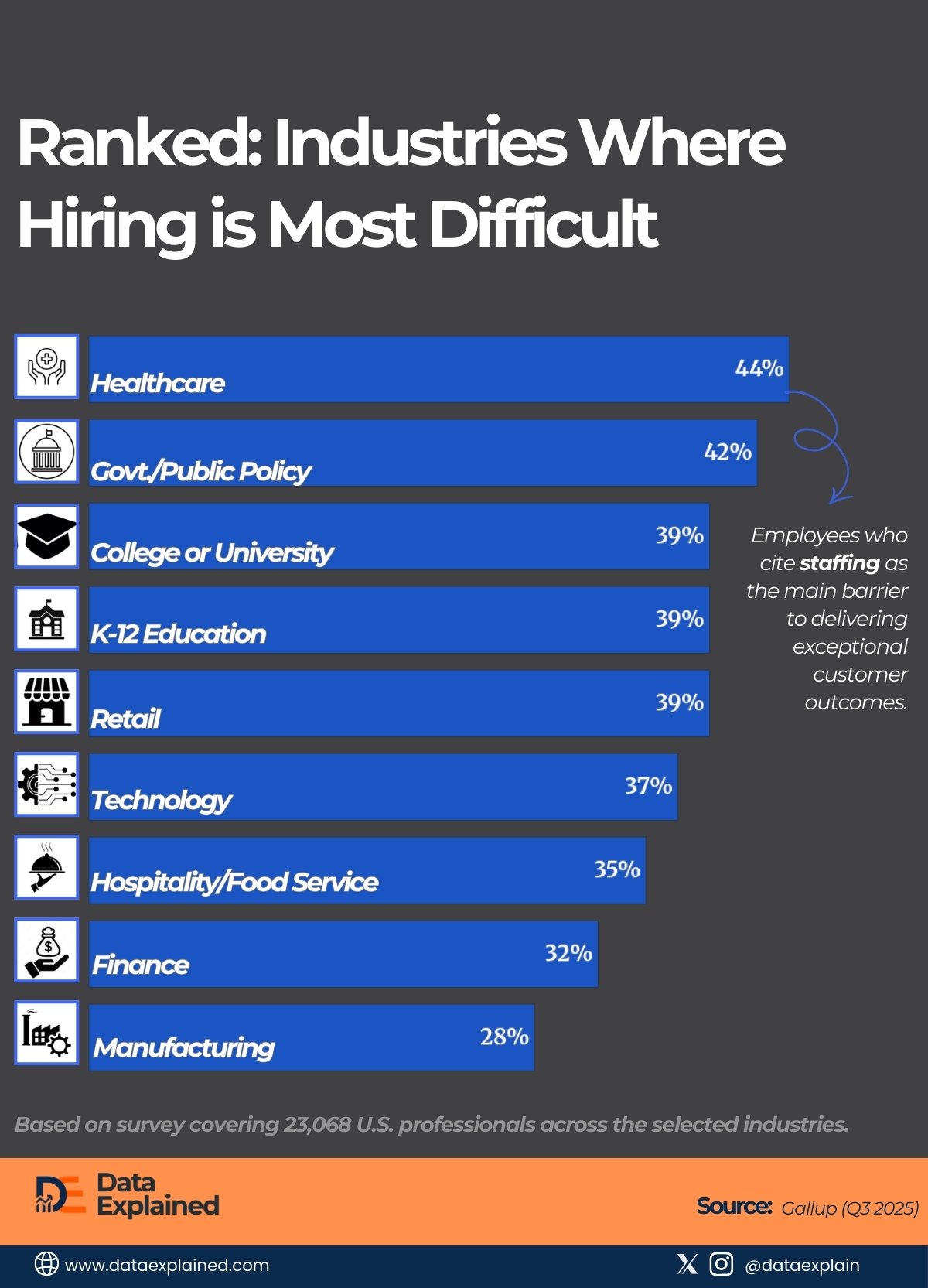
Industries where workers most frequently cite understaffing as their organization’s top barrier are often the same industries cutting headcount most aggressively.
This is according to a Gallup Q3 2025 industry survey covering 23,068 U.S. professionals across the selected industries.
In the graphics above, we used the survey’s data to show the industries in America where it’s most difficult to hire.
Interestingly, Healthcare employees report the highest staffing concerns at 44%. Yet 21% of healthcare organizations are reducing headcount. But it doesn’t end at healthcare.
TL;DR
- In Healthcare, 44% say staffing is their top barrier, meanwhile 21% are still cutting headcount.
- In Government, 42% view staffing as the biggest challenge, but 32% are reducing staff.
- AI could create new industries and jobs, but current data indicate that we are in a transition phase where disruption is faster than replacement.
Staffing Challenges Vary by Industry
| wdt_ID | wdt_created_by | wdt_created_at | wdt_last_edited_by | wdt_last_edited_at | Industry | % Staffing Is Top Barrier | % Organization Is Reducing Headcount | % Increasing Headcount |
|---|---|---|---|---|---|---|---|---|
| 1 | emmanuel-ashemiriogwa | 02/03/2026 11:04 AM | emmanuel-ashemiriogwa | 02/03/2026 11:04 AM | Hospitality/Food service | 35 | 13 | 43 |
| 2 | emmanuel-ashemiriogwa | 02/03/2026 11:04 AM | emmanuel-ashemiriogwa | 02/03/2026 11:04 AM | Healthcare | 44 | 21 | 41 |
| 3 | emmanuel-ashemiriogwa | 02/03/2026 11:04 AM | emmanuel-ashemiriogwa | 02/03/2026 11:04 AM | Finance | 32 | 21 | 34 |
| 4 | emmanuel-ashemiriogwa | 02/03/2026 11:04 AM | emmanuel-ashemiriogwa | 02/03/2026 11:04 AM | Retail | 39 | 20 | 33 |
| 5 | emmanuel-ashemiriogwa | 02/03/2026 11:04 AM | emmanuel-ashemiriogwa | 02/03/2026 11:04 AM | Manufacturing | 28 | 25 | 30 |
| 6 | emmanuel-ashemiriogwa | 02/03/2026 11:04 AM | emmanuel-ashemiriogwa | 02/03/2026 11:04 AM | Technology | 37 | 29 | 32 |
| 7 | emmanuel-ashemiriogwa | 02/03/2026 11:04 AM | emmanuel-ashemiriogwa | 02/03/2026 11:04 AM | K-12 Education | 39 | 26 | 27 |
| 8 | emmanuel-ashemiriogwa | 02/03/2026 11:04 AM | emmanuel-ashemiriogwa | 02/03/2026 11:04 AM | Government/Public policy | 42 | 32 | 24 |
| 9 | emmanuel-ashemiriogwa | 02/03/2026 11:04 AM | emmanuel-ashemiriogwa | 02/03/2026 11:04 AM | College or university | 39 | 39 | 15 |
The Public Sector Pattern
The data shows a clear divide between the public and private sectors.
Government/Public Policy and Colleges/Universities both show negative net headcount signals.
This means that more organizations are reducing staff than hiring, despite high percentages indicating staffing is their top barrier.
K-12 education even sits at just +1, which is flat growth. Also, that of the private sectors are still expanding.
Hospitality/Food Service leads, while Finance and Retail also show strong net hiring growth.
The difference shows structural pressures, as public sector organizations face tighter budget constraints and funding limits. Private companies can adjust hiring more flexibly in response to market demand and revenue growth.
The “Cutting While Burning” Metric
There is a noticeable pattern in staffing complaints relative to actual hiring decisions.
In Healthcare, 44% say staffing is their top barrier, meanwhile 21% are still cutting headcount.
In Government, 42% view staffing as the biggest challenge, but 32% are reducing staff. The most extreme case is Colleges and Universities, where 39% say staffing is the top issue, and the same 39% are cutting jobs.
This simply means that sectors are shrinking their workforce while saying they are already short-staffed.
Data from the Bureau of Labor Statistics released in February 2026 showed that the estimated number of job openings sank to 6.54 million at the end of December.
It has been (and remains) settling at the lowest level since September 2020.
The latest BLS report, alongside other labor market data released last month, provided further confirmation that the “low-hire, low-fire” slog continues.
It also indicates that budget pressures are outpacing operational needs, forcing institutions to reduce costs even at the risk of worsening service delivery and performance.
Connecting to AI/Tech Collapse
The technology sector shows 29% of organizations reducing headcount, which is the second-highest cut rate in the dataset.
This aligns with wider volatility in software stocks, including recent pressure on major firms such as Google amid rising competition from AI players such as Anthropic.
Uncertainty in AI monetization has turned into more cautious hiring and in most cases, layoffs.
Also, the narrative that AI will instantly create more jobs than it eliminates is being challenged.
Recall at the close of February 2026, Data Explained reported that major software companies lost 27% to 48% of their market value since the start of the year, as investors fear AI agents will replace their products.
It followed the concern that AI agents like Anthropic’s Claude “Cowork” can handle tasks such as tax prep, customer management, and data analytics, the same services companies charge billions for.
Fewer recruits and shifting skill needs means the labor market is adjusting to AI and the data supports the idea that the transition is shrinking.
ELI5
Government agencies and colleges are cutting more jobs than they are adding, which means layoffs are topping hiring in those sectors. This still happens even though many of these organizations say they’re already short-staffed.
They’re letting people go while still struggling to fill roles. The main reason appears to be budget pressure i.e when funding is tight, leaders often cut costs first, even if it makes daily operations harder.
Also, AI is changing the job market. While it may create new industries and opportunities in the future, the current numbers tell us that we’re in a transition period. Job disruption is happening faster than new roles are being created.
Source:
Gallup | Bureau of Labor Statistics