The summer of 2026 may have fewer available airline seats than any summer since the pandemic, and it has not yet started.
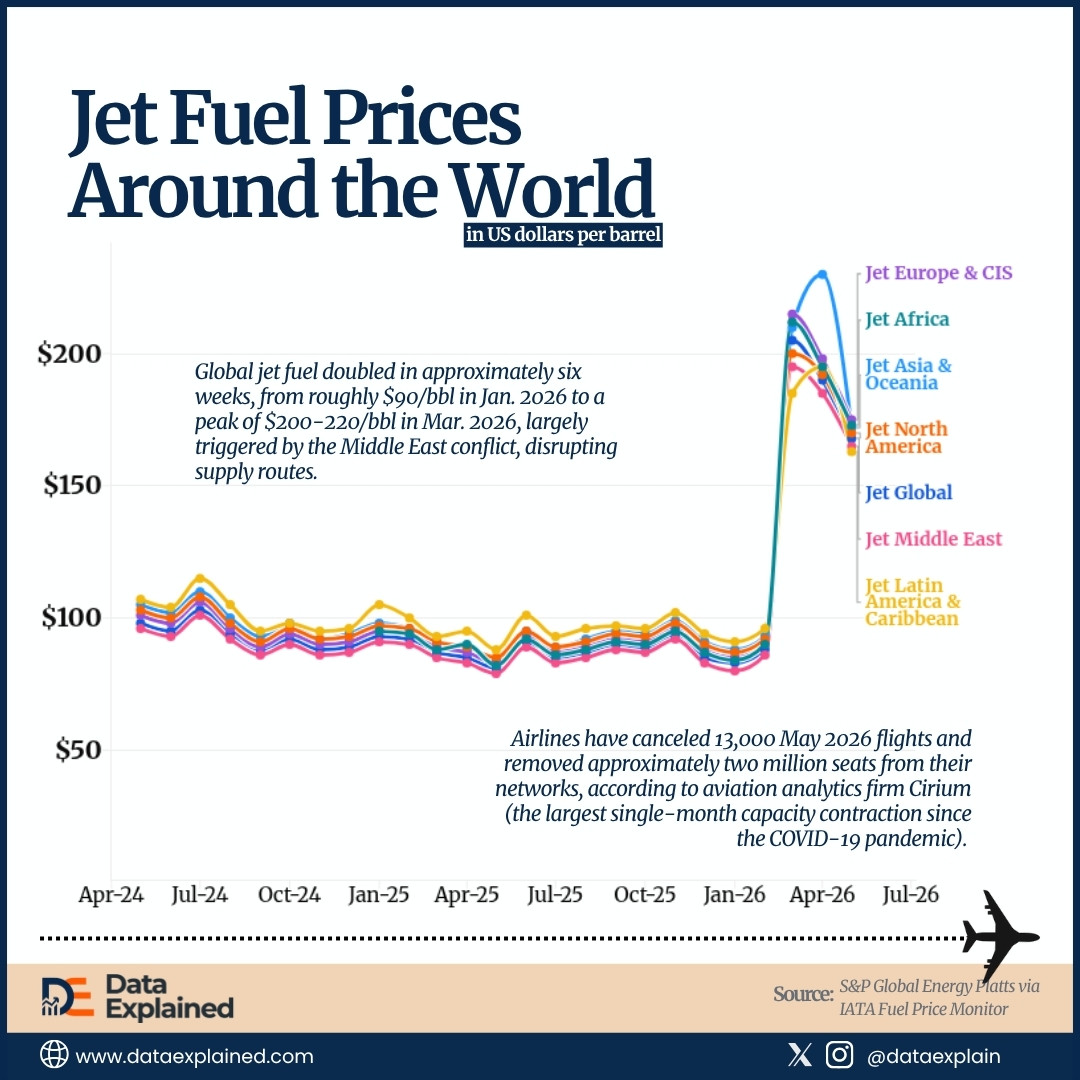
S&P Global Energy Platts data, accessed via the IATA Fuel Price Monitor, show global jet fuel prices at approximately $170 to $190 per barrel in May 2026, still roughly double the January 2026 baseline of approximately $85 to $95 per barrel.
It follows a conflict-driven spike that peaked near $220 per barrel in March.
Airlines have already canceled 13,000 May flights and removed two million seats, according to Cirium.
Summer schedules, built when fuel was $90 per barrel, are now being operated at $180 per barrel.
The capacity reduction visible in May is the leading edge of what arrives in June, July, and August.
TL;DR
- Global jet fuel doubled in approximately six weeks, from roughly $90/bbl in January 2026 to a peak of $200-220/bbl in March 2026
- It is largely triggered by the Middle East conflict, disrupting supply routes
- Airlines have canceled 13,000 May 2026 flights and removed two million seats in response, the largest capacity contraction since the pandemic, per Cirium.
| wdt_ID | wdt_created_by | wdt_created_at | wdt_last_edited_by | wdt_last_edited_at | Date | Jet Global ($/bbl) | Jet Asia & Oceania | Jet Europe & CIS | Jet Middle East | Jet North America | Jet Latin America & Caribbean | Jet Africa |
|---|---|---|---|---|---|---|---|---|---|---|---|---|
| 1 | emmanuel-ashemiriogwa | 15/05/2026 08:25 AM | emmanuel-ashemiriogwa | 15/05/2026 08:25 AM | 24/05/2026 | 98 | 105 | 101 | 96 | 103 | 107 | 0 |
| 2 | emmanuel-ashemiriogwa | 15/05/2026 08:25 AM | emmanuel-ashemiriogwa | 15/05/2026 08:25 AM | 24/06/2026 | 95 | 102 | 98 | 93 | 100 | 104 | 0 |
| 3 | emmanuel-ashemiriogwa | 15/05/2026 08:25 AM | emmanuel-ashemiriogwa | 15/05/2026 08:25 AM | 24/07/2026 | 103 | 110 | 106 | 101 | 108 | 115 | 0 |
| 4 | emmanuel-ashemiriogwa | 15/05/2026 08:25 AM | emmanuel-ashemiriogwa | 15/05/2026 08:25 AM | 24/08/2026 | 94 | 100 | 96 | 92 | 98 | 105 | 0 |
| 5 | emmanuel-ashemiriogwa | 15/05/2026 08:25 AM | emmanuel-ashemiriogwa | 15/05/2026 08:25 AM | 24/09/2026 | 88 | 93 | 89 | 86 | 91 | 95 | 0 |
| 6 | emmanuel-ashemiriogwa | 15/05/2026 08:25 AM | emmanuel-ashemiriogwa | 15/05/2026 08:25 AM | 24/10/2026 | 92 | 98 | 94 | 90 | 96 | 98 | 0 |
| 7 | emmanuel-ashemiriogwa | 15/05/2026 08:25 AM | emmanuel-ashemiriogwa | 15/05/2026 08:25 AM | 24/11/2026 | 88 | 92 | 90 | 86 | 92 | 95 | 0 |
| 8 | emmanuel-ashemiriogwa | 15/05/2026 08:25 AM | emmanuel-ashemiriogwa | 15/05/2026 08:25 AM | 24/12/2026 | 89 | 94 | 91 | 87 | 93 | 96 | 0 |
| 9 | emmanuel-ashemiriogwa | 15/05/2026 08:25 AM | emmanuel-ashemiriogwa | 15/05/2026 08:25 AM | 25/01/2026 | 93 | 98 | 95 | 91 | 97 | 105 | 95 |
| 10 | emmanuel-ashemiriogwa | 15/05/2026 08:25 AM | emmanuel-ashemiriogwa | 15/05/2026 08:25 AM | 25/02/2026 | 92 | 96 | 94 | 90 | 96 | 100 | 94 |
*Figures are approximated.
What Caused the Wall?
The price shock aligns directly with the outbreak and escalation of the Middle East conflict involving Iran, which disrupted the refining and shipping infrastructure through which a significant share of the world’s jet fuel reaches airlines.
Jet fuel is refined from crude oil and transported through supply chains that depend heavily on Gulf region processing capacity and shipping routes.
When those routes face conflict-driven disruption, prices reflect both the physical supply constraint and the risk premium that traders apply to uncertain future supply.
Who Pays the Highest Price?
Asia and Oceania reached the highest price at approximately $220 per barrel, above those of Europe, the Middle East, North America, and Latin America.
Asian carriers import the majority of their refined jet fuel through Middle Eastern supply chains.
When those chains are disrupted, freight costs, insurance premiums, and rerouting expenses for fuel shipped to Asia are the highest in any region because the distance from alternative sources is greatest.
Cancellations Are the Consequence
Airlines have canceled 13,000 May 2026 flights and removed approximately two million seats from their networks, according to aviation analytics firm Cirium (the largest single-month capacity contraction since the COVID-19 pandemic).
These are planning decisions made by airlines looking at a fuel environment that has made certain routes unprofitable to operate.
Jet fuel typically represents 20 to 30 percent of airline operating costs under normal conditions.
At double the pre-conflict price, that share rises to approximately 40-50 percent, compressing margins to near-zero or negative for carriers without sufficient hedging cover.
Where Prices Are Now
As of May 2026, global jet fuel has retreated partially from its March peak.
That is, from approximately $210 to $220 per barrel, down to approximately $170 to $190 per barrel, according to S&P Global Energy Platts.
That retreat reflects some reopening of alternative supply routes, strategic reserve activity, and the demand destruction caused by the cancellations themselves: fewer flights mean less fuel demand, which cools prices marginally from peak.
The partial retreat is not a normalization.
At $170 to $190 per barrel, fuel remains approximately double its January 2026 baseline.
The persistently elevated level is the more consequential number for airline planning.
Summer Begins in Six Weeks
The 24-month chart that S&P Global Energy Platts has assembled ends in May 2026 with prices still elevated, still declining gradually but not yet returning to the pre-shock range, and still sitting well above every data point recorded in the 22 months that preceded the February 2026 shock.
The flights that operated during those 22 months of stable fuel prices were planned, scheduled, and sold to passengers at fares based on $90-per-barrel assumptions. Some of those flights no longer exist.
ELI5
Jet fuel, what planes run on, nearly doubled in price in just six weeks early in 2026 because of a war in the Middle East that disrupted fuel supplies. Airlines can’t afford to fly as many routes at this fuel price, so they’ve canceled 13,000 flights in May and removed 2 million seats. Fuel is still about twice as expensive as it was in January, and summer travel season hasn’t even started yet.
Sources:
S&P Global Energy Platts | IATA Fuel Price Monitor | Cirium aviation analytics