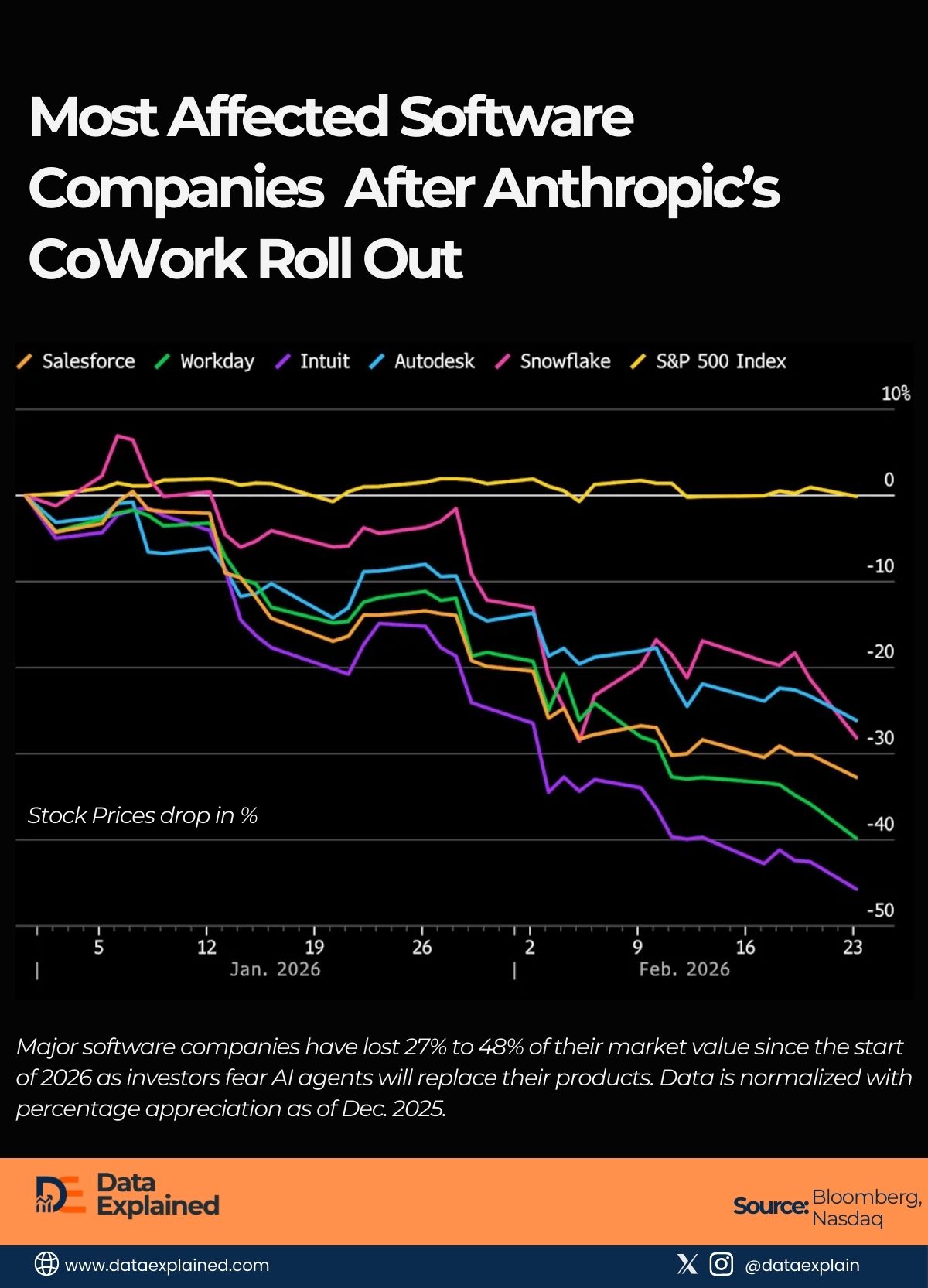
Major software companies have lost 27% to 48% of their market value since the start of 2026 as investors fear AI agents will replace their products, while the S&P 500 has fallen only 2%.
Intuit, maker of TurboTax and QuickBooks, leads the decline at -48%, followed by Workday at -40% and Salesforce at -35%.
It is important to note that this was monitored as of February 23, as stock prices could have fluctuated within the period.
The 25 to 46 percentage-point gap between software stocks and the broader market indicates investor concern that AI agents like Anthropic’s Claude “Cowork” can handle tasks such as tax prep, customer management, and data analytics, the same services companies charge billions for.
The S&P 500 Software & Services Index, with 140 members, is down 20% year-to-date, losing 4% on Thursday alone in its eighth straight session of declines.
TL;DR
- Software stocks plummeted by up to 48% in early 2026 as investors panicked over AI agents potentially replacing entire SaaS products, while the S&P 500 declined only 2%.
- Intuit led the decline with a 48% drop, followed by Workday (-40%) and Salesforce (-35%), erasing hundreds of billions in market value within just eight weeks.
The Week’s Carnage
Anthropic introduced Claude “Cowork” this week, its most advanced AI agent, designed to autonomously manage complex workflows in legal, CRM, and analytics.
The reaction from software stocks was swift and severe. Intuit dropped 48%, Workday fell 40%, and Salesforce declined 35% within just a few days.
The chart above illustrates the dramatic decline as investors rapidly sold off traditional SaaS stocks, fearing that AI agents might soon replace human labour rather than just support them.
The Chart Reveals Sector-Specific Destruction
Five leading software companies, including Intuit, Workday, Salesforce, Snowflake, and Autodesk, have each dropped between 27% and 48% since December 31, 2025.
During the same period, the S&P 500 has only declined by 2%. This results in a divergence of 25 to 46 percentage points, indicating that the decline is isolated to the software sector.
It suggests that the fear of AI replacing human labour is causing a targeted sell-off, while the main market remains relatively stable.
So, what?
This isn’t just market volatility; it’s a sign of sector obsolescence happening in real time.
The S&P 500 has declined just 2% since December 31, suggesting investors see the threat as limited to traditional software, not the entire economy.
When your core product becomes merely another AI feature, you don’t evolve — you risk fading away.
Over eight harsh weeks (31st Dec till date), the top five software companies have lost between 27% and 48% of their value, wiping out hundreds of billions in market capitalization.
The key question now is whether these companies are adapting quickly enough to survive or if they are already on the brink of collapse.
ELI5
In early 2026, software stocks dropped sharply by up to 48%, as investors worried that AI agents would replace SaaS products. The S&P 500 fell only 2%, suggesting sector-specific panic.
Leading the decline was Intuit with a 48% drop, followed by Workday at -40% and Salesforce at -35%. These losses totaled hundreds of billions in market value over eight weeks.
However, the launch of Anthropic’s Claude’ Cowork,’ an AI capable of automating tasks like tax prep and analytics, triggered concerns that traditional software may soon be seen as mere features rather than standalone billion-dollar businesses.
Thus, companies that can’t adapt to changing dynamics risk losing relevance and market share.
Sources: