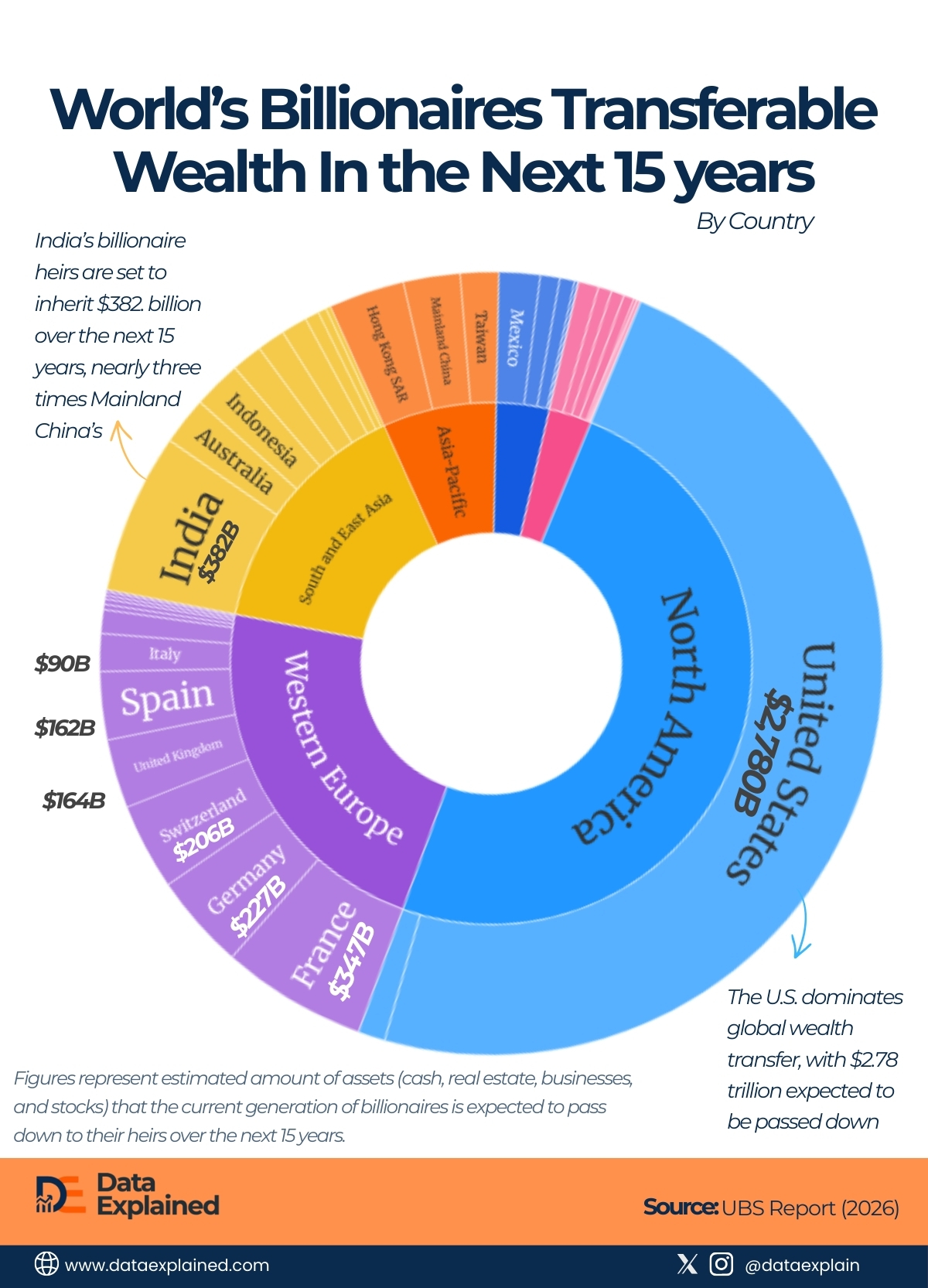
If you’ve not paid attention, global billionaires are now reaching retirement age. And, a staggering $5 trillion is set to change hands over the next 15 years.
This is according to the latest UBS/PwC report.
One interesting revelation from the data is that India’s next generation is poised to inherit nearly three times as much wealth as their counterparts in Mainland China.
TL;DR
- India’s billionaire heirs are set to inherit $382.4 billion over the next 15 years, nearly three times Mainland China’s $135.3 billion.
- The United States dominates global wealth transfer, with $2.78 trillion expected to be passed down, more than the combined transferable wealth of APAC, EMEA, and MEA regions.
For context, the report tracked “transferable wealth in the next 15 years.”
It means the estimated amount of assets (cash, real estate, businesses, and stocks) that the current generation of billionaires is expected to pass down to their heirs over the next 15 years.
Transferable Wealth by Country over the next 15 Years
| wdt_ID | wdt_created_by | wdt_created_at | wdt_last_edited_by | wdt_last_edited_at | Country | Transferable Wealth in 15 Years ($bn) | Continent |
|---|---|---|---|---|---|---|---|
| 1 | emmanuel-ashemiriogwa | 04/02/2026 08:20 AM | emmanuel-ashemiriogwa | 04/02/2026 08:20 AM | Argentina | 1.5 | Central and South America |
| 2 | emmanuel-ashemiriogwa | 04/02/2026 08:20 AM | emmanuel-ashemiriogwa | 04/02/2026 08:20 AM | Brazil | 46.4 | Central and South America |
| 3 | emmanuel-ashemiriogwa | 04/02/2026 08:20 AM | emmanuel-ashemiriogwa | 04/02/2026 08:20 AM | Chile | 35.1 | Central and South America |
| 4 | emmanuel-ashemiriogwa | 04/02/2026 08:20 AM | emmanuel-ashemiriogwa | 04/02/2026 08:20 AM | Colombia | 8.2 | Central and South America |
| 5 | emmanuel-ashemiriogwa | 04/02/2026 08:20 AM | emmanuel-ashemiriogwa | 04/02/2026 08:20 AM | Mexico | 97.7 | Central and South America |
| 6 | emmanuel-ashemiriogwa | 04/02/2026 08:20 AM | emmanuel-ashemiriogwa | 04/02/2026 08:20 AM | Canada | 64.5 | North America |
| 7 | emmanuel-ashemiriogwa | 04/02/2026 08:20 AM | emmanuel-ashemiriogwa | 04/02/2026 08:20 AM | United States | 2,779.9 | North America |
| 8 | emmanuel-ashemiriogwa | 04/02/2026 08:20 AM | emmanuel-ashemiriogwa | 04/02/2026 08:20 AM | Austria | 12.7 | Western Europe |
| 9 | emmanuel-ashemiriogwa | 04/02/2026 08:20 AM | emmanuel-ashemiriogwa | 04/02/2026 08:20 AM | Denmark | 12.4 | Western Europe |
| 10 | emmanuel-ashemiriogwa | 04/02/2026 08:20 AM | emmanuel-ashemiriogwa | 04/02/2026 08:20 AM | France | 347.1 | Western Europe |
The Asian Power Pivot
As shown in the table, Indian billionaires are on track to pass down $382.4 billion in wealth over the next 15 years, nearly three times Mainland China’s $135.3 billion.
The gap is not about how many billionaires each country has, but about the types of businesses that created that wealth and how old those founders are.
Many of India’s richest families built their fortunes decades ago in capital-intensive sectors that reward long holding periods: energy, ports, power, cement, pharmaceuticals, steel, and housing.
Figures like Mukesh Ambani, Gautam Adani, Sunil Mittal, and Uday Kotak sit atop sprawling corporate groups where ownership remains tightly concentrated, and succession is already underway.
Indian conglomerates are often structured to retain control across generations, using family trusts, holding companies, and cross-shareholdings to preserve assets.
That is why India’s inheritance pool is so large: much of its billionaire wealth is already built and ready to be handed over.
Trust-fund Heirs in China
Mainland China presents a very different picture.
Its billionaire class is disproportionately composed of first-generation tech and platform founders whose wealth was created more recently.
Names like Zhang Yiming (ByteDance), Colin Huang (PDD), and Lei Jun (Xiaomi) built fortunes in the last two decades (often tied closely to equity valuations rather than long-established family enterprises).
Many are still in their 40s or 50s, with succession a distant concern rather than an immediate priority.
Hong Kong: Small Island, Massive Legacy
Even though India’s billionaire heirs will inherit more than those in China, it might seem natural to assume China would easily outpace Hong Kong.
Yet this tiny city of 7.5 million is set to hand down $180.4 billion, surpassing the mainland.
The reason isn’t population or economic size, but the age, structure, and composition of wealth.
Hong Kong’s fortunes are dominated by long-established family dynasties whose wealth is largely in real estate, ports, utilities, and diversified conglomerates.
For example, Li Ka-Shing’s empire (including CK Asset Holdings, CK Hutchison, and Hutchison Ports) is already passing control to his sons, Victor and Richard Li.
Another example is the Kwok family of Sun Hung Kai Properties and Lee Shau Kee of Henderson Land have similarly structured multigenerational succession.
America’s $2.8 Trillion Inheritance
The United States remains the undisputed king of the global wealth inheritance wave.
Over the next 15 years, American billionaire heirs are set to receive $2.78 trillion.
That figure exceeds the combined transferable wealth of the APAC, EMEA, and MEA regions.
To put this in clearer perspective, the U.S. alone will issue more than all of Europe, Africa, the Middle East, and Asia combined.
Much of this wealth stems from long-established family empires, many dating back generations.
The Walton family, for example, who are heirs to Walmart, control assets valued at over $240 billion, while the Mars family continues to inherit billions from the eponymous confectionery empire.
Koch Industries, Ford, and Cargill also exemplify asset-heavy conglomerates that have been passed down through careful succession planning.
Unlike the younger tech founders of China, these families have decades of:
- Structured wealth accumulation
- Diversified portfolios
- Spanning real estate
- Industrial holdings
- Financial investments
- Governance systems that ensure smooth multigenerational transfers.
So, What?
This massive wealth transfer will reshape global markets.
A new generation with different values and priorities will influence everything from venture capital and stock markets to luxury goods and social impact.
They also spend differently.
Expect more demand for custom experiences, rare art, collectibles, and expensive properties in stable, desirable locations.
ELI5
Over the next 15 years, the world’s richest people will hand down about $5 trillion to their kids. India’s heirs will get $382 billion, Hong Kong $180 billion, and the U.S. $2.78 trillion (more than all of Asia, Europe, and Africa combined).
Families in established businesses pass on ready-made wealth, while heirs reshape luxury, philanthropy, and investments, turning inherited fortunes into new global influence.
Sources