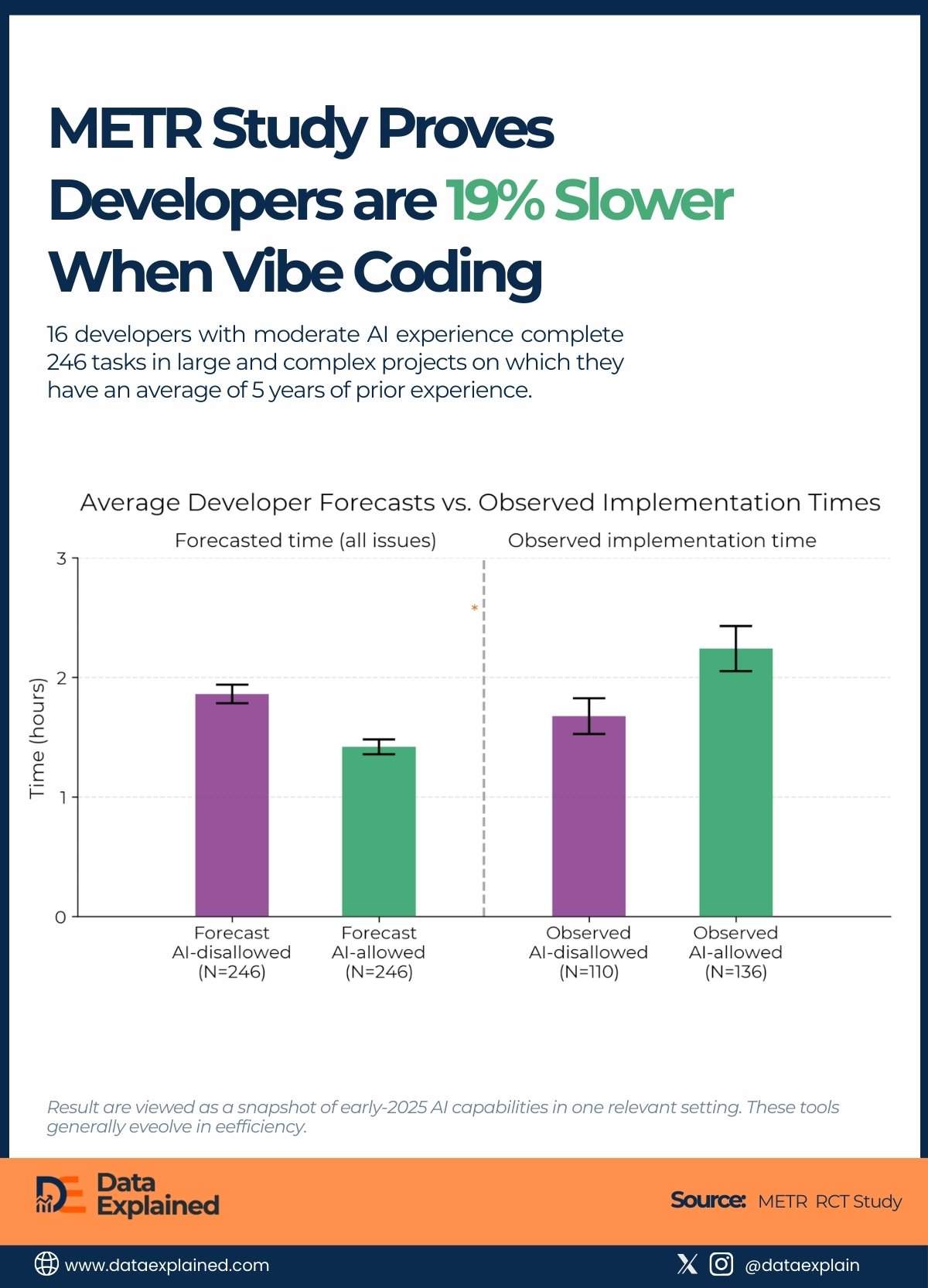
When developers are allowed to use AI tools, they take 19% longer to resolve issues, a significant slowdown that runs counter to developers’ beliefs and expert forecasts.
These findings come from METR’s developer productivity study.
The 2025 study was a randomized controlled trial (RCT) in which 16 developers with moderate AI experience completed 246 tasks in large, complex projects, with an average of 5 years of prior experience.
The visualization above shows the raw average developer-forecasted times and the observed implementation times.
We clearly see that developers take substantially longer when they are allowed to use AI tools.
TL;DR
- Developers expected AI to speed them up by 24%, and even after experiencing the slowdown, they still believed AI had sped them up by 20%.
- Most of the time was spent verifying code and correcting inaccuracies, thereby prolonging the workload.
- Large technology companies are investing in an AI coding assistant to increase developers’ productivity.
Does AI Make You “Overconfident but Underperform”?
There is a striking gap among experienced programmers in their use of AI tools.
Participants predicted they would complete the tasks fastest, estimating approximately 1.4 hours; however, the actual completion time averaged 2.2 hours, indicating that they were a very slow group in the experiment.
This mismatch indicates that access to AI created a strong expectation of speed that did not translate into real-world performance.
The result shows a psychological effect, not just a purely technical one.
In most cases, developers feel more efficient when working with AI, but the additional time spent verifying code, correcting inaccuracies, or refining outputs gradually increases the total workload.
In practice, AI has increased confidence and perceived productivity, but measured outcomes indicate underperformance, reflecting the risk of overestimating the time the tools actually save.
The “Debugging Tax”
The time many developers lose to AI does not come solely from knowing the tool. It mostly comes from what is called “vibe coding,” where AI generates large blocks of code that look right but also hide complex bugs.
A Fastly survey of 791 professional developers found that nearly 30% of senior developers reported that editing AI-generated code sufficiently to eliminate most of the initial time savings.
In that study, up to 28% of developers reported frequently having to fix or rework AI output to make it usable.
AI can provide full functionality almost instantly, creating the impression of momentum, but hidden flaws that may not surface until later testing.
As a result, developers spend more time “babysitting” and debugging AI code, sometimes more time than it would have taken to write the original code manually.
Could this be a negative ROI?
Many large technology companies are investing heavily in AI coding assistants, such as GitHub Copilot and Cursor, to enhance developer productivity.
Microsoft’s Copilot has surpassed 20 million all-time users and is used by 90% of Fortune 100 companies, making it one of the most widely adopted AI developer tools globally.
Enterprise teams can allocate hundreds of thousands of dollars annually to Copilot licenses alone.
For certain complex, open-source-level tasks, the data indicate that developers using AI may be up to 30% slower in practice than expected.
This raises questions about whether the real return on investment (ROI) matches the costs of AI tooling, particularly when time saved is offset by additional review and debugging before code can be deployed.
ELI5
AI coding tools can feel fast, but they don’t actually save real time.
Developers often have to double-check what the AI writes, correct mistakes, and test for hidden issues, which can end up stretching the workload instead of shortening it.
AI-generated code can look perfectly fine on the surface but still contain subtle bugs that only show up later during testing.
Despite these risks, large technology companies continue to invest heavily in AI coding assistants because the long-term goal is to achieve higher productivity and shorter development cycles.
The reality is that AI offers convenience and speed upfront, but it still needs human oversight to deliver its value.
Source: