The world’s population currently stands at 8.3 billion.
Since the family is the smallest unit of society, it’s interesting to examine average family size worldwide.
In some countries, homes are filled with children, grandparents, cousins, and other extended family members. In others, households are reduced to just 2 to 3 people.
TL;DR
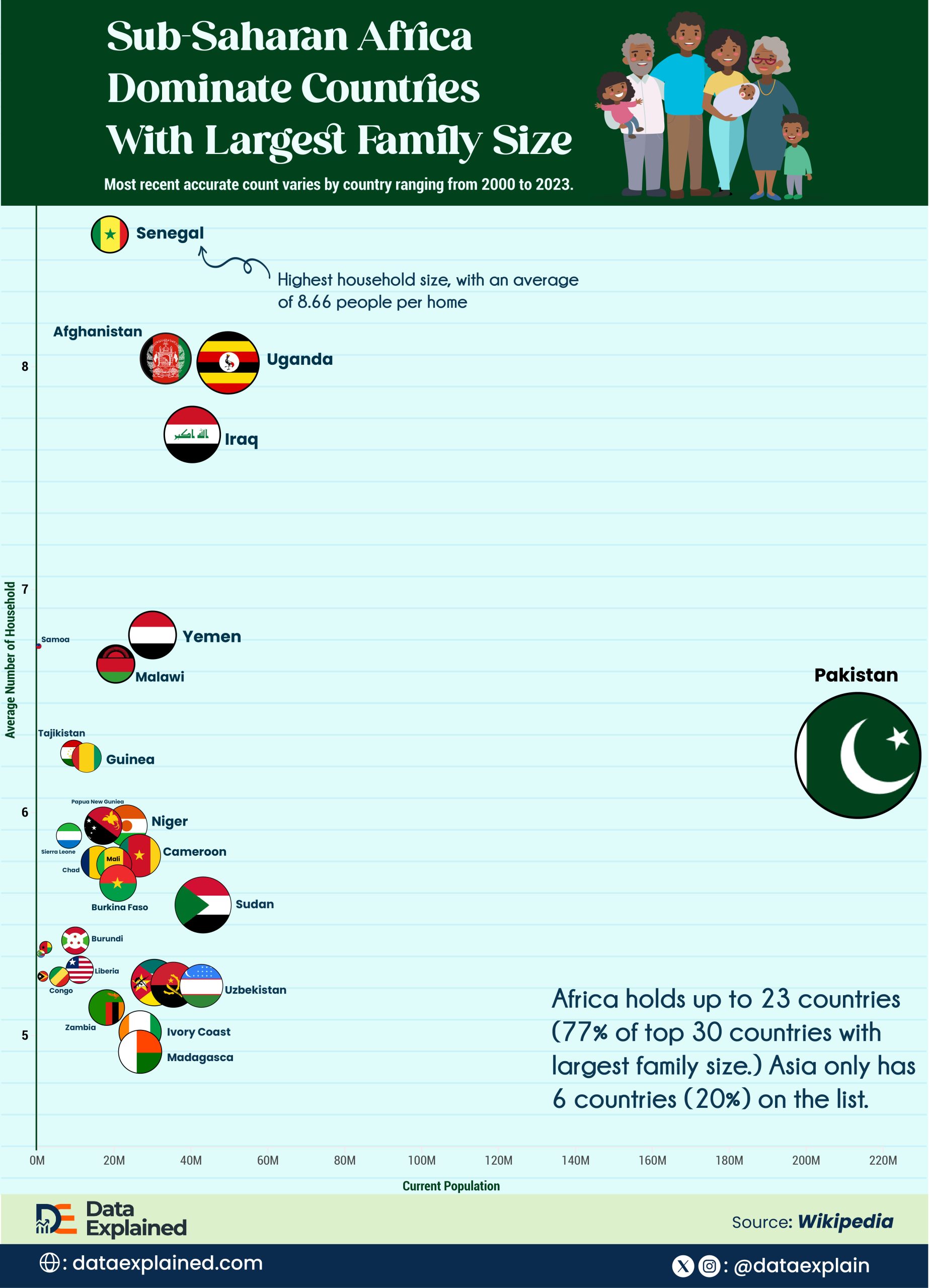
- Senegal has the highest household size, with an average of 8.66 people per home.
- Among the top 30 countries with largest family size, 73% are from Sub-Saharan Africa (the world’s last high-fertility region)
- Globally, households are getting smaller due to delayed marriages, declining fertility rates, and increased independent living.
The data is sourced from Wikipedia.
It’s important to note that the most recent accurate count varies by country, ranging from 2000 to 2023.
Top 30 Countries With the Highest Family Size
| wdt_ID | wdt_created_by | wdt_created_at | wdt_last_edited_by | wdt_last_edited_at | Rank | Country | Current Population (Millions) | Average Number of Households |
|---|---|---|---|---|---|---|---|---|
| 1 | emmanuel-ashemiriogwa | 24/02/2026 12:32 PM | emmanuel-ashemiriogwa | 24/02/2026 12:32 PM | 1 | Senegal | 18.71 | 8.66 |
| 2 | emmanuel-ashemiriogwa | 24/02/2026 12:32 PM | emmanuel-ashemiriogwa | 24/02/2026 12:32 PM | 2 | Afghanistan | 32.89 | 8.04 |
| 3 | emmanuel-ashemiriogwa | 24/02/2026 12:32 PM | emmanuel-ashemiriogwa | 24/02/2026 12:32 PM | 3 | Uganda | 49.46 | 8.02 |
| 4 | emmanuel-ashemiriogwa | 24/02/2026 12:32 PM | emmanuel-ashemiriogwa | 24/02/2026 12:32 PM | 4 | Iraq | 40.15 | 7.70 |
| 5 | emmanuel-ashemiriogwa | 24/02/2026 12:32 PM | emmanuel-ashemiriogwa | 24/02/2026 12:32 PM | 5 | Yemen | 29.83 | 6.80 |
| 6 | emmanuel-ashemiriogwa | 24/02/2026 12:32 PM | emmanuel-ashemiriogwa | 24/02/2026 12:32 PM | 6 | Samoa | 0.20 | 6.75 |
| 7 | emmanuel-ashemiriogwa | 24/02/2026 12:32 PM | emmanuel-ashemiriogwa | 24/02/2026 12:32 PM | 7 | Malawi | 20.25 | 6.67 |
| 8 | emmanuel-ashemiriogwa | 24/02/2026 12:32 PM | emmanuel-ashemiriogwa | 24/02/2026 12:32 PM | 8 | Tajikistan | 9.31 | 6.27 |
| 9 | emmanuel-ashemiriogwa | 24/02/2026 12:32 PM | emmanuel-ashemiriogwa | 24/02/2026 12:32 PM | 9 | Guinea | 12.61 | 6.25 |
| 10 | emmanuel-ashemiriogwa | 24/02/2026 12:32 PM | emmanuel-ashemiriogwa | 24/02/2026 12:32 PM | 10 | Pakistan | 213.28 | 6.26 |
As you can see, Africa holds up to 23 countries (77% of the top 30 countries with the largest family size) Asia only has 6 countries (20%) on the list.
But the African countries on this list are almost exclusively in Sub-Saharan Africa. North Africa is completely absent.
For example, no Egypt, Morocco, Algeria, Tunisia, or Libya.
Ironically, These are the World’s SMALLEST Populations
Among the top 30 countries with the largest average family size, Pakistan (213 million population) is the ONLY country in the top 30 breaking 100 million.
For example, Samoa (202,000 people) and the Comoros (758,000 people) have populations smaller than those of most cities.
Whereas, China ( with over 1.4 billion people), India, the USA, Indonesia, and even Brazil do not appear in the top 30 countries with the largest family size despite their total population.
This implies that large households don’t necessarily mean large populations.
In fact, it’s nearly the opposite.
The world’s most populous countries have undergone urbanization, nuclear families, and then smaller households.
Large household size is a pre-development indicator.
It’s Beyond Fertility Rate…
Another stark observation is that a larger household size not only hints at a high fertility rate
Household size is linked primarily to the number of children and secondarily to the presence of other family and non-family members, with influence from polygyny and extended families
Components of large households:
- High fertility (6-8 children per woman)
- Extended family (grandparents, aunts, uncles, cousins)
- Polygyny (multiple wives in some cultures, particularly in West Africa)
- Non-family members (orphans, distant relatives, domestic workers)
African countries dominate the list. And Africa’s median age is 19.3 years, according to Worldometer.
This means that households are predominantly composed of children.
If a woman has 6-8 children and lives with extended family, the household size can easily exceed 8 members.
Are Households Getting Smaller?
In most countries, household sizes have declined over the decades.
Globally, the total fertility rate was 2.3 children per woman in 2023. This is much lower than in the past; in the 1950s, it was more than twice as high: 4.9.
This trend is seen in developed regions such as Europe, North America, and East Asia, where fertility rates have declined, and independent living has become more common.
As a result, two-person and single-person households now constitute a growing share of households, indicating that modern lifestyles continue to reshape family structures worldwide.
ELI5
Senegal has the largest average household size in the world, with nearly 9 people living in a household on average.
Most countries with very large families are in Sub-Saharan Africa, which still has higher birth rates than the rest of the world.
Globally, the trend is the opposite: families are shrinking as people marry later, have fewer children, and are more likely to live alone.
Sources:
Wikipedia | Taylor and Francis | Fragile States Index | Worldometer |