Fourty eight nations began competing for the FIFA World Cup this year.
Based on what has happened in every previous edition, the number of realistic winners is considerably smaller than that.
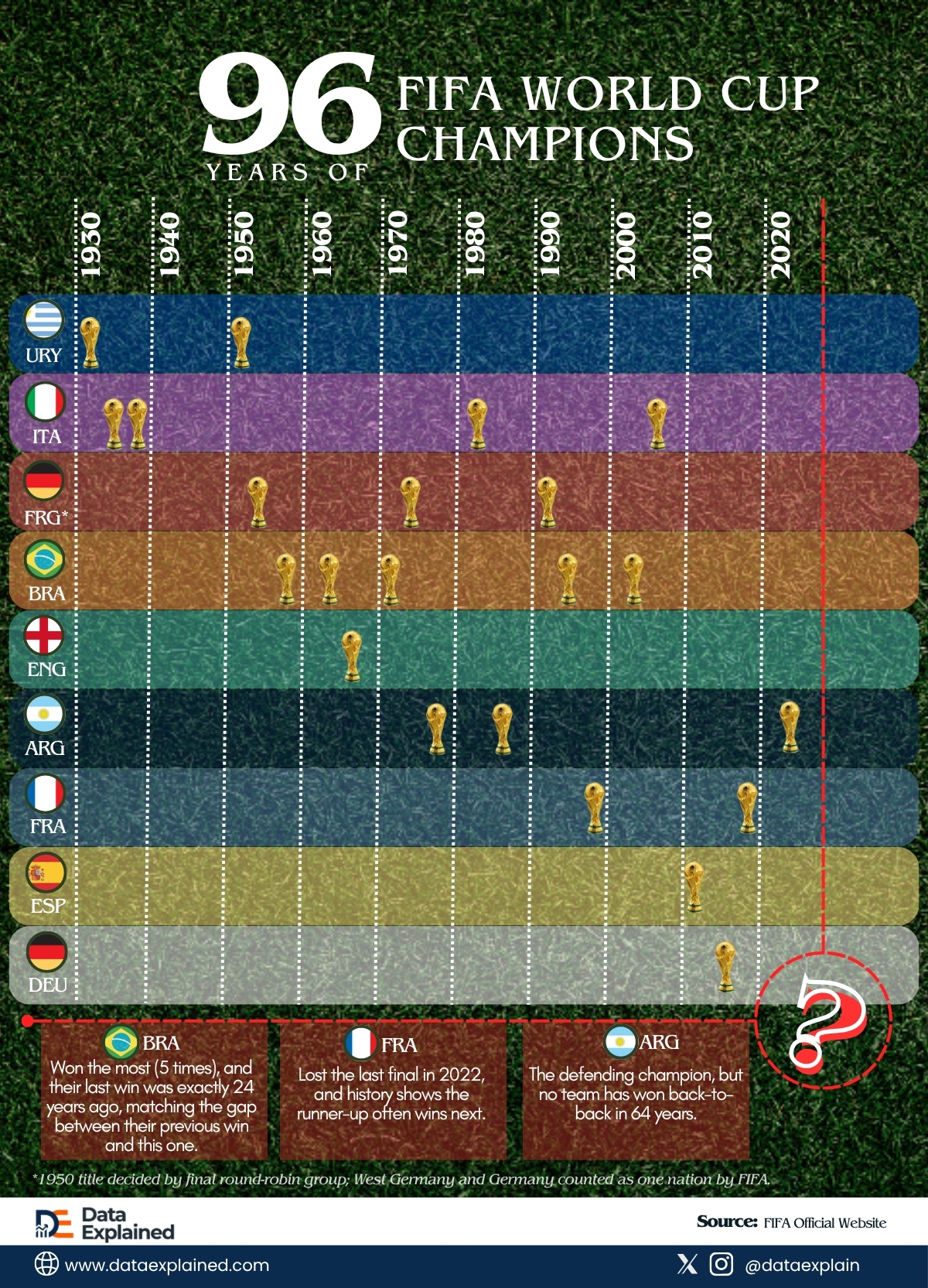
FIFA’s official records of all 22 World Cup champions, from Uruguay’s inaugural 1930 title through Argentina’s 2022 victory, document one of sport’s most concentrated outcome patterns:
Only eight countries have ever won across 96 years of competition. Brazil leads with five titles.
To put it another way, 40 of the current 48 qualifying nations have never won a single World Cup and have no historical data point suggesting they will this time.
TL;DR
- Only eight countries have ever won the World Cup across 22 tournaments since 1930: Brazil (5), Germany (4), Italy (4), Argentina (3), France (2), Uruguay (2), England (1), and Spain (1).
- The data specifically supports three 2026 contenders: Brazil (24-year gap matching their pre-1994 drought), France (runner-up precedent from 2022 pointing to 2026 win), and Argentina (defending champion despite the historical odds)
Note: 1950 title decided by final round-robin group; West Germany and Germany counted as one nation by FIFA.
The question the data can address is not which of those 48 will win. It is which of the eight who have won before are most supported by the specific patterns the record shows.
ALSO READ: FIFA Says World Cup Will Add $17B to US Economy; Here’s Where The Money Goes
Brazil’s 24-Year Clock
| wdt_ID | wdt_created_by | wdt_created_at | wdt_last_edited_by | wdt_last_edited_at | Year | Champion | Runner-Up |
|---|---|---|---|---|---|---|---|
| 1 | emmanuel-ashemiriogwa | 10/06/2026 05:09 PM | emmanuel-ashemiriogwa | 10/06/2026 05:09 PM | 1930 | Uruguay | Argentina |
| 2 | emmanuel-ashemiriogwa | 10/06/2026 05:09 PM | emmanuel-ashemiriogwa | 10/06/2026 05:09 PM | 1934 | Italy | Czechoslovakia |
| 3 | emmanuel-ashemiriogwa | 10/06/2026 05:09 PM | emmanuel-ashemiriogwa | 10/06/2026 05:09 PM | 1938 | Italy | Hungary |
| 4 | emmanuel-ashemiriogwa | 10/06/2026 05:09 PM | emmanuel-ashemiriogwa | 10/06/2026 05:09 PM | 1950 | Uruguay | Brazil |
| 5 | emmanuel-ashemiriogwa | 10/06/2026 05:09 PM | emmanuel-ashemiriogwa | 10/06/2026 05:09 PM | 1954 | West Germany | Hungary |
| 6 | emmanuel-ashemiriogwa | 10/06/2026 05:09 PM | emmanuel-ashemiriogwa | 10/06/2026 05:09 PM | 1958 | Brazil | Sweden |
| 7 | emmanuel-ashemiriogwa | 10/06/2026 05:09 PM | emmanuel-ashemiriogwa | 10/06/2026 05:09 PM | 1962 | Brazil | Czechoslovakia |
| 8 | emmanuel-ashemiriogwa | 10/06/2026 05:09 PM | emmanuel-ashemiriogwa | 10/06/2026 05:09 PM | 1966 | England | West Germany |
| 9 | emmanuel-ashemiriogwa | 10/06/2026 05:09 PM | emmanuel-ashemiriogwa | 10/06/2026 05:09 PM | 1970 | Brazil | Italy |
| 10 | emmanuel-ashemiriogwa | 10/06/2026 05:09 PM | emmanuel-ashemiriogwa | 10/06/2026 05:09 PM | 1974 | West Germany | Netherlands |
Brazil has won five World Cups, more than any other nation. Their last championship was in 2002. That is 24 years ago.
The coincidence that the data produces is specific.
Brazil’s longest previous gap between World Cup titles was exactly 24 years (from their 1970 victory to their 1994 championship).
The 1994 title ended a drought of precisely the same length as the one they carry into tomorrow’s tournament.
That is a numerical pattern from the historical record, not a formula. But it is the most precise data-based argument available for a Brazilian title in 2026, and it is the argument that history generates without any editorializing.
Brazil has also never won a World Cup on home soil
Their two home tournaments produced the 1950 defeat to Uruguay at the Maracanã and the 2014 semi-final 7-1 loss to Germany.
The 2026 tournament is hosted in the United States, Canada, and Mexico. Historically, Brazil wins away from home.
ALSO READ: Ranked: Demand for Short-Term Rental In 2026 World Cup Host Cities
France and the Runner-Up Pattern
France lost the 2022 World Cup final to Argentina. According to the full dataset, that is a historically loaded position.
Two specific precedents in the data show the runner-up winning the next tournament:
- West Germany lost the 1966 final to England and won the 1970 championship.
- France lost the 2006 final to Italy and won the 2018 championship.
Both runners-up converted their final-stage experience into the next title four years later.
Argentina’s Unprecedented Attempt
No defending champion has retained the World Cup title since Brazil won consecutive championships in 1958 and 1962.
That is 64 years and 15 consecutive failed title defenses.
West Germany tried in 1978. Brazil tried in 1966 and were eliminated in the group stage. France tried in 2002 and was also eliminated in the group stage. Spain tried in 2014. Germany tried in 2018.
Argentina arrives at 2026 attempting what every defending champion since Brazil has failed to do.
The historical record is specific and consistent on this point.
It does not make Argentina’s defense impossible
Tournaments are decided on pitches, not in datasets. But 64 years of unsuccessful title defenses represent the most durable pattern in the entire record.
ALSO READ: Visualized: FIFA World Cup Prize Fund Has Grown 32x Since 1982
The Closed Club
The broader story the dataset tells is about exclusion as much as it is about prediction.
No African, Asian, North American, Central American, or Oceanian country has ever won the World Cup in 22 tournaments.
The 2026 hosts (the United States, Canada, and Mexico) are competing in their own tournament, with no historical championships among them.
ELI5 (Explain It Like I’m 5)
The 2026 FIFA World Cup starts this month with 48 countries playing, but in 96 years, only 8 countries have ever won. Brazil has won the most (5 times), and their last win was exactly 24 years ago, matching the gap between their previous win and this one. France lost the last final in 2022, and history shows the runner-up often wins next. Argentina is the defending champion, but no team has won back-to-back in 64 years. The data points to those three as the most likely winners.
Source: