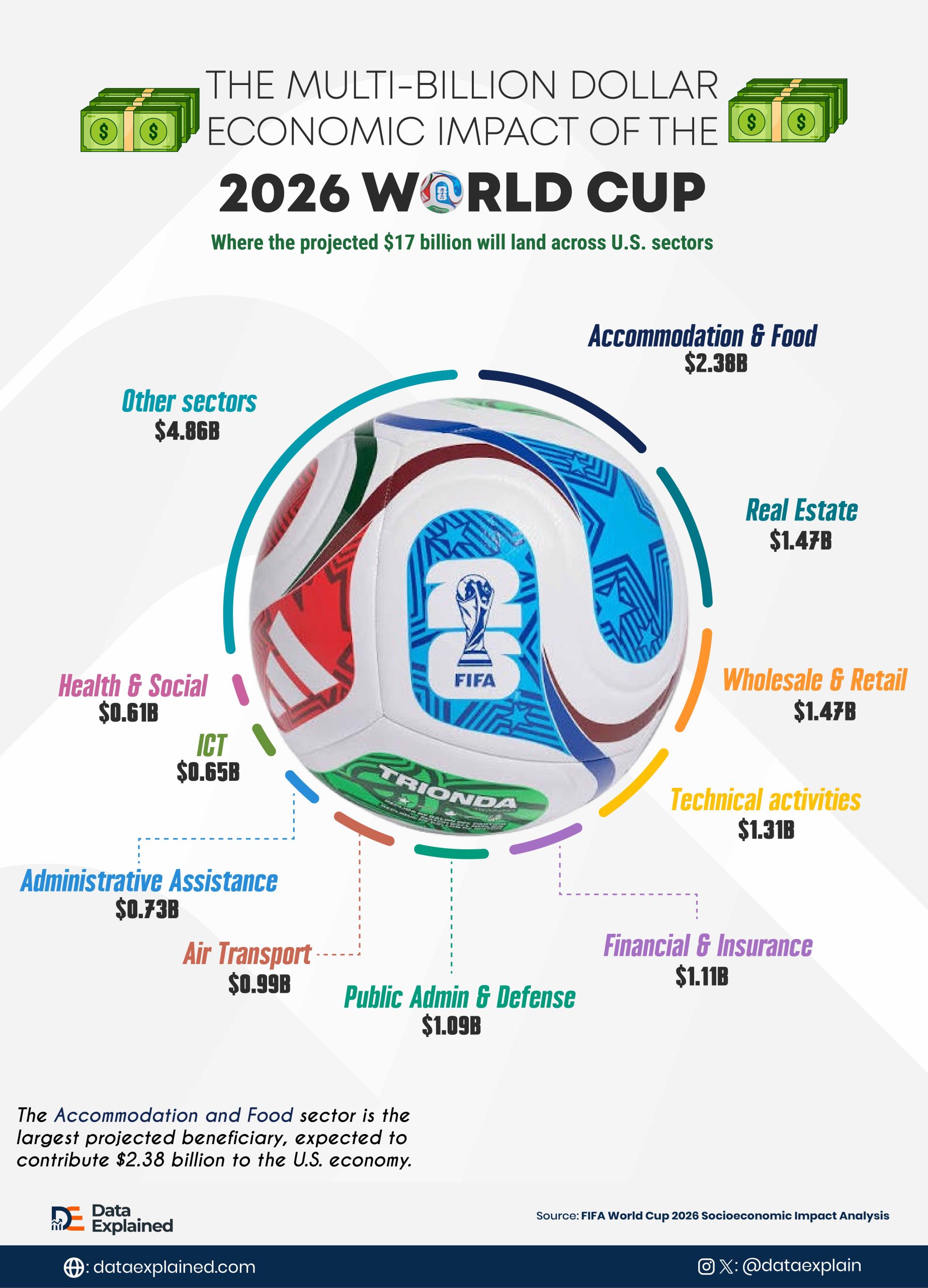
The 2026 FIFA World Cup is projected to add $17.15 billion to the U.S. economy.
This estimation comes from the FIFA World Cup 2026 Socioeconomic Impact Analysis, released in March 2025 and available through the FIFA Digital Hub.
The methodology measures how tournament-related expenditures propagate through U.S. value chains.
In other words, it’s based on how spending at a Miami hotel triggers economic activity in the food supply, laundry services, property management, and financial services further down the economic chain.
But what is most interesting is which sector benefits the most.
TL;DR
- The Accommodation and Food sector has the largest projected benefit, with a $2.38 billion contribution to the country’s Gross Domestic Product (GDP).
- Public Administration and Defense receives $1.09 billion in projected GDP impact, a figure substantially produced by security, policing, and government administrative costs that are primarily borne by U.S. taxpayers
ALSO READ: FIFA World Cup Prize Fund Has Grown 32x Since 1982
| wdt_ID | wdt_created_by | wdt_created_at | wdt_last_edited_by | wdt_last_edited_at | U.S. Sector | GDP Contribution ($B) |
|---|---|---|---|---|---|---|
| 1 | emmanuel-ashemiriogwa | 16/06/2026 04:45 PM | emmanuel-ashemiriogwa | 16/06/2026 04:45 PM | Accommodation & Food | 2.40 |
| 2 | emmanuel-ashemiriogwa | 16/06/2026 04:45 PM | emmanuel-ashemiriogwa | 16/06/2026 04:45 PM | Real Estate | 2.00 |
| 3 | emmanuel-ashemiriogwa | 16/06/2026 04:45 PM | emmanuel-ashemiriogwa | 16/06/2026 04:45 PM | Wholesale & Retail | 1.50 |
| 4 | emmanuel-ashemiriogwa | 16/06/2026 04:45 PM | emmanuel-ashemiriogwa | 16/06/2026 04:45 PM | Technical activities | 1.30 |
| 5 | emmanuel-ashemiriogwa | 16/06/2026 04:45 PM | emmanuel-ashemiriogwa | 16/06/2026 04:45 PM | Financial & Insurance | 1.10 |
| 6 | emmanuel-ashemiriogwa | 16/06/2026 04:45 PM | emmanuel-ashemiriogwa | 16/06/2026 04:45 PM | Public Admin & Defense | 1.10 |
| 7 | emmanuel-ashemiriogwa | 16/06/2026 04:45 PM | emmanuel-ashemiriogwa | 16/06/2026 04:45 PM | Air transport | 1.00 |
| 8 | emmanuel-ashemiriogwa | 16/06/2026 04:45 PM | emmanuel-ashemiriogwa | 16/06/2026 04:45 PM | Administrative Assistance | 0.70 |
| 9 | emmanuel-ashemiriogwa | 16/06/2026 04:45 PM | emmanuel-ashemiriogwa | 16/06/2026 04:45 PM | ICT | 0.70 |
| 10 | emmanuel-ashemiriogwa | 16/06/2026 04:45 PM | emmanuel-ashemiriogwa | 16/06/2026 04:45 PM | Health & Social | 0.60 |
First, Will These Numbers Actually Happen?
The analysis was commissioned and published by FIFA, the entity with the most direct interest in demonstrating the tournament’s economic value to host governments and the public.
This does not make the analysis false.
It does mean the $17.148 billion should be read as FIFA’s case for its own event rather than an independent assessment.
Independent academic reviews of comparable major sports events (the 2010 South Africa World Cup, the 2022 Qatar World Cup, multiple Olympic Games) have consistently found that organizer-commissioned pre-event impact studies project outcomes that exceed those subsequently measured by independent post-event analysis.
The pattern is documented across multiple events and multiple research institutions.
The independent assessment of what it actually delivered will take longer to produce than the tournament itself.
Where the Money Lands
Accommodation and Food leads at $2.38 billion, 13.9% of total U.S. impact.
This is the most direct beneficiary: hotels, restaurants, bars, and food services in the eleven host cities absorbing visitor spending over six weeks of tournament activity.
It is the sector the casual observer would expect to top the list, and it does.
ALSO READ: FIFA World Cup: 96 Years of Data Narrows to 3 Realistic Winners
Something About Public Admin Number…
The sixth-largest sector is worth specific attention.
Public Administration and Defense, contributing $1.09 billion to GDP, means the government administrative and security layer of the tournament generates more than $1 billion in economic activity.
That activity is primarily funded by the public.
Security operations, policing, emergency services, customs and immigration processing, and government administrative coordination for 11 host cities simultaneously are the costs behind that number.
They are largely borne by city, state, and federal budgets.
That is, taxpayer-funded activity that appears as economic benefit in the GDP column while representing expenditure in the public finance column.
Air Transport and the Rest
Air Transport sits at $994 million, just below $1 billion.
The analysis captures the U.S. aviation sector’s benefit from intercity fan movement between host cities and from international arrival flights processed through U.S. airports.
Administrative Assistance follows at $727 million, covering the temporary employment layer of event staffing and logistics.
ICT contributes $653 million from broadcasting, streaming, and communications infrastructure.
ELI5 (Explain It Like I’m 5)
FIFA says its 2026 World Cup will add $17 billion to the U.S. economy. Most of that money goes to hotels, restaurants, property services, and shops in the cities hosting games. About $1 billion goes to government and security costs, which are mostly funded by taxpayers. These are projections from FIFA’s own study, not independently verified figures.
Source:
FIFA World Cup 2026 Socioeconomic Impact Analysis