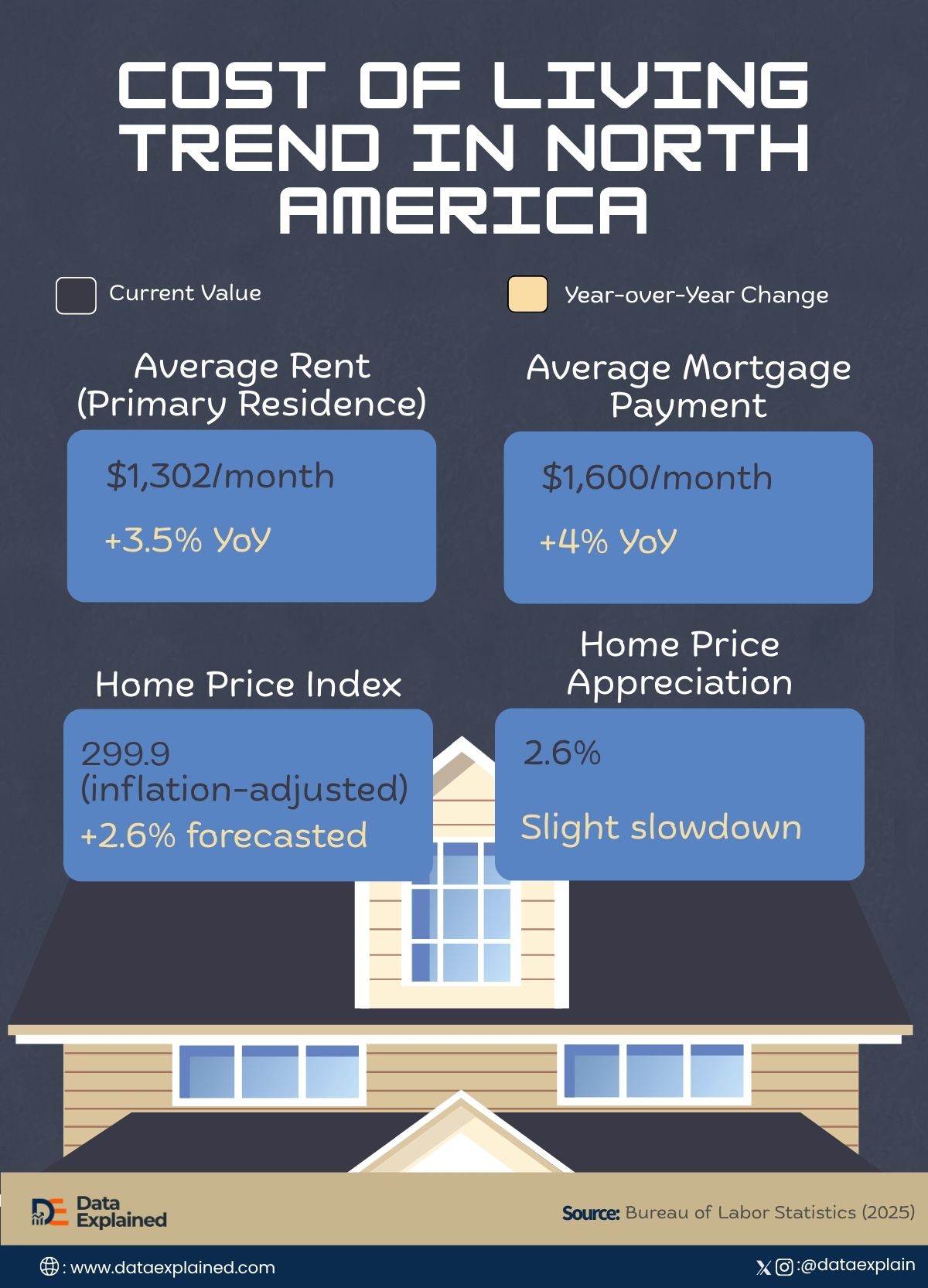
Living in North America is not entirely affordable right now compared to the global average.
Prices for housing, food, and utilities are increasing faster than wages in many areas.
The cost-of-living index measures how much more expensive everyday goods and services have become relative to income.
The data used in the infographic comes from the Bureau of Labor Statistics’ Consumer Price Index.
TL;DR
- The average rent for primary residences is $1,302 per month. The average mortgage payment for all existing mortgage holders stands at approximately $1,600 per month
- Transportation is the second-highest household expenditure, constituting about 17% of total spending
The U.S. Shelter & Housing Costs Leading the Squeeze
| wdt_ID | wdt_created_by | wdt_created_at | wdt_last_edited_by | wdt_last_edited_at | Parameter | Current Value | YoY Change |
|---|---|---|---|---|---|---|---|
| 1 | Monica Ebunoluwa | 30/07/2026 04:14 PM | Monica Ebunoluwa | 30/07/2026 04:14 PM | Average Rent (Primary Residence) | $1,302/month | 3.5% year-over-year |
| 2 | Monica Ebunoluwa | 30/07/2026 04:14 PM | Monica Ebunoluwa | 30/07/2026 04:14 PM | Average Mortgage Payment | $1,600/month | 4% year-over-year |
| 3 | Monica Ebunoluwa | 30/07/2026 04:14 PM | Monica Ebunoluwa | 30/07/2026 04:14 PM | Home Price Index | 299.9 (inflation-adjusted) | 2.6% forecasted |
| 4 | Monica Ebunoluwa | 30/07/2026 04:14 PM | Monica Ebunoluwa | 30/07/2026 04:14 PM | Home Price Appreciation | 2.60% | Slight slowdown |
In the U.S., shelter costs are the primary driver of increased living expenses.
The average rent for primary residences is $1,302 per month.
The average mortgage payment for all existing mortgage holders is approximately $1,600 per month, according to the Federal Reserve as of 2025, while new buyers face payments averaging $2,127 to $2,329 per month.
Home prices have reached an inflation-adjusted index of 299.9, more than double the historical average, indicating a significant affordability challenge for many households.
ALSO READ: Ranked: Cost of Living Trend Across South America
Metro vs. Rural Cost Differences
Over the last few years, inflation for essential goods has consistently been higher in rural areas.
From 2021 to 2025, rural inflation averaged 4.9%, slightly lower than urban inflation at 5.4%, but still enough to strain household budgets.
Rural households face higher grocery price increases than metro residents, with rural grocery prices rising 7.6% over the past year compared to 5.6% in urban areas.
Utility costs also tend to be higher in rural areas.
According to the ALICE (Asset Limited, Income Constrained, Employed) Essentials Index, rural households are seeing faster increases in electricity and natural gas bills, which add to the overall cost of living.
Key Pressure Points for Households
The surge in home prices, up over 50% since the pandemic, coupled with mortgage rates averaging approximately 6.7% in 2025, has significantly strained affordability. Millions are now being priced out of homeownership.
The above is according to the Freddie Mac Primary Mortgage Survey as of 2025.
Transportation is the second-highest household expenditure, constituting about 17% of total spending. Average annual costs are around $13,318, covering vehicle purchases, fuel, and maintenance.
The above reflects 2024 BLS Consumer Expenditure data.
Rising fuel prices and vehicle costs continue to pressure household budgets.
Food makes up roughly 12.9% of household spending.
While overall inflation has moderated, food prices rose 3.2% from August 2024 to August 2025, with higher costs in several categories adding to household strain.
ELI5
Think of your allowance as your income.
Over time, the prices of everything you buy, like snacks, clothes, and rides, keep going up, but the amount of money you get hasn’t kept pace.
That’s what’s happening with the cost of living in North America.
Prices for housing, food, and transportation are rising faster than most people’s wages, so families can afford less with the same income.
When energy prices and interest rates climb, nearly everything else costs more, too. In simple terms, life’s bills are outpacing people’s paychecks.
Sources: