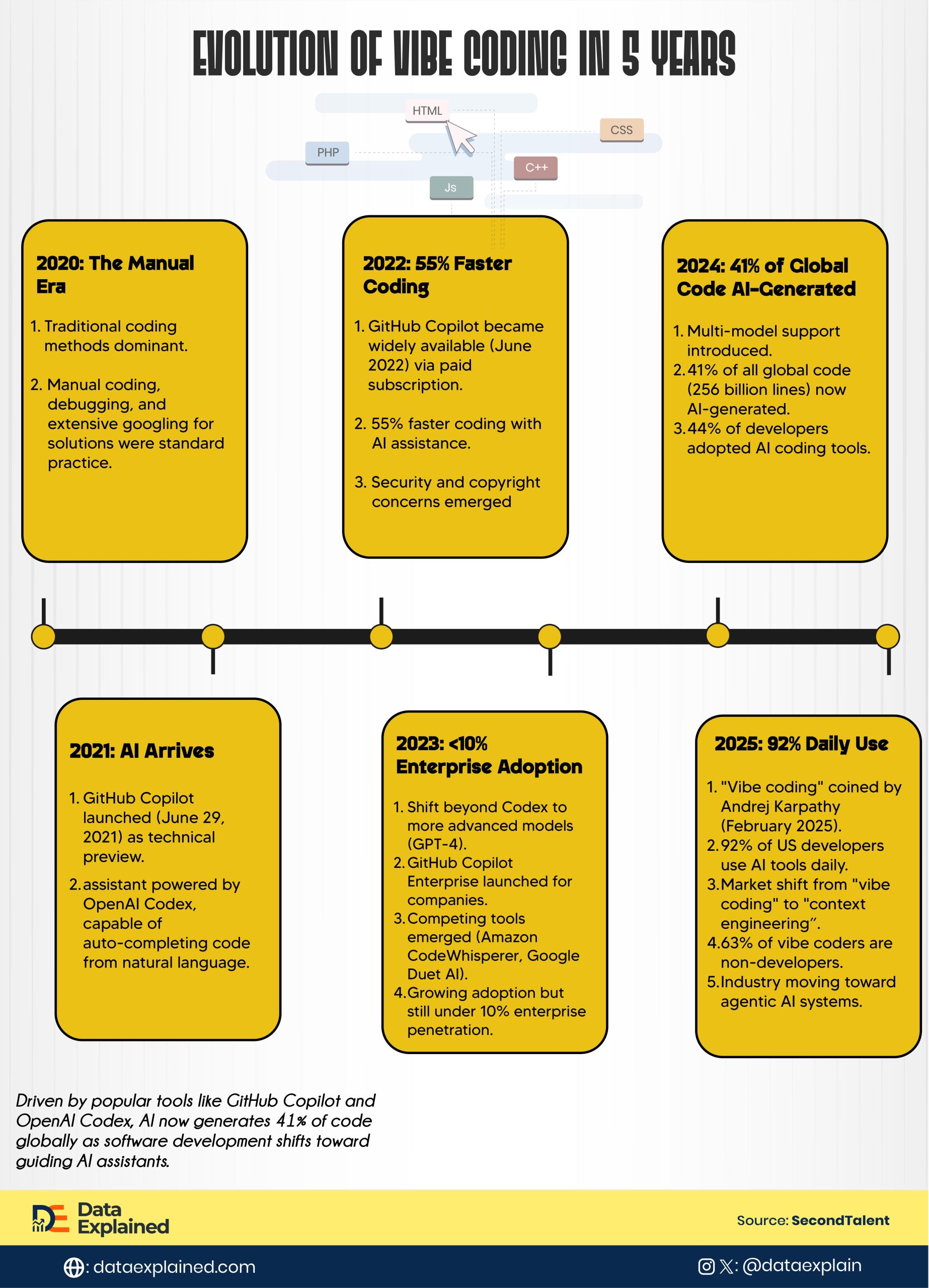
Co-founder of OpenAI, Andrej Karpathy, coined the term “vibe coding” in February 2025.
He used it to describe a new method of software development where programmers guide an AI assistant to generate code through a conversational process, rather than writing it line by line themselves.
It’s becoming the new normal in dev culture as studies have shown 92% of U.S. developers ‘vibe code.’
TL;DR
- The Vibe coding industry is expected to reach a market size of $4.7 billion by 2025 and $12.3 billion by 2027.
- Approximately 92% of developers in the U.S. utilize AI coding tools daily, and AI now generates around 41% of the code worldwide.
- GitHub Copilot, OpenAI Codex, and Amazon CodeWhisperer are the leading players in this space.
Although this niche was given a name in 2025, it had been growing before then.
The data for this timeline explainer is gathered from various AI industry reports, including MIT Technology Review and SecondTalent.
AI Vibe Coding Trend Since 2020
| wdt_ID | wdt_created_by | wdt_created_at | wdt_last_edited_by | wdt_last_edited_at | Year | Key Trends |
|---|---|---|---|---|---|---|
| 1 | Monica Ebunoluwa | 30/07/2026 03:25 PM | Monica Ebunoluwa | 30/07/2026 03:25 PM | 2020 | Traditional coding methods dominant. Manual coding, debugging, and extensive googling for solutions were standard practice. |
| 2 | Monica Ebunoluwa | 30/07/2026 03:25 PM | Monica Ebunoluwa | 30/07/2026 03:25 PM | 2021 | GitHub Copilot launched (June 29, 2021) as a technical preview. First major AI coding assistant powered by OpenAI Codex, capable of auto-completing code from natural language. |
| 3 | Monica Ebunoluwa | 30/07/2026 03:25 PM | Monica Ebunoluwa | 30/07/2026 03:25 PM | 2022 | GitHub Copilot became widely available (June 2022) via paid subscription. 55% faster coding with AI assistance. Security and copyright concerns emerged |
| 4 | Monica Ebunoluwa | 30/07/2026 03:25 PM | Monica Ebunoluwa | 30/07/2026 03:25 PM | 2023 | Shift beyond Codex to more advanced models (GPT-4). GitHub Copilot Enterprise launched for companies. Competing tools emerged (Amazon CodeWhisperer, Google Duet AI). Growing adoption but still under 10% enterprise penetration. |
| 5 | Monica Ebunoluwa | 30/07/2026 03:25 PM | Monica Ebunoluwa | 30/07/2026 03:25 PM | 2024 | Multi-model support introduced. 41% of all global code (256 billion lines) now AI-generated 44% of developers adopted AI coding tools. |
| 6 | Monica Ebunoluwa | 30/07/2026 03:25 PM | Monica Ebunoluwa | 30/07/2026 03:25 PM | 2025 | "Vibe coding" coined by Andrej Karpathy (February 2025). 92% of US developers use AI tools daily. Market shift from "vibe coding" to "context engineering." 63% of vibe coders are non-developers. Industry moving toward agentic AI systems. |
Source: MIT Technology Review
In the last five years, Vibe Coding has evolved from a niche concept to a key component of software development.
Initially, from 2021 to 2022, it focused on testing natural-language prompts but had little impact. By 2023, companies had begun to adopt AI coding tools, leading to broader adoption.
In 2024, developers reported significant productivity gains as many enterprises embraced these tools. However, concerns about privacy, code quality, and a skills gap emerged.
By 2025, nearly all U.S. developers are expected to use AI coding tools daily, with a substantial part of new code generated by AI.
Adoption of Vibe Coding By Industry
| wdt_ID | wdt_created_by | wdt_created_at | wdt_last_edited_by | wdt_last_edited_at | Industry Sector | Adoption Rate |
|---|---|---|---|---|---|---|
| 1 | Monica Ebunoluwa | 30/07/2026 03:34 PM | Monica Ebunoluwa | 30/07/2026 03:34 PM | Tech Startups | 73% |
| 2 | Monica Ebunoluwa | 30/07/2026 03:34 PM | Monica Ebunoluwa | 30/07/2026 03:34 PM | Digital Agencies | 61% |
| 3 | Monica Ebunoluwa | 30/07/2026 03:34 PM | Monica Ebunoluwa | 30/07/2026 03:34 PM | E-commerce | 57% |
| 4 | Monica Ebunoluwa | 30/07/2026 03:34 PM | Monica Ebunoluwa | 30/07/2026 03:34 PM | Financial Services | 34% |
| 5 | Monica Ebunoluwa | 30/07/2026 03:34 PM | Monica Ebunoluwa | 30/07/2026 03:34 PM | Healthcare | 28% |
Source: SecondTalent.
As you can see, Startups and digital agencies take the lead on adopting vibe coding, with 73% and 61% adoption rates, respectively.
This can be linked to fewer old rules and a willingness to experiment.
In contrast, healthcare (28%) and finance (34%) are more cautious of its adoption, mainly using vibe coding for less critical systems.
The bottom line is that DevOps coding has evolved from a new trend to a standard part of many work routines and companies, but its depth of use varies by industry and regulatory requirements.
Market Size of Vibe Coding
| wdt_ID | wdt_created_by | wdt_created_at | wdt_last_edited_by | wdt_last_edited_at | Market Segment | 2025 Market Size | 2027 Market Projection |
|---|---|---|---|---|---|---|---|
| 1 | Monica Ebunoluwa | 30/07/2026 03:41 PM | Monica Ebunoluwa | 30/07/2026 03:41 PM | Enterprise Platforms | $2.8 billion | $7.1 billion |
| 2 | Monica Ebunoluwa | 30/07/2026 03:41 PM | Monica Ebunoluwa | 30/07/2026 03:41 PM | Individual Developer Tools | $1.2 billion | $2.9 billion |
| 3 | Monica Ebunoluwa | 30/07/2026 03:41 PM | Monica Ebunoluwa | 30/07/2026 03:41 PM | No-Code/Low-Code Vibe Tools | $0.7 billion | $2.3 billion |
Source: SecondTalent.
Vibe coding projected growth from $4.7 billion in 2025 to $12.3 billion by 2027 represents a 38% CAGR increase, which is impressive.
There are three main areas in Vibe coding, with Enterprise platforms leading at $2.8 billion, driven by the need for integration and governance.
Individual developer tools are valued at $1.2 billion and projected to reach $2.9 billion by 2027, while No-code platforms, at $0.7 billion, are smaller but growing quickly.
The primary reasons for this growth include advancements in AI, an increase in businesses utilizing these tools, and companies preparing to adopt them.
Tools Most Preferred by Developers in Vibe Coding
| wdt_ID | wdt_created_by | wdt_created_at | wdt_last_edited_by | wdt_last_edited_at | Tool / Platform | Adoption Rate | Key Use Cases |
|---|---|---|---|---|---|---|---|
| 1 | Monica Ebunoluwa | 30/07/2026 03:47 PM | Monica Ebunoluwa | 30/07/2026 03:47 PM | GitHub Copilot | 65% | Auto-completion, boilerplate generation, code suggestions |
| 2 | Monica Ebunoluwa | 30/07/2026 03:47 PM | Monica Ebunoluwa | 30/07/2026 03:47 PM | OpenAI Codex / ChatGPT for Code | 48% | Generating scripts, debugging, prototyping |
| 3 | Monica Ebunoluwa | 30/07/2026 03:47 PM | Monica Ebunoluwa | 30/07/2026 03:47 PM | Amazon CodeWhisperer | 31% | AWS integration, cloud-focused development |
| 4 | Monica Ebunoluwa | 30/07/2026 03:47 PM | Monica Ebunoluwa | 30/07/2026 03:47 PM | Tabnine / Codota | 28% | AI-assisted autocompletion, multi-language support |
| 5 | Monica Ebunoluwa | 30/07/2026 03:47 PM | Monica Ebunoluwa | 30/07/2026 03:47 PM | Replit Ghostwriter | 15% | Web-based coding, quick prototyping |
Source: SecondTalent.
GitHub Copilot is the most popular, used by 65% of developers, as it integrates well with IDEs and provides practical code suggestions.
OpenAI Codex/ChatGPT follows at 48%, especially popular for scripting and prototyping.
Other tools, such as Amazon CodeWhisperer and Tabnine, cater to specific needs, while Replit Ghostwriter is favored for web projects.
ELI5: Evolution of Vibe Coding in 5 Years
Vibe coding stems from the sensation of “vibing” with an AI model to produce functional code in record time. Instead of manually typing every line of code, developers act more like “directors,” guiding AI systems to build applications through conversational prompts.
Five years ago, it was just an experiment. By 2022, AI tools had become more advanced and were assisting with basic coding tasks.
In 2024, developers reported that it boosted their productivity, and companies began using it a lot. Right now, AI generates a substantial amount of code.
Sources:
MIT Technology Review | SecondTalent | Codelevate | Indexdev