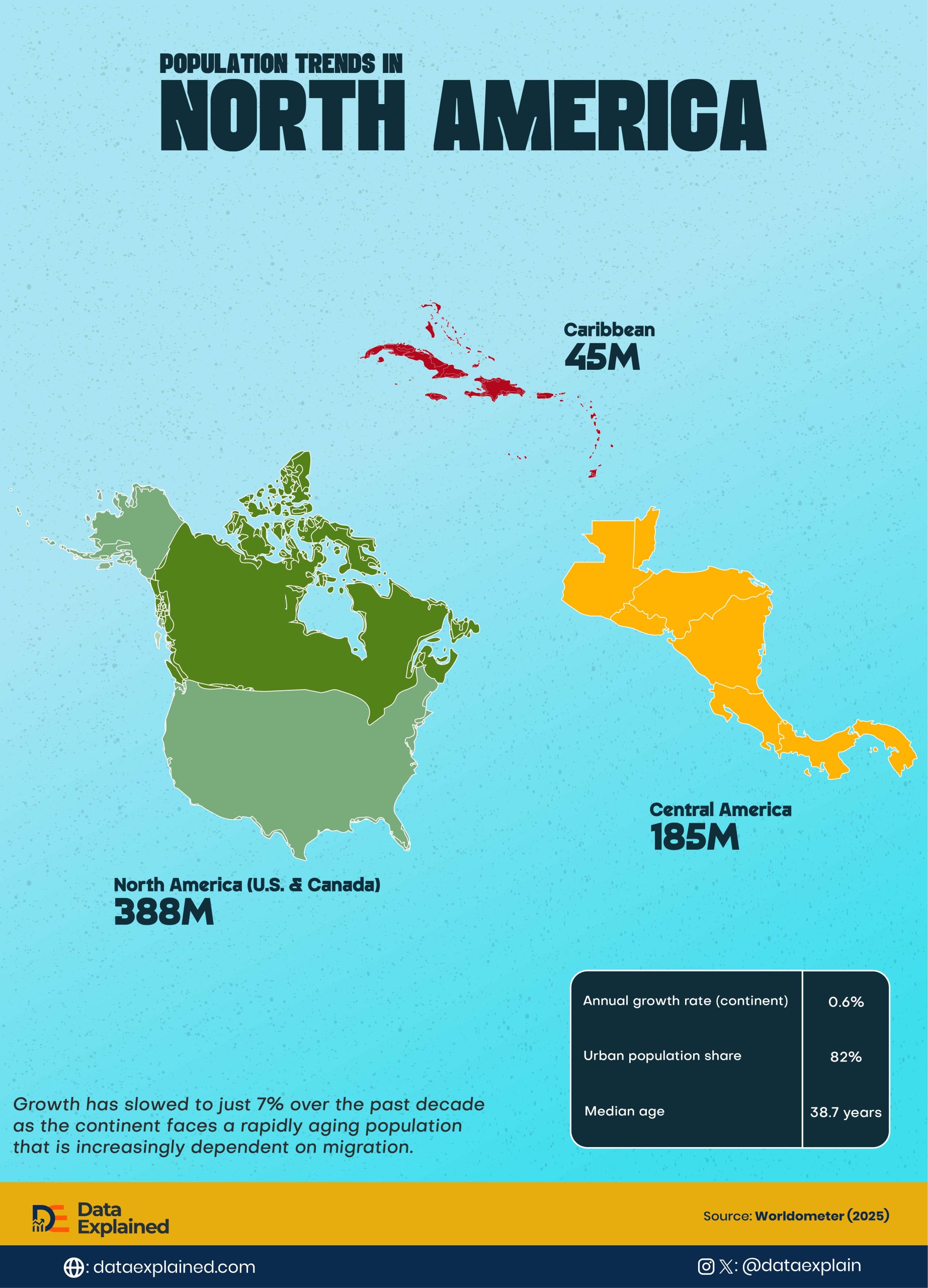
North America’s population is shifting quietly but steadily, growing slower than the global average, aging faster than before, and shaped more by migration than by births.
TL;DR
- North America’s population is estimated at 388 million in October 2025, accounting for 4.71% of the world’s population.
- Over the last 10 years, North America’s population has increased by only 7%.
- The largest populations live in the United States and Mexico, which together account for about 3/4 of the continent’s population.
Population figures and growth estimates are drawn primarily from Worldometer’s latest update, which is verified against the United Nations data.
NOTE: North America in this story refers to the UN subregion of Northern America.
ALSO READ: How Abu Dhabi’s Population Has Boomed Over the Past Decade
North America’s Population in 2025: Size, Growth Rate
| wdt_ID | wdt_created_by | wdt_created_at | wdt_last_edited_by | wdt_last_edited_at | Year | Population |
|---|---|---|---|---|---|---|
| 1 | Monica Ebunoluwa | 21/07/2026 09:59 AM | Monica Ebunoluwa | 21/07/2026 09:59 AM | North America (U.S. & Canada) | 388 million (out of 618 million total) |
| 2 | Monica Ebunoluwa | 21/07/2026 09:59 AM | Monica Ebunoluwa | 21/07/2026 09:59 AM | Central America | 185 million |
| 3 | Monica Ebunoluwa | 21/07/2026 09:59 AM | Monica Ebunoluwa | 21/07/2026 09:59 AM | Caribbean | 45 million |
| 4 | Monica Ebunoluwa | 21/07/2026 09:59 AM | Monica Ebunoluwa | 21/07/2026 09:59 AM | Annual growth rate (continent) | 0.60% |
| 5 | Monica Ebunoluwa | 21/07/2026 09:59 AM | Monica Ebunoluwa | 21/07/2026 09:59 AM | Urban population share | 82% |
| 6 | Monica Ebunoluwa | 21/07/2026 09:59 AM | Monica Ebunoluwa | 21/07/2026 09:59 AM | Median age | 38.7 years |
Source: Worldometer, 2025
North America’s total population in 2025 is estimated at roughly 388 million, with an average annual growth rate of about 0.6%.
Most of this growth comes from North America (the U.S. and Canada), where urbanization and immigration sustain steady expansion despite aging and low fertility.
Together, the U.S. and Mexico account for more than three-quarters of the continent’s population, reflecting how demographic weight remains concentrated in these two countries.
North America vs Central America vs Caribbean
North America’s population landscape isn’t uniform.
North America, led by the United States and Canada, experiences modest population growth, averaging around 0.5–0.6% annually, driven mainly by immigration rather than births.
In 2024, North America received around 39 million international migrants, primarily from Latin America and the Caribbean, and Eastern and South-Eastern Asia.
Further south, Central America and the Caribbean tell a different story.
Central America’s population is expanding faster, supported by higher fertility and younger age structures, though migration to the U.S. tempers overall gains.
The Caribbean, with a population of roughly 45 million, is growing the slowest, with several islands experiencing stagnant or negative growth due to emigration and aging.
Future Projections: What Demographers Forecast Through 2050
| wdt_ID | wdt_created_by | wdt_created_at | wdt_last_edited_by | wdt_last_edited_at | Year | Population Estimate (North America) |
|---|---|---|---|---|---|---|
| 1 | emmanuel-ashemiriogwa | 23/07/2026 03:16 PM | emmanuel-ashemiriogwa | 23/07/2026 03:16 PM | 2025 | 388 |
| 2 | emmanuel-ashemiriogwa | 23/07/2026 03:16 PM | emmanuel-ashemiriogwa | 23/07/2026 03:16 PM | 2030 | 397 |
| 3 | emmanuel-ashemiriogwa | 23/07/2026 03:16 PM | emmanuel-ashemiriogwa | 23/07/2026 03:16 PM | 2035 | 406 |
| 4 | emmanuel-ashemiriogwa | 23/07/2026 03:16 PM | emmanuel-ashemiriogwa | 23/07/2026 03:16 PM | 2040 | 414 |
| 5 | emmanuel-ashemiriogwa | 23/07/2026 03:16 PM | emmanuel-ashemiriogwa | 23/07/2026 03:16 PM | 2045 | 421 |
| 6 | emmanuel-ashemiriogwa | 23/07/2026 03:16 PM | emmanuel-ashemiriogwa | 23/07/2026 03:16 PM | 2050 | 427 |
Over the next few decades, North America’s population is expected to continue growing, but at a more moderate pace than in prior eras.
Population structures will age, with more people over 60 and fewer under 15, reshaping labor markets and healthcare systems.
The U.S. alone is projected to reach around 371 million by 2050, according to a study by the Cooper Center (benchmarked on 2020 Census data).
Crucially, much of the growth will hinge on migration and reductions in mortality rates.
With fertility rates staying below replacement levels, natural increase (births minus deaths) will likely contribute less over time, especially in North America.
Meanwhile, the share of older adults (65+) in the population is forecast to expand significantly.
The aging trend will intensify dependency burdens and shift demands in health, pensions, and social support systems.
ELI5: North America’s Population Trend in a Nutshell
North America’s population is still growing, but slowly.
Most people live in the U.S. and Mexico, while smaller regions like Central America and the Caribbean are growing at different speeds.
Women don’t give birth at a higher rate in North America than in some other regions, such as Africa. So, the main reason the population is rising now is that people are moving in from other countries.
Over time, this means there will be more older people and fewer young ones.
By 2050, the continent will have more people overall, but they’ll be older, more urban, and more dependent on migration to keep the population from shrinking.
Sources: