The 2026 FIFA World Cup is the world’s single largest television advertising event.
Billions of people are watching matches on broadcast platforms. Rights holders sold premium inventory at record rates.
However, the media channel through which people are watching the tournament the most (TV) isn’t the one most marketers think pays off for advertising.
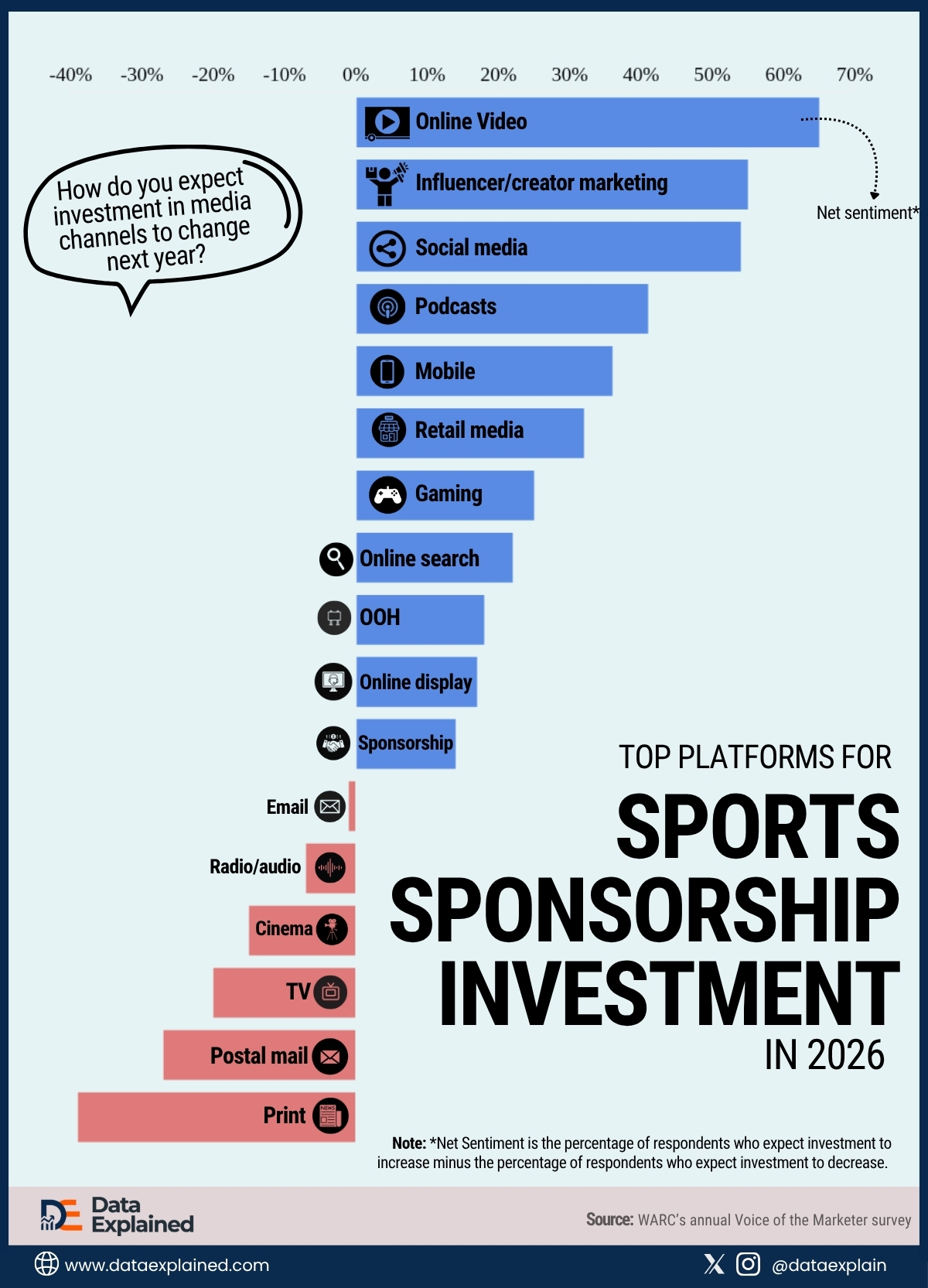
The infographic above is based on a 2025 survey of marketers by WARC.
They were asked about their sentiment on where they expect more investment across 17 media channels next year.
Net Sentiment equals the percentage of respondents who expect investment to increase minus the percentage of respondents who expect investment to decrease.
Online video leads all media channels in net investment sentiment, at +65%. TV has a net investment sentiment of -20%.
TL;DR
- TV sits at -20% (the 2026 FIFA World Cup, the world’s single largest television advertising event, is occurring simultaneously with net negative marketer sentiment for the medium carrying it
- Sponsorship (the channel encompassing FIFA’s official partners, shirt sponsors, and stadium naming rights) has the lowest positive sentiment among positive channels.
| wdt_ID | wdt_created_by | wdt_created_at | wdt_last_edited_by | wdt_last_edited_at | Marketing Channel | Net Sentiment (%) |
|---|---|---|---|---|---|---|
| 1 | emmanuel-ashemiriogwa | 24/06/2026 09:20 AM | emmanuel-ashemiriogwa | 24/06/2026 09:20 AM | Online video | 65 |
| 2 | emmanuel-ashemiriogwa | 24/06/2026 09:20 AM | emmanuel-ashemiriogwa | 24/06/2026 09:20 AM | Influencer/creator marketing | 55 |
| 3 | emmanuel-ashemiriogwa | 24/06/2026 09:20 AM | emmanuel-ashemiriogwa | 24/06/2026 09:20 AM | Social media | 54 |
| 4 | emmanuel-ashemiriogwa | 24/06/2026 09:20 AM | emmanuel-ashemiriogwa | 24/06/2026 09:20 AM | Podcasts | 41 |
| 5 | emmanuel-ashemiriogwa | 24/06/2026 09:20 AM | emmanuel-ashemiriogwa | 24/06/2026 09:20 AM | Mobile | 36 |
| 6 | emmanuel-ashemiriogwa | 24/06/2026 09:20 AM | emmanuel-ashemiriogwa | 24/06/2026 09:20 AM | Retail media | 32 |
| 7 | emmanuel-ashemiriogwa | 24/06/2026 09:20 AM | emmanuel-ashemiriogwa | 24/06/2026 09:20 AM | Gaming | 25 |
| 8 | emmanuel-ashemiriogwa | 24/06/2026 09:20 AM | emmanuel-ashemiriogwa | 24/06/2026 09:20 AM | Online search | 22 |
| 9 | emmanuel-ashemiriogwa | 24/06/2026 09:20 AM | emmanuel-ashemiriogwa | 24/06/2026 09:20 AM | OOH | 18 |
| 10 | emmanuel-ashemiriogwa | 24/06/2026 09:20 AM | emmanuel-ashemiriogwa | 24/06/2026 09:20 AM | Online display | 17 |
ALSO READ: World Cup To Create More Jobs Outside US Than Inside It, FIFA Analysis Shows
WARC’s Voice of the Marketer 2026 measures net sentiment across 17 media channels (the percentage of marketing professionals expecting to increase investment minus those expecting to decrease it).
The spread between the most and least favored channels is 104 percentage points.
Online video sits at the top at +65%. Print sits at the bottom at -39%.
Where the World Cup’s Extra Advertising Goes
Four minutes and 20 seconds per match. Seven hours, 30 minutes, and 40 seconds across the entire 2026 tournament.
That is the additional advertising inventory created by mandatory hydration breaks (available to commercial broadcasters in markets where the BBC and ITV are not showing the games).
Viewers on those services see punditry and player interviews. Viewers everywhere else see advertising.
That inventory does not flow into the channels marketing professionals are most negative about.
It flows into online video (pre-rolls, mid-rolls, and branded content in streaming environments), which carries the highest positive sentiment of any channel in the dataset at +65%.
The World Cup’s additional advertising time is landing in exactly the channel the industry is most enthusiastic about, at exactly the moment it is pulling back from the broadcast medium that carries the matches.
ALSO READ: FIFA World Cup: 96 Years of Data Narrows to 3 Realistic Winners
TV’s Structural Position
The paradox is not that the World Cup is generating TV advertising revenue; it is.
In fact, premium World Cup broadcast slots have sold at premium prices.
The paradox is that when asked about their medium-term investment intentions beyond the event cycle, marketers are net negative on the medium by 20 points.
The World Cup represents the kind of exception that does not change a trend.
Major live sports events justify TV advertising investment in a way that regular scheduling does not. But the WARC data captures intent for the year ahead, and in the year ahead, more marketers plan to reduce their TV investment than increase it.
So, What?
The advertising industry’s channel map is clearly defined in the WARC Voice of the Marketer 2026 data.
Digital grows and traditional retreats.
The line between the two categories corresponds almost perfectly with the line between positive and negative net sentiment across all 17 channels measured.
The World Cup of 2026 is the world’s most-watched sporting event, being broadcast on a medium that the industry is paying for, which is structurally negative.
Indeed, the matches are on TV, but the budgets are heading to the phone screen.
ELI5 (Explain It Like I’m 5)
Marketing people were asked where they plan to spend more money on ads next year. Online video came first at +65% positive. TV came in at -20%, meaning more people want to spend LESS on TV ads than more.
The World Cup is the biggest TV ad event in the world, but it’s happening as advertisers shift their money to YouTube-style videos, social media, and influencers instead. Print ads (like newspapers) are the most abandoned at -39%.
Source:
WARC, Voice of the Marketer 2026.