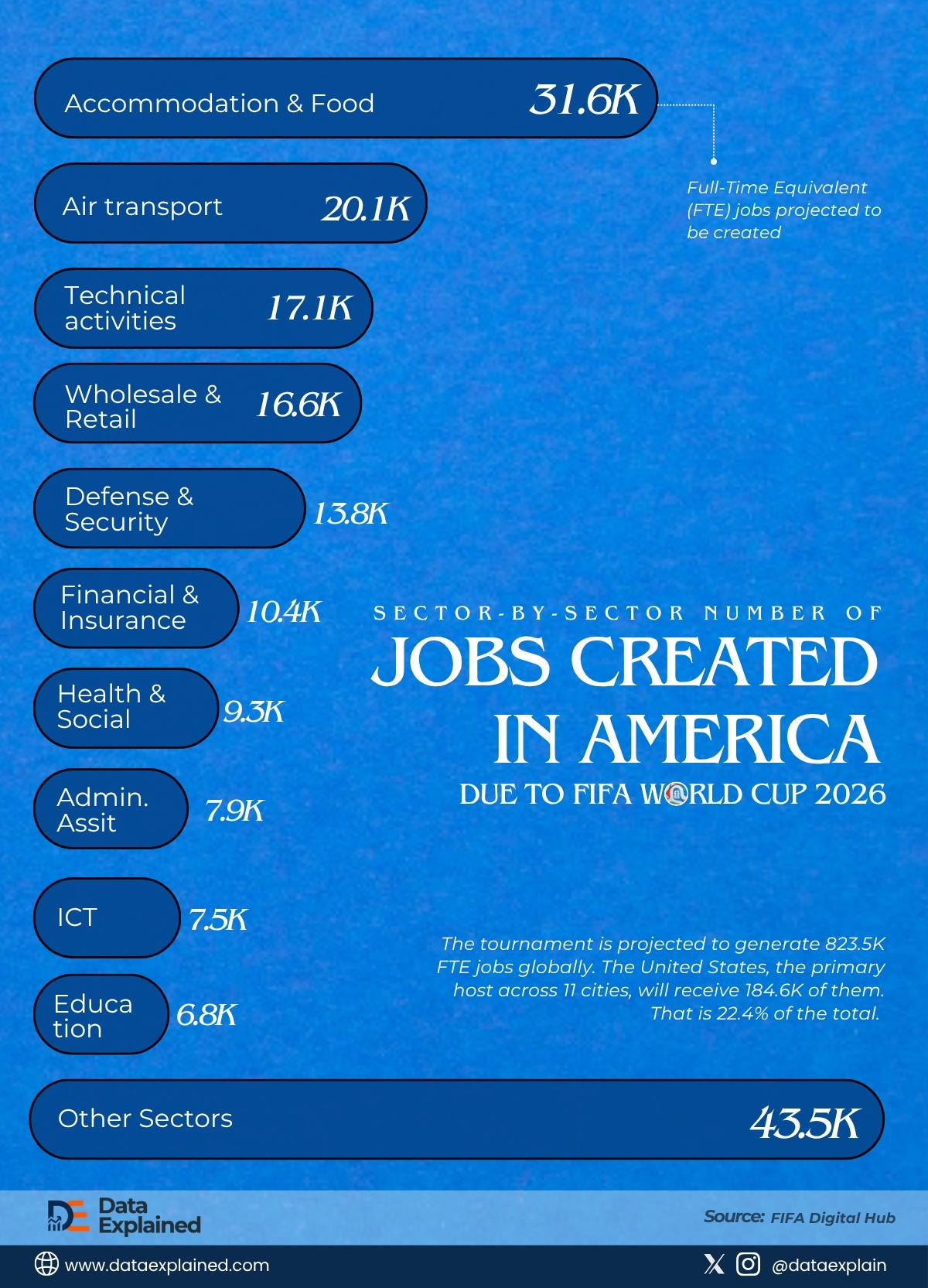
The United States is hosting the World Cup. Most of the jobs it creates will be somewhere else.
According to FIFA’s own socioeconomic impact analysis, published in March 2025 and available through the FIFA Digital Hub, the 2026 World Cup will generate 823,474 Full-Time Equivalent (FTE) jobs globally.
The United States, the primary host across 11 cities, will receive 184,679 of them.
That is 22.4% of the total.
The other 638,796 FTEs, representing 77.6% of all employment generated by a tournament hosted in America, will be created in countries not hosting it.
TL;DR
- The infographic shows the distribution of jobs in the U.S. economy due to the ongoing FIFA World Cup tournament.
- Defense and Security is the fifth-largest employment sector in the US with 13,822 FTE jobs. That’s publicly funded positions that appear as an economic benefit in FIFA’s employment count.
| wdt_ID | wdt_created_by | wdt_created_at | wdt_last_edited_by | wdt_last_edited_at | U.S. Sector | Full-Time Employee Jobs Added |
|---|---|---|---|---|---|---|
| 1 | emmanuel-ashemiriogwa | 18/06/2026 12:53 PM | emmanuel-ashemiriogwa | 18/06/2026 12:53 PM | Accommodation & Food | 31,660 |
| 2 | emmanuel-ashemiriogwa | 18/06/2026 12:53 PM | emmanuel-ashemiriogwa | 18/06/2026 12:53 PM | Air transport | 20,055 |
| 3 | emmanuel-ashemiriogwa | 18/06/2026 12:53 PM | emmanuel-ashemiriogwa | 18/06/2026 12:53 PM | Technical activities | 17,097 |
| 4 | emmanuel-ashemiriogwa | 18/06/2026 12:53 PM | emmanuel-ashemiriogwa | 18/06/2026 12:53 PM | Wholesale & Retail | 16,605 |
| 5 | emmanuel-ashemiriogwa | 18/06/2026 12:53 PM | emmanuel-ashemiriogwa | 18/06/2026 12:53 PM | Defense & Security | 13,822 |
| 6 | emmanuel-ashemiriogwa | 18/06/2026 12:53 PM | emmanuel-ashemiriogwa | 18/06/2026 12:53 PM | Financial & Insurance | 10,368 |
| 7 | emmanuel-ashemiriogwa | 18/06/2026 12:53 PM | emmanuel-ashemiriogwa | 18/06/2026 12:53 PM | Health & Social | 9,293 |
| 8 | emmanuel-ashemiriogwa | 18/06/2026 12:53 PM | emmanuel-ashemiriogwa | 18/06/2026 12:53 PM | Administrative Assistance | 7,924 |
| 9 | emmanuel-ashemiriogwa | 18/06/2026 12:53 PM | emmanuel-ashemiriogwa | 18/06/2026 12:53 PM | ICT | 7,524 |
| 10 | emmanuel-ashemiriogwa | 18/06/2026 12:53 PM | emmanuel-ashemiriogwa | 18/06/2026 12:53 PM | Education | 6,837 |
ALSO READ: Visualized: Stadiums Hosting the Most & Least FIFA World Cup Games
What Does this Mean?
According to the sports organization, the World Cup “generates relatively fewer jobs in the U.S. due to structural features of the labor market, where employment is predominantly concentrated among high-skilled, high-wage workers.”
In plain terms, it means American workers earn more per job than workers in lower-wage economies, so the same dollar of World Cup spending generates fewer FTE units in the US than it would elsewhere.
A tourism dollar spent in a country with lower labor costs creates more FTE jobs per dollar spent.
A tourism dollar spent in the United States creates fewer FTE jobs but higher-income ones.
The employment number is lower because the wages are higher.
Where the U.S. Jobs Land
Within the 184,679 U.S. FTEs, Accommodation and Food leads at 31,660.
That’s the expected result for a tournament driving millions of visitor hotel nights and restaurant meals across 11 cities.
Air Transport follows at 20,055, while Technical Activities sits third at 17,097.
ALSO READ: FIFA Says World Cup Will Add $17B to US Economy; Here’s Where The Money Goes
Where the Rest of the World’s Jobs Go
The 638,796 FTEs in non-hosting countries follow a different distribution.
Wholesale and retail top the non-US employment sectors at 72,167 FTEs, more than four times the US retail figure of 16,605.
FIFA-licensed merchandise, replica kits, branded products, and tournament goods are primarily manufactured and sold through supply chains in lower-wage economies.
The jobs created by hundreds of millions of people buying World Cup products globally are not in the United States.
Defense and Security in non-hosting countries generate 48,853 FTEs, 3.5 times the US security figure
So, What?
Cities and states across the United States have spent years preparing bids, upgrading venues, and investing in infrastructure, in part based on the employment case for hosting.
The FIFA projection supports a specific and honest version of that case: the tournament creates 185,000 FTE jobs in the US, concentrated in aviation, hospitality, technical services, and security.
Those jobs are real; many are well compensated, and they are distributed across 11 cities during a period of intensive economic activity.
The projection also shows that the employment rationale for hosting is a weaker argument than the GDP rationale.
The $17.148 billion in projected US GDP impact translates into 184,679 FTE jobs and approximately $92,880 in GDP per FTE, consistent with a high-wage economy.
The employment headcount is modest relative to the economic impact because the average job created is well-paid.
ELI5 (Explain It Like I’m 5)
The World Cup will create about 823,000 jobs worldwide, but only 185,000 of them are in America, even though America is hosting it. Most jobs (about 639,000) are in other countries, mainly because cheap merchandise gets made abroad and supply chains are global. FIFA’s own report says America gets fewer jobs than you’d expect because American workers are paid more, so the same money creates fewer but better-paying jobs. The largest US job category is hotels and food services.
Source:
FIFA World Cup 2026 Socioeconomic Impact Analysis, published March 2025.