Japan and the United States are China’s most consequential strategic rivals. They are also its two largest customers for rare earth metals and compounds.
These compounds are materials inside fighter jets, electric vehicle motors, missile guidance systems, and wind turbines.
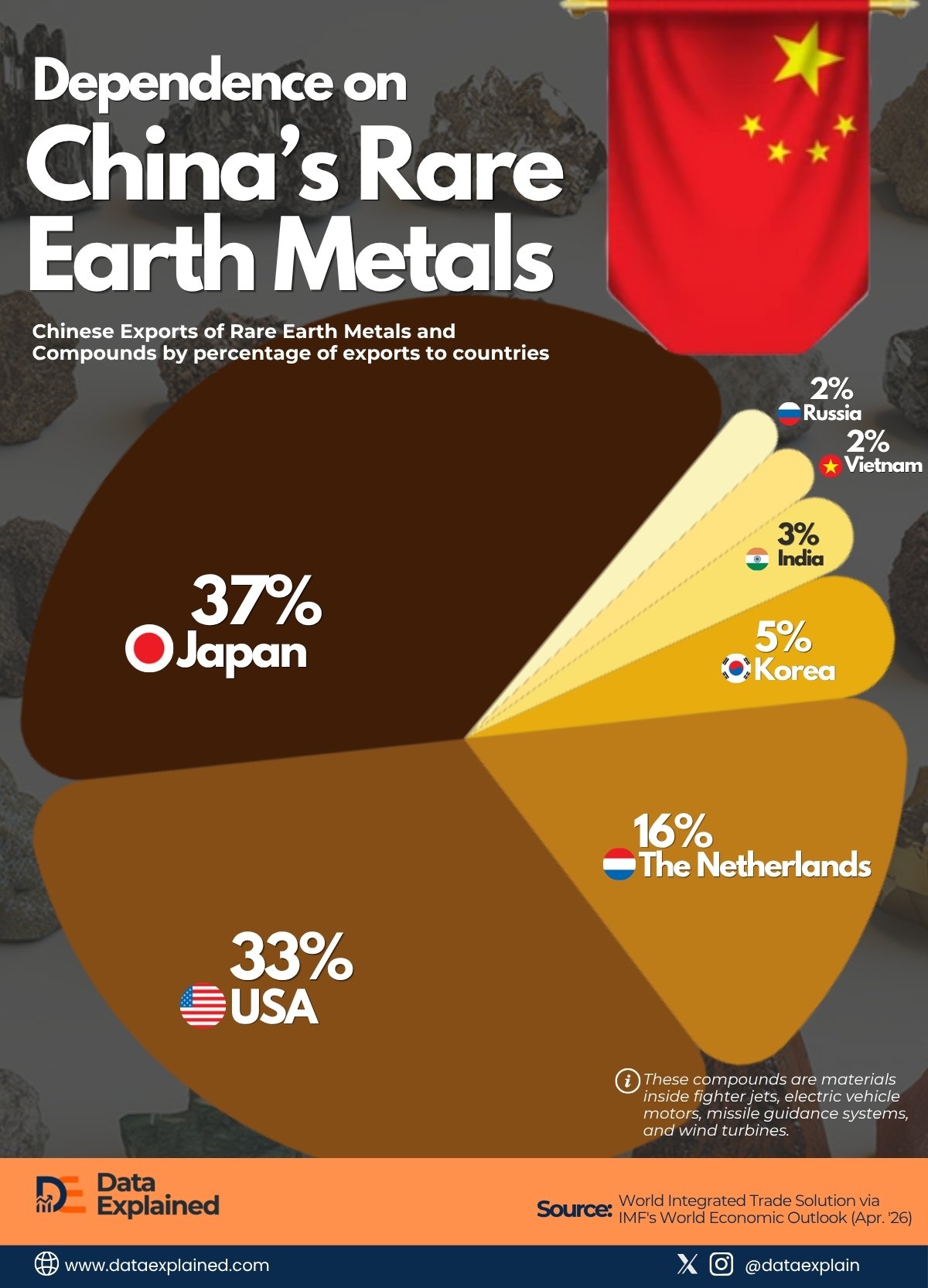
Today’s infographic shows Chinese Exports of Rare Earth Metals and Compounds by country.
The data comes from the IMF’s World Economic Outlook published in April 2026. It was actually sourced from World Integrated Trade Solution data.
TL;DR
- Japan receives 37% of China’s rare earth exports, and the United States receives 33%.
- Together, they absorb 70% of the supply that China controls and that no other country has replicated at an industrial scale.
| wdt_ID | wdt_created_by | wdt_created_at | wdt_last_edited_by | wdt_last_edited_at | Country | Percentage Share |
|---|---|---|---|---|---|---|
| 1 | emmanuel-ashemiriogwa | 26/04/2026 01:12 AM | emmanuel-ashemiriogwa | 26/04/2026 01:12 AM | Japan | 37 |
| 2 | emmanuel-ashemiriogwa | 26/04/2026 01:12 AM | emmanuel-ashemiriogwa | 26/04/2026 01:12 AM | United States | 33 |
| 3 | emmanuel-ashemiriogwa | 26/04/2026 01:12 AM | emmanuel-ashemiriogwa | 26/04/2026 01:12 AM | The Netherlands | 16 |
| 4 | emmanuel-ashemiriogwa | 26/04/2026 01:12 AM | emmanuel-ashemiriogwa | 26/04/2026 01:12 AM | Korea | 5 |
| 5 | emmanuel-ashemiriogwa | 26/04/2026 01:12 AM | emmanuel-ashemiriogwa | 26/04/2026 01:12 AM | India | 3 |
| 6 | emmanuel-ashemiriogwa | 26/04/2026 01:12 AM | emmanuel-ashemiriogwa | 26/04/2026 01:12 AM | Russia | 2 |
| 7 | emmanuel-ashemiriogwa | 26/04/2026 01:12 AM | emmanuel-ashemiriogwa | 26/04/2026 01:12 AM | Vietnam | 2 |
CONTEXT MATTERS
The IMF does not include charts in its flagship economic assessment without purpose.
A rare-earth export destination map appearing in the April 2026 World Economic Outlook is the institution’s way of flagging supply concentration as a systemic macroeconomic risk.
It’s not a supply chain management challenge for individual companies, but a structural vulnerability at the level of global economic stability.
Two-Country Concentration
Seven named destinations account for virtually all of China’s rare earth export flows. Two of them account for 70%.
Japan has no significant domestic rare earth deposits.
Its hybrid-vehicle manufacturing, consumer-electronics sector, and defense-components industry depend entirely on imported supply.
In 2010, China halted rare-earth shipments to Japan for approximately two months amid a territorial dispute over the Senkaku/Diaoyu Islands.
Rare earth prices spiked globally. And, Japan launched a national diversification strategy.
Fifteen years later, Japan still receives more Chinese rare-earth exports than any other country on Earth.
The United States, at 33%, presents a different kind of contradiction.
American defense contractors (including Lockheed Martin and Raytheon) use rare earth elements in F-35 fighter jets, guided missiles, and radar systems.
The Pentagon’s hardware supply chain runs through China for materials used in the weapons systems the United States deploys globally.
In April 2025, China imposed export controls on seven rare earth elements, including terbium, dysprosium, and yttrium.
That’s precisely the heavy rare earths used in defense applications.
The Processing Gap
China produces approximately 60-70% of the global rare earth ore.
More critically, it processes an estimated 85-90% of the global rare earth supply into usable industrial compounds.
The United States mines rare earth ore at its Mountain Pass facility in California. It processes almost none domestically.
Much of that ore is shipped to China for refining and returns as compounds that count toward America’s 33% import share. The United States is effectively buying back its own geology in Chinese-processed form.
Clean Energy Complication
Neodymium and dysprosium are in the permanent magnets inside every major electric vehicle motor and wind turbine generator.
The countries most committed to accelerating EV adoption and renewable energy deployment are also the ones most dependent on Chinese rare-earth processing.
The clean energy transition and the rare earth supply chain are the same supply chain.
ELI5
China controls most of the world’s supply of rare earth metals. These are special materials used in fighter jets, electric cars, and phone screens. New IMF data show Japan receives 37% of China’s rare earth exports, and America receives 33% (even though both countries are in major disputes with China). Despite knowing this for years, neither country has found a way to stop depending on China for these critical materials.
Source:
IMF World Economic Outlook, April 2026