
Last year, 2025, stood out as both active and deadly for earthquakes, with 16 major events claiming roughly 8,000 lives.
Zooming out, the impact isn’t evenly spread. Some countries face these disasters far more frequently than others.
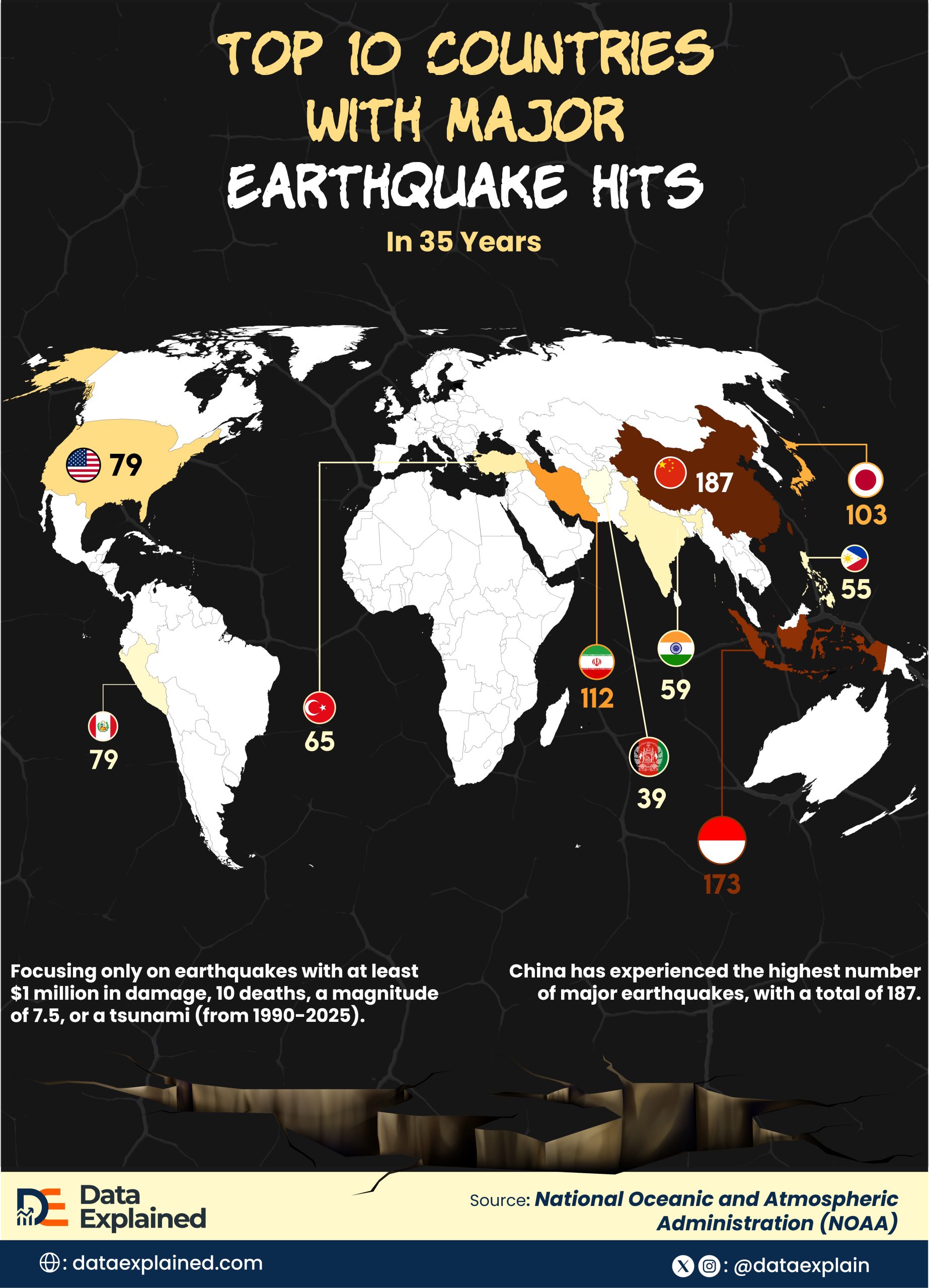
Drawing on data from the National Oceanic and Atmospheric Administration (NOAA), this graphic highlights the countries most affected by major earthquakes between 1990 and 2025.
For consistency, only significant events are included—those that caused at least $1 million in damage, resulted in 10 or more deaths, registered a magnitude of 7.5 or higher, or triggered a tsunami.
TL;DR
- In the last 35 years, China has experienced the highest number of major earthquakes, with a total of 187.
- Some regions experience frequent seismic activity because they lie along major tectonic plate boundaries where plates move.
Countries Hit by the Most Earthquakes, Ranked
| wdt_ID | wdt_created_by | wdt_created_at | wdt_last_edited_by | wdt_last_edited_at | Country | Number of Earthquakes |
|---|---|---|---|---|---|---|
| 1 | Monica Ebunoluwa | 08/04/2026 02:58 PM | Monica Ebunoluwa | 08/04/2026 02:58 PM | China | 187 |
| 2 | Monica Ebunoluwa | 08/04/2026 02:58 PM | Monica Ebunoluwa | 08/04/2026 02:58 PM | Indonesia | 173 |
| 3 | Monica Ebunoluwa | 08/04/2026 02:58 PM | Monica Ebunoluwa | 08/04/2026 02:58 PM | Iran | 112 |
| 4 | Monica Ebunoluwa | 08/04/2026 02:58 PM | Monica Ebunoluwa | 08/04/2026 02:58 PM | Japan | 103 |
| 5 | Monica Ebunoluwa | 08/04/2026 02:58 PM | Monica Ebunoluwa | 08/04/2026 02:58 PM | United States | 79 |
| 6 | Monica Ebunoluwa | 08/04/2026 02:58 PM | Monica Ebunoluwa | 08/04/2026 02:58 PM | Turkey | 65 |
| 7 | Monica Ebunoluwa | 08/04/2026 02:58 PM | Monica Ebunoluwa | 08/04/2026 02:58 PM | India | 59 |
| 8 | Monica Ebunoluwa | 08/04/2026 02:58 PM | Monica Ebunoluwa | 08/04/2026 02:58 PM | Philippines | 55 |
| 9 | Monica Ebunoluwa | 08/04/2026 02:58 PM | Monica Ebunoluwa | 08/04/2026 02:58 PM | Peru | 51 |
| 10 | Monica Ebunoluwa | 08/04/2026 02:58 PM | Monica Ebunoluwa | 08/04/2026 02:58 PM | Afghanistan | 39 |
Countries like China, Indonesia, Japan, and Iran experience the most earthquakes because they lie along major tectonic plate boundaries.
This includes the Pacific Ring of Fire and the Alpine-Himalayan belt, where plates collide, slide, or pull apart.
The constant movements build up pressure beneath the Earth’s surface, causing the quakes.
When that pressure is released, earthquakes range from small tremors to powerful, destructive events.
Since millions of people live in these high-risk zones, earthquakes in these countries mostly have a greater impact on lives, infrastructure, and economies than in regions with lower activity.
Why Are These Countries So Active?
Many of the countries prone to quakes are located along the Pacific Ring of Fire, a vast, horseshoe-shaped region that encircles the Pacific Ocean.
This is where some of the world’s most active tectonic plates are found.
The constant movement and collision of these plates create frequent earthquakes, volcanic eruptions, and other seismic events, making these countries vulnerable.
Major Historical Earthquake Activity
Some of the world’s most devastating earthquakes have occurred in countries along active tectonic zones.
For instance:
- Japan’s 2011 Tōhoku earthquake reached a magnitude of 9.1, triggering a massive tsunami and the Fukushima nuclear disaster.
- In Indonesia, the 2004 Sumatra-Andaman earthquake, with a magnitude of 9.1, caused a catastrophic tsunami that killed about 228,000 people across multiple countries, according to NOAA.
- Turkey’s 1999 İzmit earthquake, with a magnitude of 7.6, destroyed neighborhoods and claimed tens of thousands of lives
- Chile’s 1960 Valdivia earthquake, with a magnitude of 9.5, was the strongest recorded earthquake in modern history.
These events highlight the power of tectonic forces in regions along subduction zones and transform faults.
Historical earthquake records show that countries in these high-risk zones encounter recurring seismic hazards, not only from one-off significant events but also from frequent moderate tremors.
Impact vs Frequency
Frequent earthquakes are mostly small or moderate, so they rarely cause widespread destruction.
For example, Japan experiences thousands of minor tremors yearly, but most cause little damage due to strict building codes and preparedness.
In contrast, rare quakes can be extremely dangerous.
The 2004 Sumatra-Andaman earthquake and the 2010 Haiti earthquake caused massive loss of life and destruction, even though such events are not frequent in those regions.
NOTE: There’s the factor of violent shaking with considerable structural damage (MMIX), but in many datasets, especially older or sparsely reported events, evidence is insufficient to confidently classify impacts at this level. As a result, NOAA may underrepresent or omit MMIX classifications to maintain data reliability. This ensures consistency but can slightly underestimate extreme localized damage, particularly in regions with limited instrumentation or incomplete historical records.
ELI5
Earthquakes hit different countries with different magnitudes and effects.
Countries like China, Indonesia, Japan, and Iran get earthquakes most often because they are located along active tectonic plate boundaries where the Earth’s crust constantly moves.
Most of these quakes are small and cause minor damage.
Still, occasionally, rare, powerful earthquakes can strike and be very destructive, reminding us why these regions are always on high alert.
Source: