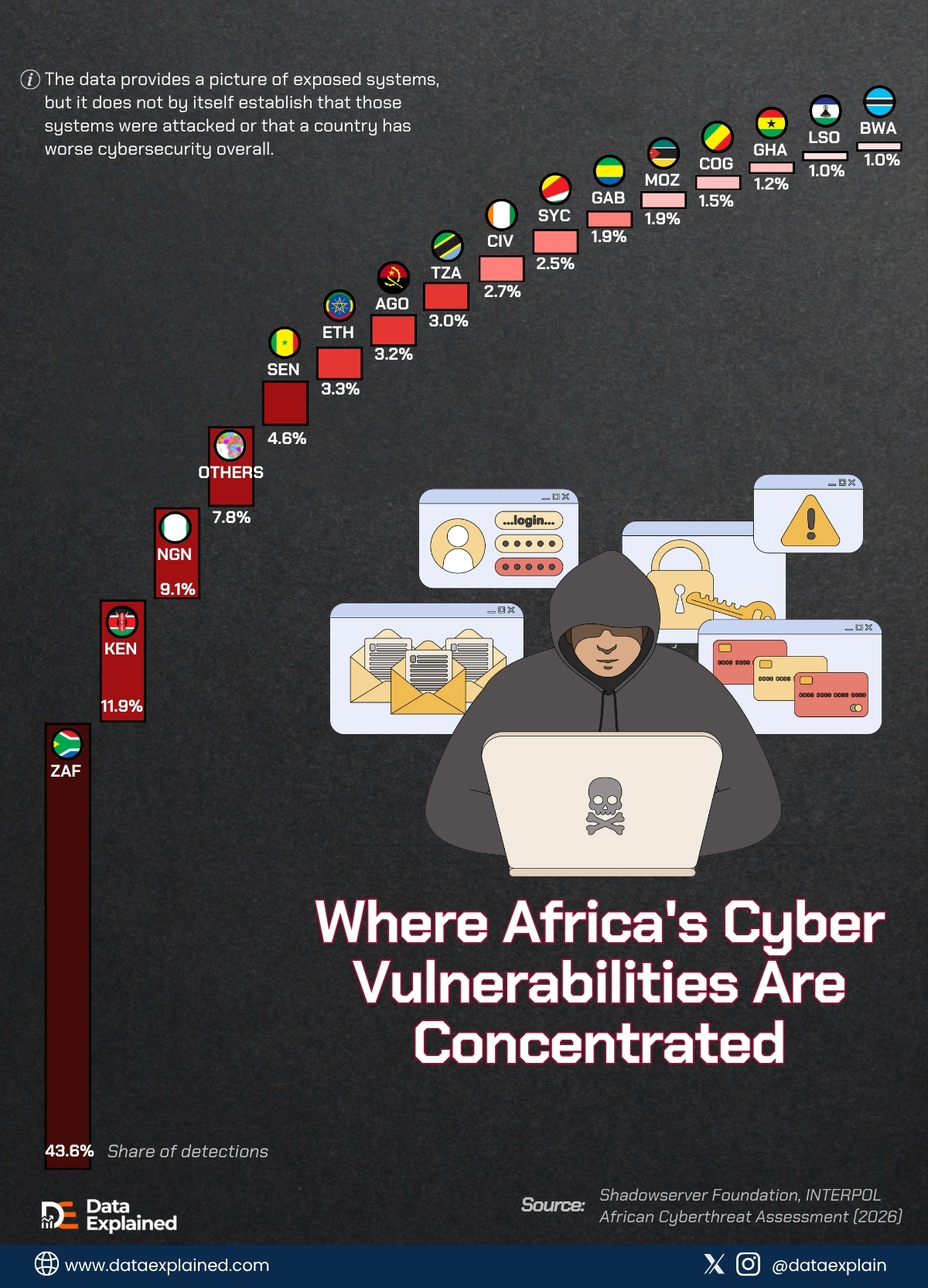
Africa’s cyber-vulnerability matter is heavily concentrated in a handful of countries.
South Africa alone accounted for 43.6% of detected vulnerabilities in 2025.
This is according to data from the Shadowserver Foundation cited in the INTERPOL African Cyberthreat Assessment published in June 2026.
It paints a striking picture of where vulnerable digital infrastructure was being detected across the continent.
TL;DR
- South Africa accounts for 43.6% of detected vulnerabilities.
- Three countries make up 64.6% of the total.
- The data shows concentration, not necessarily more cyberattacks.
ALSO READ: Countries With The Most Data Breaches In 2026
South Africa Stands Apart
| wdt_ID | wdt_created_by | wdt_created_at | wdt_last_edited_by | wdt_last_edited_at | Rank | Country | Share (%) |
|---|---|---|---|---|---|---|---|
| 1 | emmanuel-ashemiriogwa | 08/08/2026 04:27 PM | emmanuel-ashemiriogwa | 08/08/2026 04:27 PM | 1 | South Africa | 43.60 |
| 2 | emmanuel-ashemiriogwa | 08/08/2026 04:27 PM | emmanuel-ashemiriogwa | 08/08/2026 04:27 PM | 2 | Kenya | 11.90 |
| 3 | emmanuel-ashemiriogwa | 08/08/2026 04:27 PM | emmanuel-ashemiriogwa | 08/08/2026 04:27 PM | 3 | Nigeria | 9.10 |
| 4 | emmanuel-ashemiriogwa | 08/08/2026 04:27 PM | emmanuel-ashemiriogwa | 08/08/2026 04:27 PM | 4 | Senegal | 4.60 |
| 5 | emmanuel-ashemiriogwa | 08/08/2026 04:27 PM | emmanuel-ashemiriogwa | 08/08/2026 04:27 PM | 5 | Ethiopia | 3.30 |
| 6 | emmanuel-ashemiriogwa | 08/08/2026 04:27 PM | emmanuel-ashemiriogwa | 08/08/2026 04:27 PM | 6 | Angola | 3.20 |
| 7 | emmanuel-ashemiriogwa | 08/08/2026 04:27 PM | emmanuel-ashemiriogwa | 08/08/2026 04:27 PM | 7 | Tanzania | 3.00 |
| 8 | emmanuel-ashemiriogwa | 08/08/2026 04:27 PM | emmanuel-ashemiriogwa | 08/08/2026 04:27 PM | 8 | Côte d’Ivoire | 2.70 |
| 9 | emmanuel-ashemiriogwa | 08/08/2026 04:27 PM | emmanuel-ashemiriogwa | 08/08/2026 04:27 PM | 9 | Seychelles | 2.50 |
| 10 | emmanuel-ashemiriogwa | 08/08/2026 04:27 PM | emmanuel-ashemiriogwa | 08/08/2026 04:27 PM | 10 | Gabon | 1.90 |
South Africa’s lead is difficult to miss.
Its 43.6% share was more than the combined shares of the next five countries: Kenya, Nigeria, Senegal, Ethiopia and Angola.
Kenya ranked second at 11.9%, followed by Nigeria at 9.1%.
Senegal accounted for 4.6%, while Ethiopia and Angola recorded 3.3% and 3.2%, respectively.
The concentration becomes even clearer further down the ranking.
The top 10 countries accounted for about 85.8% of the distribution, leaving all the remaining countries with a relatively small share.
A surprising outlier
One of the more unusual figures is Seychelles.
The island nation accounted for 2.5% of detected vulnerabilities, placing it ahead of larger economies such as Ghana, the Democratic Republic of Congo and Lesotho in the record.
That is a reminder that population size alone does not explain the distribution.
A country’s level of digital connectivity, the amount of internet-facing infrastructure it operates and how much of that infrastructure is visible to security researchers can all influence what gets detected.
For the same reason, the figures should not be interpreted as a simple league table of which African countries are “least secure.”
ALSO READ: What Is Data? Complete Guide to Data Types, Uses & Management
What the Data Actually Measures
The distinction matters.
Detected vulnerabilities are not the same thing as successful cyberattacks, cybercrime victims, or the total number of insecure computers in a country.
The Shadowserver Foundation operates internet-wide scanning and monitoring systems that identify potentially vulnerable or compromised infrastructure.
Its data can therefore provide a picture of exposed systems, but it does not by itself establish that those systems were attacked or that a country has worse cybersecurity overall.
The broader INTERPOL assessment paints a worrying picture of the continent’s cyber environment.
Two-thirds of African member countries surveyed said cyber-related offenses represented a medium-to-high share of all crime.
Meanwhile, online scams, ransomware, business email compromise and digital sextortion were among the most frequently reported threats.
ELI5
Think of the data as a map showing where researchers found vulnerable digital systems, not where hackers necessarily attacked.
South Africa had the biggest share at 43.6%, followed by Kenya and Nigeria.
Together, those three accounted for nearly two-thirds of the detected vulnerabilities.
The key message is that Africa’s digital exposure is heavily concentrated, although the figures do not prove that these countries are the least secure.
Source: