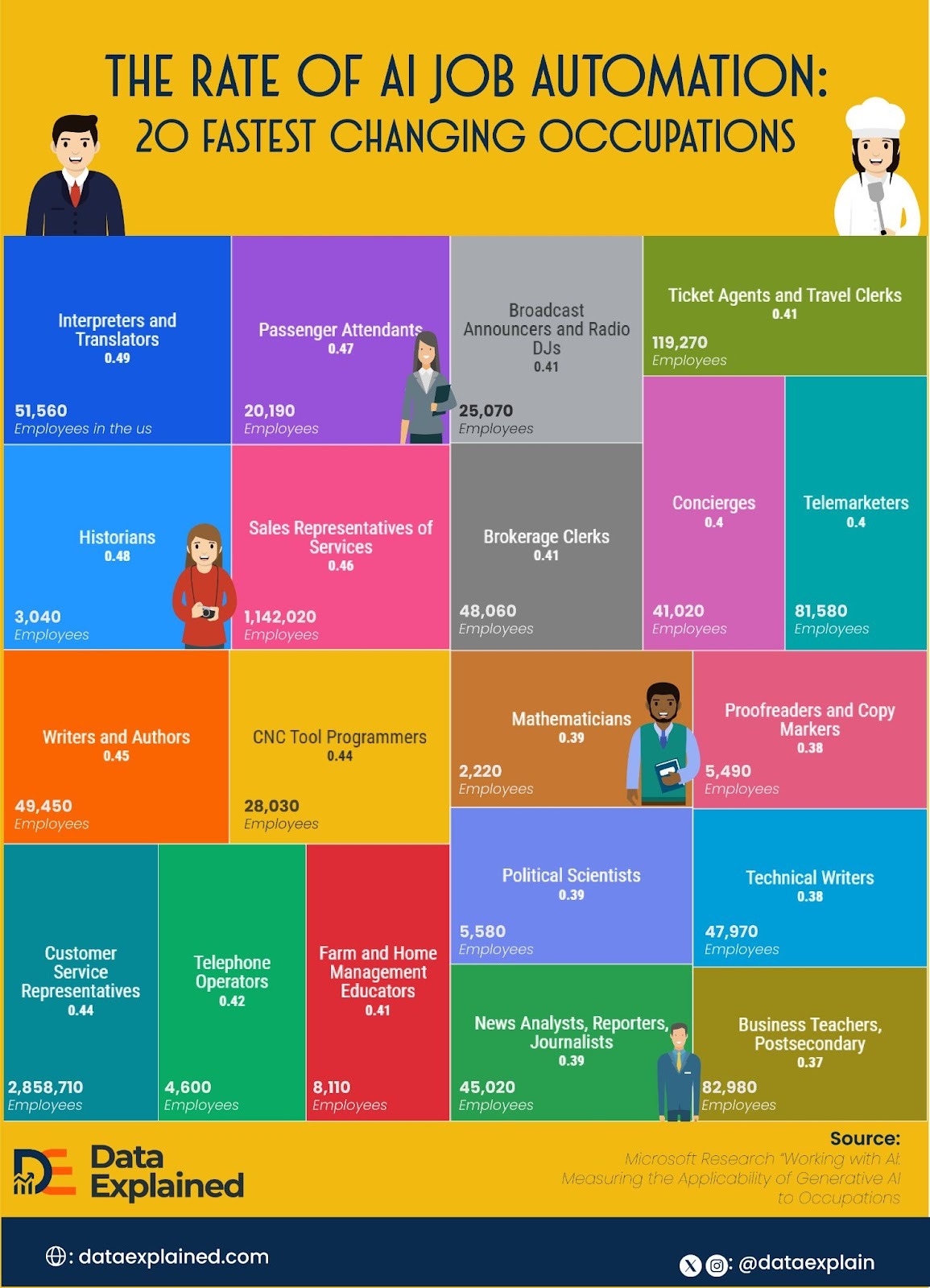
For years, people have asked which jobs artificial intelligence will replace. Microsoft Research’s latest study offers one of the most precise data-driven answers so far.
The study, published in July 2025, analyzed 200,000 real Copilot conversations to find out how often generative AI was already being used in workplace tasks and how well it performed.
From there, researchers built an “AI applicability score.” It’s a measure of how much AI can currently contribute to each occupation.
TL;DR
- Interpreters and translators rank first overall as the occupation changing the fastest to AI automation.
- Generally, communication and desk-based roles face the most automation risk, while physical jobs remain largely untouched.
- Nursing Assistants and Mechanics score just 0.03, showing minimal AI overlap.
Based on the report, jobs that scored up to 0.49 are the most exposed and at risk from AI. Occupations with scores lower than 0.35 are less exposed.
| wdt_ID | wdt_created_by | wdt_created_at | wdt_last_edited_by | wdt_last_edited_at | Rank | Occupation | Overall Score | Number of employees in the U.S |
|---|---|---|---|---|---|---|---|---|
| 1 | Monica Ebunoluwa | 20/01/2026 03:23 PM | Monica Ebunoluwa | 20/01/2026 03:23 PM | 1 | Interpreters and Translators | 49 | 51.560 |
| 2 | Monica Ebunoluwa | 20/01/2026 03:23 PM | Monica Ebunoluwa | 20/01/2026 03:23 PM | 2 | Historians | 48 | 3.040 |
| 3 | Monica Ebunoluwa | 20/01/2026 03:23 PM | Monica Ebunoluwa | 20/01/2026 03:23 PM | 3 | Passenger Attendants | 47 | 20.190 |
| 4 | Monica Ebunoluwa | 20/01/2026 03:23 PM | Monica Ebunoluwa | 20/01/2026 03:27 PM | 4 | Sales Representatives of Services | 46 | 1,142.020 |
| 5 | Monica Ebunoluwa | 20/01/2026 03:23 PM | Monica Ebunoluwa | 20/01/2026 03:23 PM | 5 | Writers and Authors | 45 | 49.450 |
| 6 | Monica Ebunoluwa | 20/01/2026 03:23 PM | Monica Ebunoluwa | 20/01/2026 03:23 PM | 6 | CNC Tool Programmers | 44 | 28.030 |
| 7 | Monica Ebunoluwa | 20/01/2026 03:23 PM | Monica Ebunoluwa | 20/01/2026 03:27 PM | 7 | Customer Service Representatives | 44 | 2,858.710 |
| 8 | Monica Ebunoluwa | 20/01/2026 03:23 PM | Monica Ebunoluwa | 20/01/2026 03:23 PM | 8 | Telephone Operators | 42 | 4.600 |
| 9 | Monica Ebunoluwa | 20/01/2026 03:23 PM | Monica Ebunoluwa | 20/01/2026 03:23 PM | 9 | Farm and Home Management Educators | 41 | 8.110 |
| 10 | Monica Ebunoluwa | 20/01/2026 03:23 PM | Monica Ebunoluwa | 20/01/2026 03:23 PM | 10 | Broadcast Announcers and Radio DJs | 41 | 25.070 |
Communication and Creative Jobs Top the List
According to the data, the occupations most exposed to AI automation are the ones that rely heavily on language, information, and communication.
At the top of the chart are Interpreters and Translators, with an AI applicability score of 0.49 (the highest of any job group).
That means nearly half of the tasks they perform can already be completed by AI tools like Copilot or ChatGPT with a decent level of success.
They’re followed closely by Historians (0.48), Writers and Authors (0.45), and Customer Service Representatives (0.44).
Even creative and entertainment roles are feeling the AI effect.
Radio announcers and DJs scored 0.41, showing that generative tools are already being used to script, generate, or refine content that would once have required full-time human effort.
Manual Work Still Safe (For Now)
At the other end of the list sit jobs that depend on physical skill and human presence (the ones least touched by the current wave of automation).
Phlebotomists, nursing assistants, and mechanics all scored just 0.03 on the AI applicability scale.
That’s about one-fifteenth the exposure of top-ranked communication roles.
In other words, AI may be able to draft a patient report or interpret lab data, but it still can’t draw your blood or fix your tire.
Even high-skill professions that rely on hands-on expertise, like oral surgeons or ship engineers, ranked low.
These jobs require spatial awareness and on-site problem-solving. These are areas where large language models still struggle.
How Widespread Could This Be?
The broader implications are huge.
The top three job groups most affected by AI…
- Sales and Related Occupations
- Computer and Mathematical Roles
- Office & Administrative Support
…employ tens of millions globally.
Even a modest level of automation in those sectors could change how companies hire, train, and manage people.
If AI can take over 30–40% of routine communication work, workers will be expected to focus on higher-level thinking, client relationships, and strategic judgment.
Microsoft’s data also shows that education and income aren’t clear shields.
While AI exposure is slightly higher in degree-level jobs, the correlation between wage and risk is weak (about 0.07).
That means AI risk cuts across both blue-collar and white-collar lines.
What matters is whether your work lives in text, data, or physical space.
A Pattern We’ve Seen Before
This pattern of rapid disruption followed by adaptation is like deja vu of earlier waves of automation.
When computers entered offices in the 1980s, clerical jobs declined, but new ones emerged around data entry, analysis, and IT management.
Today’s shift looks similar, but faster.
The report notes that the median founding year of companies using AI at scale is after 2018, underscoring the ecosystem’s freshness and speed.
That means new job types such as AI trainers, prompt engineers, and ethics officers are appearing almost as quickly as old ones evolve.
ELI5: Jobs At Risk to AI
Occupations like writers, translators, and customer service reps are most affected by AI automation, with nearly half of their daily tasks now automatable.
Nurses, mechanics, and technicians face little AI risk because their work needs physical skill and human touch.
However, it’s less of a ‘replacement’ issue. Most workers will share tasks with AI tools, using them to speed up writing, research, and problem-solving.
Sources:
Microsoft Research “Working with AI:Measuring the Applicability of Generative AI to Occupations”