We’re currently in an era where the average woman has only 2.2 births.
This is lower than the global fertility rate in the 1960s, which was around 5 births per woman.
Fertility rate is the average number of children that are born to a woman over her lifetime.
TL;DR
- Every continent is below or approaching the replacement fertility level of 2.1 births per woman.
- Africa dropped from 5.0 to 4.1 births per woman over just 20 years, but it remains the region with the highest fertility rate.
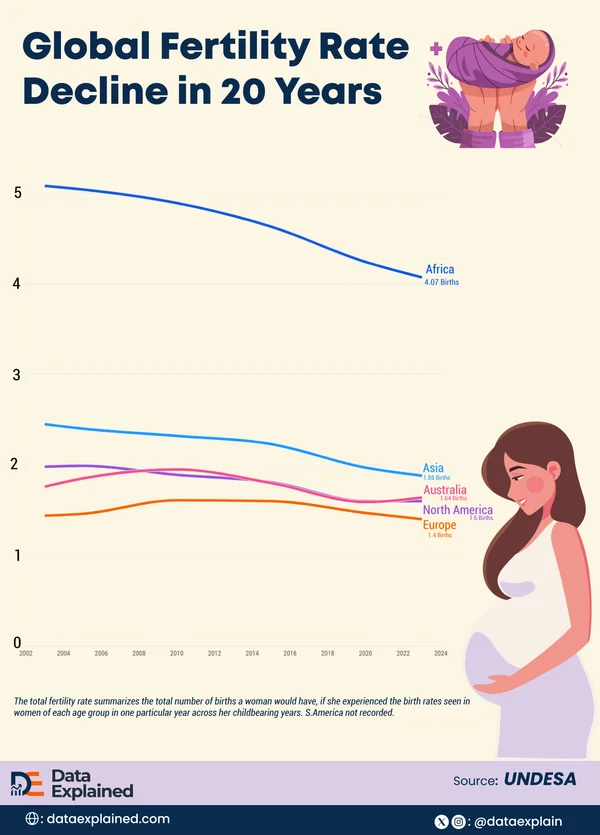
This visualisation shows the global decline in fertility rates over the last 20 years (2003-2023), based on data from the United Nations Department of Economic and Social Affairs (UNDESA).
Trend of Fertility Rate Decline By Region
| wdt_ID | wdt_created_by | wdt_created_at | wdt_last_edited_by | wdt_last_edited_at | Years | Africa | Asia | North America | Australia | Europe |
|---|---|---|---|---|---|---|---|---|---|---|
| 1 | dataexplained.4re | 19/01/2026 09:41 AM | emmanuel-ashemiriogwa | 20/01/2026 08:00 PM | 2003 | 5.08 | 2.45 | 1.98 | 1.76 | 1.44 |
| 2 | dataexplained.4re | 19/01/2026 09:41 AM | emmanuel-ashemiriogwa | 20/01/2026 08:00 PM | 2004 | 5.06 | 2.43 | 1.98 | 1.78 | 1.47 |
| 3 | dataexplained.4re | 19/01/2026 09:41 AM | emmanuel-ashemiriogwa | 20/01/2026 08:00 PM | 2005 | 5.04 | 2.40 | 1.99 | 1.85 | 1.46 |
| 4 | dataexplained.4re | 19/01/2026 09:41 AM | emmanuel-ashemiriogwa | 20/01/2026 08:01 PM | 2006 | 5.01 | 2.38 | 2.04 | 1.88 | 1.49 |
| 5 | dataexplained.4re | 19/01/2026 09:41 AM | emmanuel-ashemiriogwa | 20/01/2026 08:01 PM | 2007 | 4.99 | 2.37 | 2.05 | 1.99 | 1.53 |
| 6 | dataexplained.4re | 19/01/2026 09:41 AM | emmanuel-ashemiriogwa | 20/01/2026 08:02 PM | 2008 | 4.97 | 2.36 | 2.02 | 2.02 | 1.59 |
| 7 | dataexplained.4re | 19/01/2026 09:41 AM | emmanuel-ashemiriogwa | 20/01/2026 08:02 PM | 2009 | 4.93 | 2.35 | 1.96 | 1.97 | 1.61 |
| 8 | dataexplained.4re | 19/01/2026 09:41 AM | emmanuel-ashemiriogwa | 20/01/2026 08:02 PM | 2010 | 4.89 | 2.32 | 1.89 | 1.95 | 1.61 |
| 9 | dataexplained.4re | 19/01/2026 09:41 AM | emmanuel-ashemiriogwa | 20/01/2026 08:03 PM | 2011 | 4.84 | 2.30 | 1.86 | 1.92 | 1.59 |
| 10 | dataexplained.4re | 19/01/2026 09:41 AM | emmanuel-ashemiriogwa | 20/01/2026 08:03 PM | 2012 | 4.80 | 2.33 | 1.84 | 1.93 | 1.61 |
The striking detail from this trend is that every continent is below or approaching replacement level.
Replacement fertility (2.1 births per woman) is the rate needed to maintain the population without immigration.
Asia Crossed the Rubicon
Asia fell below replacement level (~2.0 per woman) in 2023, meaning 60% of the world’s population now lives in a sub-replacement fertility region.
Countries like China (1.1), South Korea (0.72), and Japan (1.3) are in catastrophic decline, while India recently dropped to 2.0.
This guarantees Asia’s population will shrink within decades.
Little wonder that China recently enacted a policy that gives families $500 (3,600 yuan) per child under three each year.
Africa’s Rapid Decline Is the Biggest Story
Africa dropped from 5.0 to 4.1 births per woman in just 20 years, a 20% decline and the steepest trajectory on the chart.
While still highest, this signals:
- Urbanization acceleration: Women moving to cities, gaining education/employment
- Contraceptive access expansion: Family planning programs reaching rural areas
- Female education surge: Educated women have fewer children globally
If Africa continues at this pace, it will reach replacement-level fertility by 2050-2060, eliminating the world’s last high-fertility region.
Why Stagnation in Developed Regions?
Europe, North America, and Australia have been stuck at 1.5-1.6 for 20 years, far below replacement.
No developed country has reversed this decline through policy (despite decades of pro-natalist efforts).
This implies:
- Structural causes: Not temporary economic shocks, but permanent shifts in values/economics
- Policy failure: Baby bonuses, parental leave, and childcare subsidies haven’t worked
- Immigration dependency: Developed nations need immigration to avoid population collapse.
The Issue with Immigration
Since no developed country has raised fertility through policy, immigration is the only way to stabilize populations.
But this creates political backlash.
For example, President Donald Trump of the United States, in his first 100 days, dramatically upended U.S. immigration policy through sweeping executive orders, lawsuits, and an aggressive campaign of raids, detention,s and deportations.
So, Countries face a choice:
- Accept population decline and economic contraction
- Accept mass immigration and cultural change
- Neither is politically palatable
Countries with the Highest Fertility Rate
Data from the United Nations Department of Economic and Social Affairs (UN DESA) shows that in sub‑Saharan Africa, women still have more than five children each.
Chad, Somalia, and the Democratic Republic of the Congo lead the global list with around 5.9 to 6.0 births per woman.
Other high‑fertility countries include the Central African Republic, Mali, Angola, and Burundi, each with fertility rates well above 4.5 births per woman.
The data show that countries with the highest fertility rates are mainly those with lower incomes, weaker access to family planning, higher child mortality in past decades, and social norms favoring larger families.
ELI5: Fertility Rate Decline
Around the world, people are having fewer children than before. This is mainly because women are now more educated, work more, and use birth control.
However, some countries still have very large families, especially in parts of sub-Saharan Africa like Chad, Somalia, and the Democratic Republic of the Congo, where women typically have 5 to 6 children. Cultural norms, limited access to family planning, and economic conditions all play a role.
Source: