As the United States continues to rely on tariffs as a key trade policy tool, new data show that one thing has not changed:
China remains the largest source of tariff revenue flowing into the U.S. Treasury.
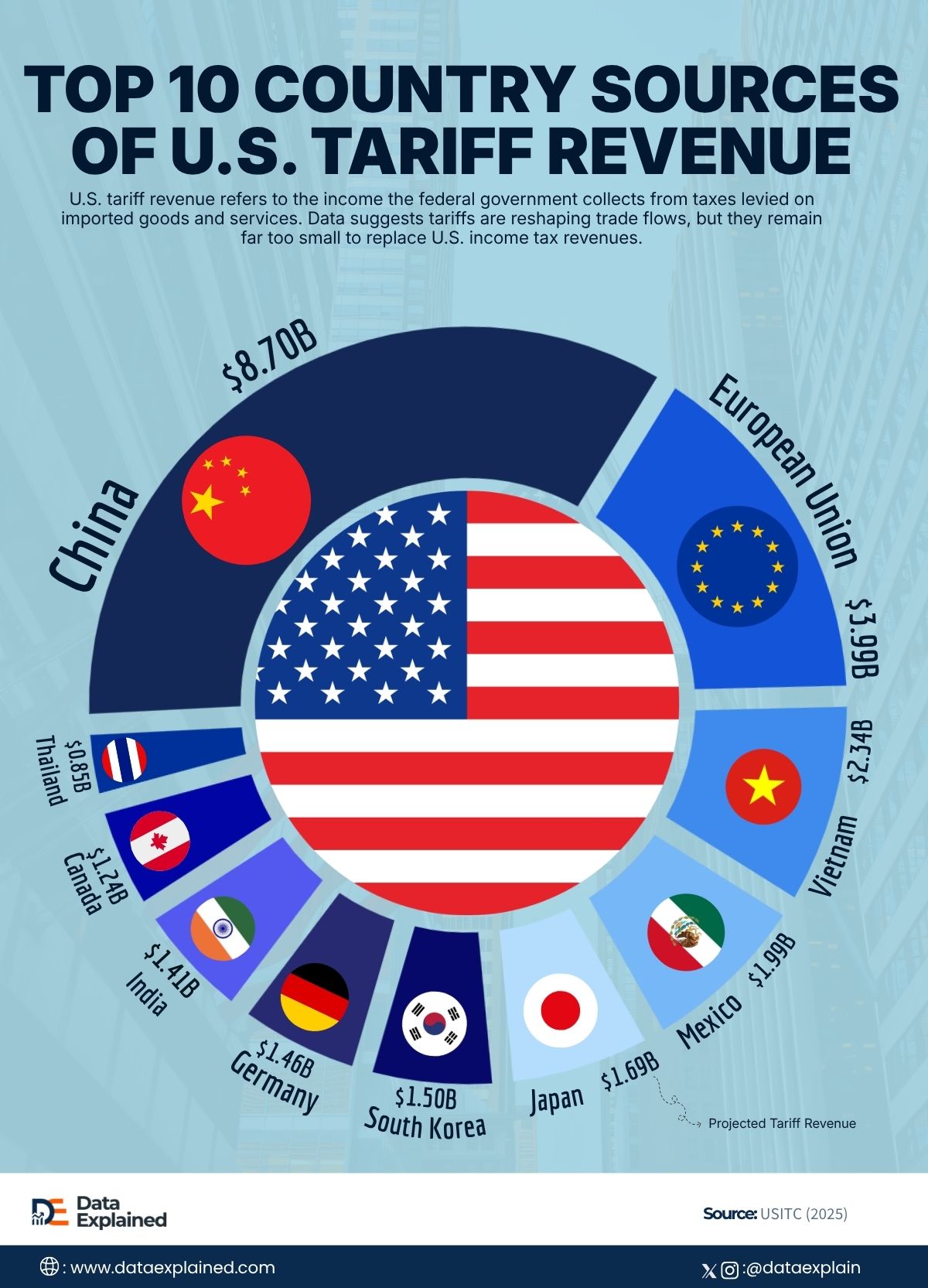
The visualization above shows tariff revenues on goods imported across a range of countries as of September 2025.
It’s based on data obtained from the U.S. International Trade Commission (USITC) DataWeb, accessed via the Andersen Institute.
TL;DR
- China remains the largest source of U.S. tariff revenue, generating $8.7 billion as of September 2025.
- Vietnam has emerged as a major contributor, ranking third ahead of several larger economies.
- The data suggests tariffs are reshaping trade flows, but they remain far too small to replace U.S. income tax revenues.
ALSO READ: Global Tariffs Map Reveals Year of Chaos Before Trump’s Retreat to 10% Rate
Top Country Sources of U.S. Tariff Revenue (Sept. 2025)
| wdt_ID | wdt_created_by | wdt_created_at | wdt_last_edited_by | wdt_last_edited_at | Country | U.S. Tariff contribution ($B) |
|---|---|---|---|---|---|---|
| 1 | Monica Ebunoluwa | 16/07/2026 12:57 PM | Monica Ebunoluwa | 16/07/2026 12:57 PM | China | 8.70 |
| 2 | Monica Ebunoluwa | 16/07/2026 12:57 PM | Monica Ebunoluwa | 16/07/2026 12:57 PM | EU | 3.99 |
| 3 | Monica Ebunoluwa | 16/07/2026 12:57 PM | Monica Ebunoluwa | 16/07/2026 12:57 PM | Vietnam | 2.34 |
| 4 | Monica Ebunoluwa | 16/07/2026 12:57 PM | Monica Ebunoluwa | 16/07/2026 12:57 PM | Mexico | 1.99 |
| 5 | Monica Ebunoluwa | 16/07/2026 12:57 PM | Monica Ebunoluwa | 16/07/2026 12:57 PM | Japan | 1.69 |
| 6 | Monica Ebunoluwa | 16/07/2026 12:57 PM | Monica Ebunoluwa | 16/07/2026 12:57 PM | South Korea | 1.50 |
| 7 | Monica Ebunoluwa | 16/07/2026 12:57 PM | Monica Ebunoluwa | 16/07/2026 12:57 PM | Germany | 1.46 |
| 8 | Monica Ebunoluwa | 16/07/2026 12:57 PM | Monica Ebunoluwa | 16/07/2026 12:57 PM | India | 1.41 |
| 9 | Monica Ebunoluwa | 16/07/2026 12:57 PM | Monica Ebunoluwa | 16/07/2026 12:57 PM | Canada | 1.24 |
| 10 | Monica Ebunoluwa | 16/07/2026 12:57 PM | Monica Ebunoluwa | 16/07/2026 12:57 PM | Thailand | 0.85 |
The figures come at a time when tariffs have returned to the center of political and economic debate, with policymakers arguing over whether higher import duties can reshape global trade, strengthen domestic manufacturing and generate meaningful government revenue.
The data suggests tariffs are indeed raising billions of dollars.
But it also shows that America’s tariff revenue remains heavily dependent on imports from China.
What’s the Big Deal With China?
China tops the rankings with $8.70 billion in tariff revenue, followed by the European Union at $3.99 billion and Vietnam at $2.34 billion.
One of the clearest patterns is the size of China’s lead.
The revenue collected from Chinese imports alone exceeds the combined contributions of several major trading partners, including Mexico, Japan, South Korea, India and Canada.
That highlights an important reality.
Despite years of trade tensions and efforts by companies to diversify their supply chains, Chinese goods continue to account for a significant share of imports entering the U.S. market that are subject to tariffs.
Vietnam’s Rise Reflects Changing Supply Chains
While China dominates the rankings, Vietnam stands out as one of the biggest stories in the data.
The country generated $2.34 billion in U.S. tariff revenue, placing it ahead of Mexico, Japan, Canada and several other major economies.
That reflects broader shifts in global manufacturing over the past decade.
As businesses sought alternatives to China amid heightened trade tensions, many expanded production in Vietnam and other Southeast Asian economies.
The latest tariff figures suggest those countries now play a much larger role in supplying goods to the U.S.
The same trend can be seen further down the rankings, where Thailand, Taiwan, Indonesia, Malaysia, the Philippines and Singapore all contribute to U.S. tariff collections.
What the Data Tells Us about Global Trade
China continues to occupy the central position in America’s tariff revenue stream, showing that economic ties between the world’s two largest economies remain substantial despite years of policy changes.
At the same time, Vietnam’s rise and the growing contributions from other Asian economies suggest supply chains are expanding rather than simply moving from one country to another.
For businesses, investors and policymakers, that may be the most important takeaway.
The latest figures show that global manufacturing is becoming more diversified, but not disconnected.
China still sits at the heart of America’s tariff revenue, even as neighboring economies play an increasingly important role in the changing map of international trade.
ELI5
The U.S. collects tariff money when certain imported goods enter the country. China still brings in the most tariff revenue, while Vietnam has become a much bigger contributor than before. The data show that trade is shifting across Asia, but China remains the largest source of tariff revenue for the U.S. government.
Source:
U.S. International Trade Commission (USITC) DataWeb, accessed via Andersen Institute.
Note: The data reflect U.S. tariff revenue collected on imports from major trading partners as of September 2025.