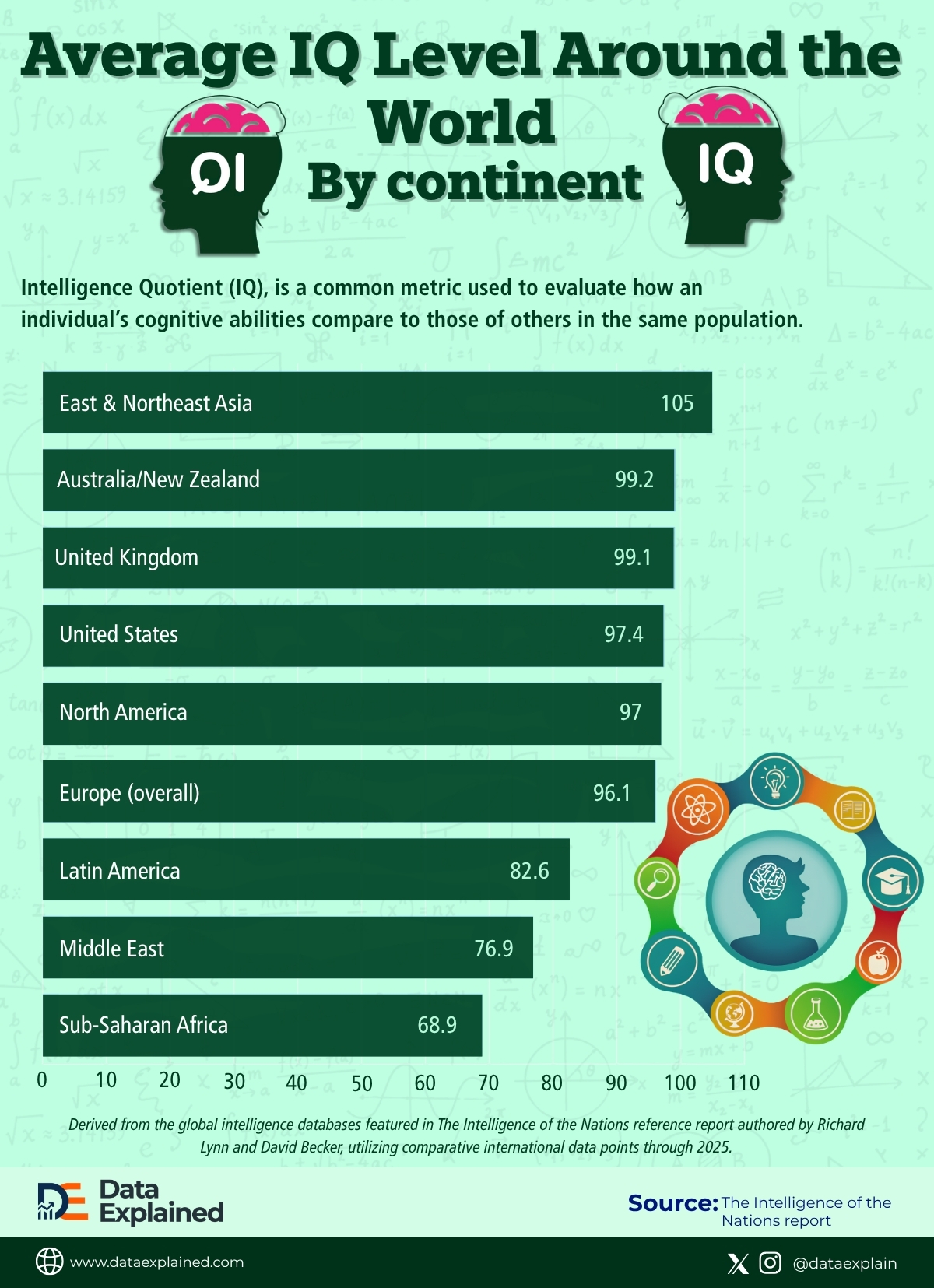
IQ, the abbreviation for intelligence quotient, is a common metric used to evaluate how an individual’s cognitive abilities compare to those of others in the same population.
The countries with the highest average IQ scores are all located in East or Northeast Asia, followed by North and Central Europe.
Caveat: Estimates of national and regional IQ remain highly controversial. Many psychologists, statisticians, and social scientists have criticized national-IQ datasets for methodological limitations, including inconsistent data quality, sampling issues, cultural bias in testing, and the difficulty of comparing cognitive performance across countries and populations. As a result, such rankings are not widely accepted by the scientific community as definitive measures of intelligence.
TL;DR
- The population-weighted global average IQ is around 81.85 when all regions are combined.
- There’s a notable decline in global IQ in some developed countries.
The rankings are from The Intelligence of Nations report.
Typically, IQ tests are designed with an average (mean) score of 100. Individuals who score above 130 are generally regarded as having exceptionally high intelligence, while those who score below 70 are often considered significantly below average.
Average IQ by Region
| wdt_ID | wdt_created_by | wdt_created_at | wdt_last_edited_by | wdt_last_edited_at | NO | Region | Average IQ |
|---|---|---|---|---|---|---|---|
| 1 | Monica Ebunoluwa | 08/06/2026 03:54 PM | Monica Ebunoluwa | 08/06/2026 03:54 PM | 1 | East/Northeast Asia | 105.0 |
| 2 | Monica Ebunoluwa | 08/06/2026 03:54 PM | Monica Ebunoluwa | 08/06/2026 03:54 PM | 2 | Australia/New Zealand | 99.2 |
| 3 | Monica Ebunoluwa | 08/06/2026 03:54 PM | Monica Ebunoluwa | 08/06/2026 03:54 PM | 3 | United Kingdom | 99.1 |
| 4 | Monica Ebunoluwa | 08/06/2026 03:54 PM | Monica Ebunoluwa | 08/06/2026 03:54 PM | 4 | United States | 97.4 |
| 5 | Monica Ebunoluwa | 08/06/2026 03:54 PM | Monica Ebunoluwa | 08/06/2026 03:54 PM | 5 | North America | 97.0 |
| 6 | Monica Ebunoluwa | 08/06/2026 03:54 PM | Monica Ebunoluwa | 08/06/2026 03:54 PM | 6 | Europe (overall) | 96.1 |
| 7 | Monica Ebunoluwa | 08/06/2026 03:54 PM | Monica Ebunoluwa | 08/06/2026 03:54 PM | 7 | Latin America | 82.6 |
| 8 | Monica Ebunoluwa | 08/06/2026 03:54 PM | Monica Ebunoluwa | 08/06/2026 03:54 PM | 8 | Middle East | 76.9 |
| 9 | Monica Ebunoluwa | 08/06/2026 03:54 PM | Monica Ebunoluwa | 08/06/2026 03:54 PM | 9 | Sub-Saharan Africa | 68.9 |
Europe averages 96.1 across 29 nations, with Northern and Western Europe scoring higher than their Southern and Eastern counterparts. Scandinavia and Estonia average 98.2, while Southern Europe averages 93.7.
East Asia leads globally, with scores consistently above 105 in Japan, Taiwan, Singapore, Hong Kong, and South Korea.
Latin America averages 82.6 across 34 countries, while the Arab-Muslim world, defined by nations with Muslim majorities, averages 76.9, though results vary widely within this grouping.
Nations with Higher Average IQs Link to Positive Personalities
According to the data, nations with higher average IQs tend to show slight positive associations with personality traits such as Openness and Agreeableness.
This implies that societies with higher cognitive scores may value adaptability and innovation over strict adherence to rules.
Meanwhile, some studies cited in the report suggest that higher-IQ populations are often associated with lower levels of violence, stronger governance, and more reliable institutions.
On the other hand, countries with lower average IQs are more likely to experience higher birth rates, increased exposure to infectious diseases, and slower economic development.
ELI5
IQ is a score used to measure how a person’s thinking and problem-solving abilities compare with those of others. The average IQ score is 100. A score above 130 is considered very high, while a score below 70 is considered much lower than average. Among world regions, East and Northeast Asia have the highest average IQ at 105.0, followed by Australia/New Zealand at 99.2.
NOTE: National-IQ rankings are controversial and have been widely criticized by researchers over concerns about data quality, sampling methods, cultural bias, and cross-country comparability. They should be interpreted with caution and not as definitive measures of intelligence.
Source: