Don’t be surprised when you see many top organisations earmarking huge funds for AI cloud security ( or related acquisitions) throughout 2026.
Between May and July 2025, one of the “Big Four” accounting firms, PwC, surveyed 3,887 business and tech executives across 72 countries.
One key question was “Which investments are you prioritising when allocating your organisation’s cyber budget in the next 12 months?”
TL;DR
- Nearly eight-in-ten (78%) organisations say their cyber budget will increase over the next 12 months.
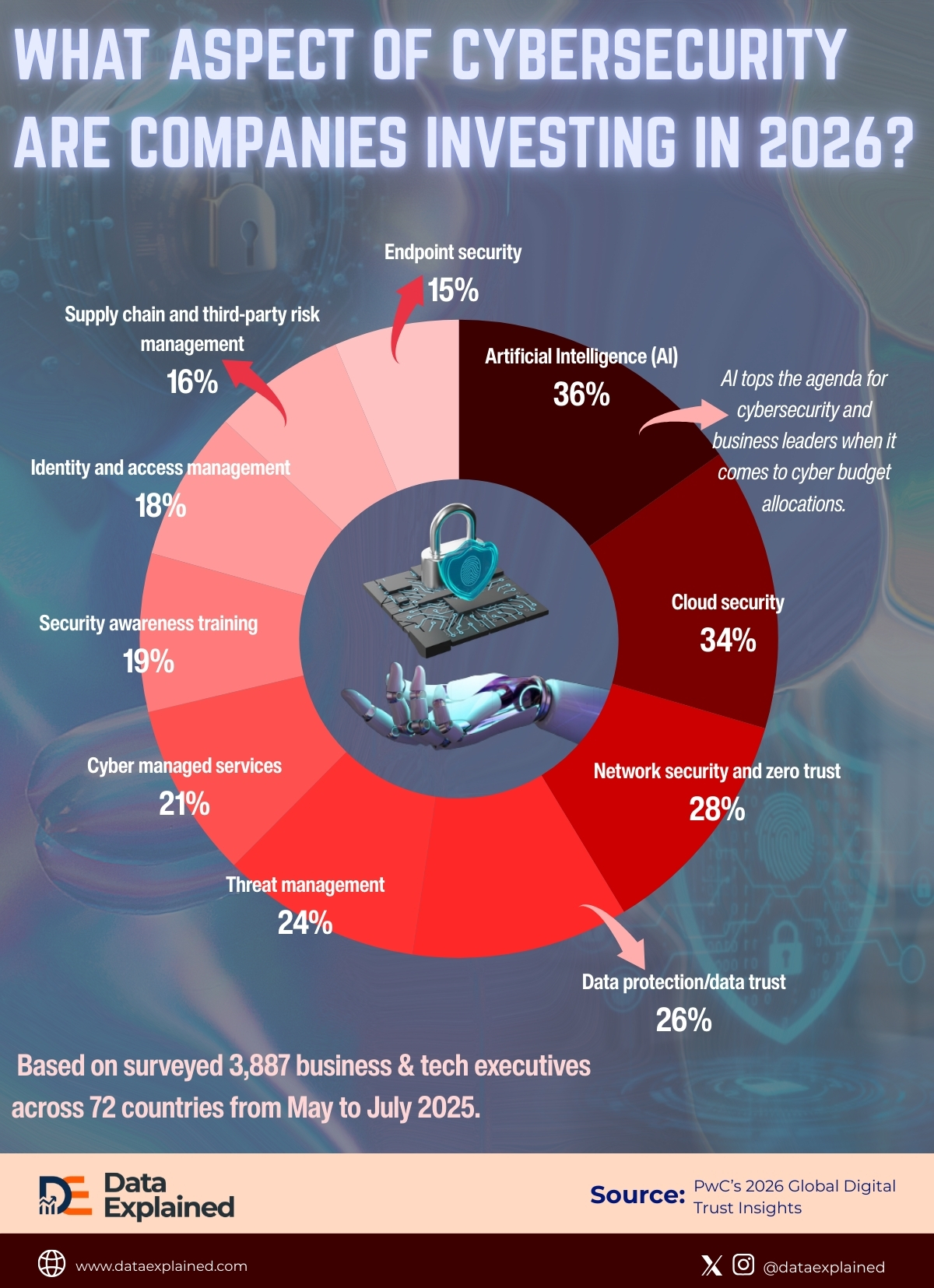
- Investment in artificial intelligence was the top budget priority (36%) over the next 12 months, ahead of cloud security and network security.
- 50% of organisations say “lack of knowledge” is the top challenge in implementing AI for cyber defence, which means there’s a skill gap.
Today’s visualisation shows the investments organisations are prioritising when allocating cyber budgets, based on the data from PwC’s 2026 Global Digital Trust Insights.
| wdt_ID | wdt_created_by | wdt_created_at | wdt_last_edited_by | wdt_last_edited_at | Cybersecurity Investments | Degree of priority (%) |
|---|---|---|---|---|---|---|
| 1 | Monica Ebunoluwa | 23/03/2026 12:13 PM | Monica Ebunoluwa | 23/03/2026 12:13 PM | Artificial Intelligence (AI) | 36 |
| 2 | Monica Ebunoluwa | 23/03/2026 12:13 PM | Monica Ebunoluwa | 23/03/2026 12:13 PM | Cloud security | 34 |
| 3 | Monica Ebunoluwa | 23/03/2026 12:13 PM | Monica Ebunoluwa | 23/03/2026 12:13 PM | Network security and zero trust | 28 |
| 4 | Monica Ebunoluwa | 23/03/2026 12:13 PM | Monica Ebunoluwa | 23/03/2026 12:13 PM | Data protection/data trust | 26 |
| 5 | Monica Ebunoluwa | 23/03/2026 12:13 PM | Monica Ebunoluwa | 23/03/2026 12:13 PM | Threat management | 24 |
| 6 | Monica Ebunoluwa | 23/03/2026 12:13 PM | Monica Ebunoluwa | 23/03/2026 12:13 PM | Cyber managed services | 21 |
| 7 | Monica Ebunoluwa | 23/03/2026 12:13 PM | Monica Ebunoluwa | 23/03/2026 12:13 PM | Security awareness training | 19 |
| 8 | Monica Ebunoluwa | 23/03/2026 12:13 PM | Monica Ebunoluwa | 23/03/2026 12:13 PM | Identity and access management | 18 |
| 9 | Monica Ebunoluwa | 23/03/2026 12:13 PM | Monica Ebunoluwa | 23/03/2026 12:13 PM | Supply chain and third-party risk management | 16 |
| 10 | Monica Ebunoluwa | 23/03/2026 12:13 PM | Monica Ebunoluwa | 23/03/2026 12:13 PM | Endpoint security | 15 |
Source: PwC’s 2026 Global Digital Trust Insight
Surveyed 3,887 business & tech executives across 72 countries from May to July 2025.
As you can see, AI tops the agenda for cybersecurity and business leaders when it comes to cyber budget allocations.
Why AI Is On Top?
In the survey, roughly half say their organisation is at best only ‘somewhat capable’ of withstanding cyber attacks targeting specific vulnerabilities surveyed, with only 6% saying they’re ‘very capable’ across all areas surveyed.
For context, new and emerging technologies, including AI and quantum computing, continue to transform the cyber risk landscape.
So the motive to invest more in AI is valid.
Could This Be Misplaced Priorities?
We’ve already seen that AI and cloud security are the top two cyber budget priorities for the year ahead.
But when organisations were asked which cyber threats they were least prepared to address, Cloud-related threats and attacks on connected products ranked highest.
Cyber threats organisations are least prepared to address
| wdt_ID | wdt_created_by | wdt_created_at | wdt_last_edited_by | wdt_last_edited_at | Cybersecurity threat | Percentage of organisations reporting |
|---|---|---|---|---|---|---|
| 1 | Monica Ebunoluwa | 23/03/2026 12:22 PM | Monica Ebunoluwa | 23/03/2026 12:22 PM | Cloud-related threats | 33% |
| 2 | Monica Ebunoluwa | 23/03/2026 12:22 PM | Monica Ebunoluwa | 23/03/2026 12:22 PM | Attacks on connected products | 28% |
| 3 | Monica Ebunoluwa | 23/03/2026 12:22 PM | Monica Ebunoluwa | 23/03/2026 12:22 PM | Third-party breach | 27% |
| 4 | Monica Ebunoluwa | 23/03/2026 12:22 PM | Monica Ebunoluwa | 23/03/2026 12:22 PM | Distributed denial-of-service (DDoS) attacks | 26% |
| 5 | Monica Ebunoluwa | 23/03/2026 12:22 PM | Monica Ebunoluwa | 23/03/2026 12:22 PM | Quantum computing threats | 25% |
| 6 | Monica Ebunoluwa | 23/03/2026 12:22 PM | Monica Ebunoluwa | 23/03/2026 12:22 PM | Social engineering | 23% |
| 7 | Monica Ebunoluwa | 23/03/2026 12:22 PM | Monica Ebunoluwa | 23/03/2026 12:22 PM | Software supply-chain compromise | 21% |
| 8 | Monica Ebunoluwa | 23/03/2026 12:22 PM | Monica Ebunoluwa | 23/03/2026 12:22 PM | Hack-and-leak operations | 20% |
| 9 | Monica Ebunoluwa | 23/03/2026 12:22 PM | Monica Ebunoluwa | 23/03/2026 12:22 PM | Ransomware | 20% |
| 10 | Monica Ebunoluwa | 23/03/2026 12:22 PM | Monica Ebunoluwa | 23/03/2026 12:22 PM | Employment infiltration | 19% |
Note: the question was asked of “Security leaders, COOs and Operations Directors” (n=1,971), not all respondents.
So, for cloud-related threats, the gap between risk and readiness is being recognised, and funding is following.
But for “attacks on connected products”, far fewer are allocating a budget to it.
This mismatch suggests some threats are still flying under the radar.
Skill Gap Still an Issue…
Companies are struggling to strengthen their AI and cybersecurity systems because they simply don’t have enough skilled people.
Half of organisations say their biggest challenge is not knowing how to use AI for cyber defence, and 41% say they lack the right talent to make it work.
Despite this skills gap, businesses are trying to adapt.
Many are now focusing on AI and machine-learning security tools (53%), automation (48%), reducing the number of disconnected security tools they use (47%), and training or reskilling staff (47%).
But the talent shortage goes beyond AI.
Almost half (47%) of leaders say they don’t have enough qualified experts to secure critical systems like industrial equipment, factories, and connected devices.
ELI5: Cybersecurity Investment Priority for 2026
About 78% of companies plan to increase cybersecurity spending in the next 12 months.
Their top priority is investing in AI tools for security, even more than in cloud protection or network security. Many of them admit they are not ready to handle cloud attacks or threats targeting connected devices.
At the same time, half of all companies say they don’t fully understand how to use AI for cyber defence, showing that the biggest barrier isn’t money, it’s a lack of skills and expertise.
Sources:
PwC’s 2026 Global Digital Trust Insights