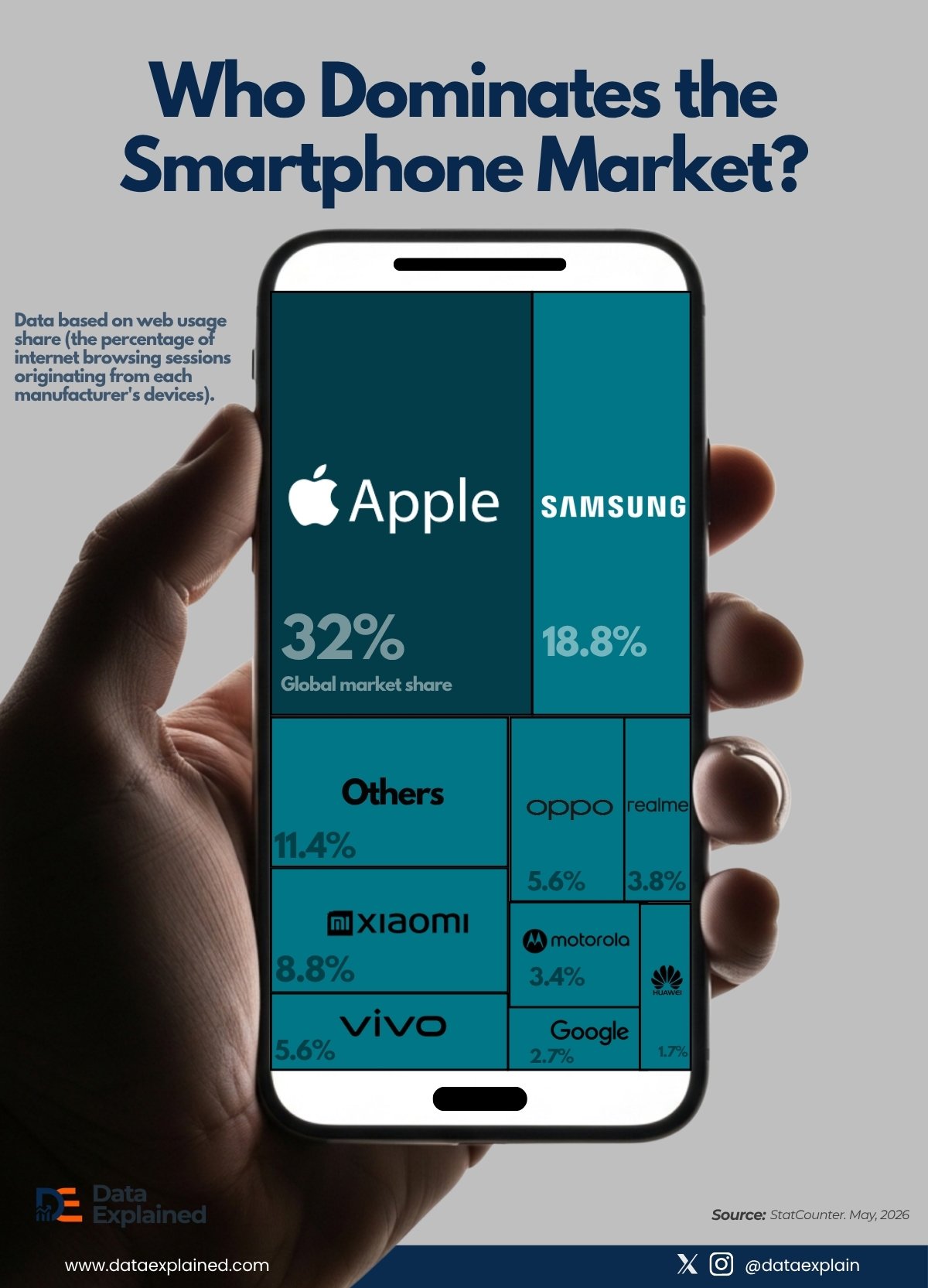
StatCounter’s global smartphone market share data for May 2026 ranks nine brands by web usage share (the percentage of internet browsing sessions originating from each manufacturer’s devices).
The result is a specific and revealing snapshot of who controls the world’s most personal computing device in 2026.
Before reading the numbers, the methodology matters.
StatCounter measures web traffic, not unit sales.
iPhone users browse the internet more intensively than the average Android user, generating more browser sessions per device.
Apple’s 31.95% in this dataset reflects usage intensity and premium-user behavior as much as it does market share.
In unit sales terms, Apple’s global share is closer to 18-20%.
TL;DR
- Apple leads global smartphone web usage share at 31.95%
- StatCounter measures browsing activity, not unit sales, meaning Apple’s true device market share is closer to 18-20%
- Five Chinese brands collectively hold 25.61% of the web usage share
- Huawei has collapsed from a near-challenger to Apple and Samsung in 2020 to just 1.66%
| wdt_ID | wdt_created_by | wdt_created_at | wdt_last_edited_by | wdt_last_edited_at | Phone | Market Share (%) |
|---|---|---|---|---|---|---|
| 1 | emmanuel-ashemiriogwa | 06/06/2026 02:12 PM | emmanuel-ashemiriogwa | 06/06/2026 02:12 PM | Apple | 32.0 |
| 2 | emmanuel-ashemiriogwa | 06/06/2026 02:12 PM | emmanuel-ashemiriogwa | 06/06/2026 02:12 PM | Samsung | 18.8 |
| 3 | emmanuel-ashemiriogwa | 06/06/2026 02:12 PM | emmanuel-ashemiriogwa | 06/06/2026 02:12 PM | Xiaomi | 8.8 |
| 4 | emmanuel-ashemiriogwa | 06/06/2026 02:12 PM | emmanuel-ashemiriogwa | 06/06/2026 02:12 PM | Vivo | 5.6 |
| 5 | emmanuel-ashemiriogwa | 06/06/2026 02:12 PM | emmanuel-ashemiriogwa | 06/06/2026 02:12 PM | Oppo | 5.6 |
| 6 | emmanuel-ashemiriogwa | 06/06/2026 02:12 PM | emmanuel-ashemiriogwa | 06/06/2026 02:12 PM | Realme | 3.8 |
| 7 | emmanuel-ashemiriogwa | 06/06/2026 02:12 PM | emmanuel-ashemiriogwa | 06/06/2026 02:12 PM | Motorola | 3.4 |
| 8 | emmanuel-ashemiriogwa | 06/06/2026 02:12 PM | emmanuel-ashemiriogwa | 06/06/2026 02:12 PM | Huawei | 1.7 |
| 9 | emmanuel-ashemiriogwa | 06/06/2026 02:12 PM | emmanuel-ashemiriogwa | 06/06/2026 02:12 PM | 2.7 | |
| 10 | emmanuel-ashemiriogwa | 06/06/2026 02:12 PM | emmanuel-ashemiriogwa | 06/06/2026 02:12 PM | Others | 11.4 |
Apple and the Gap
Apple sits at 31.95%, nearly double Samsung’s 18.84%, its nearest named competitor.
The gap between first and second place is larger than Samsung’s entire share. It is larger than all five Chinese brands combined. It is larger than every other named entry in the table.
The gap exists for structural reasons.
Apple controls both its hardware and its iOS software, creating a closed ecosystem that produces extraordinary user retention. iPhone users browse more, spend more time in apps, and generate more traceable browser activity than Android users do globally.
Apple’s premium pricing restricts its devices to higher-income users who are also heavier internet consumers.
The combination of ecosystem lock-in and demographic concentration produces a web usage share that consistently overstates Apple’s unit volume advantage while accurately reflecting its dominance in the world’s most valuable consumer technology segment.
Samsung is Caught Between Two Forces
Samsung, at 18.84%, is the only non-American and non-Chinese brand with significant market presence, competing against Apple’s software ecosystem on one side and Chinese manufacturing volume on the other.
Five Chinese manufacturers hold a combined 25.61%:
- Xiaomi (8.84%)
- Vivo (5.64%)
- Oppo (5.64%)
- Realme (3.83%)
- Huawei (1.66%)
Add Motorola at 3.37% (owned by China’s Lenovo), and Chinese corporate ownership accounts for approximately 28.98% of global smartphone web usage.
The Huawei Number
In 2020, Huawei was the world’s second-largest smartphone manufacturer by unit shipments, briefly overtaking Samsung in a single quarter.
It was building a global 5G ecosystem, investing heavily in chip design through its HiSilicon subsidiary, and positioning itself to challenge Apple in the premium segment.
Then, US export controls imposed in 2019 and expanded in 2020 cut the company off from Google’s Android services, from TSMC’s chip fabrication, and from a range of Western component suppliers.
Six years later, the company that was on a trajectory to lead the global smartphone market holds a 1.66% share of web usage.
That’s below Google’s Pixel at 2.69% and a fraction of the share of competitors that were significantly smaller than Huawei in 2020.
ELI5
Apple has the biggest slice of the smartphone market at about 32%, while Samsung is second at 19%. But if you add up all the Chinese phone brands (Xiaomi, Vivo, Oppo, Realme, and Huawei) they beat Samsung together with 26%. The most dramatic story is Huawei: it used to be almost as big as Samsung, but the US government ban on selling it American technology shrank it to just 1.66% of the market.
Source: