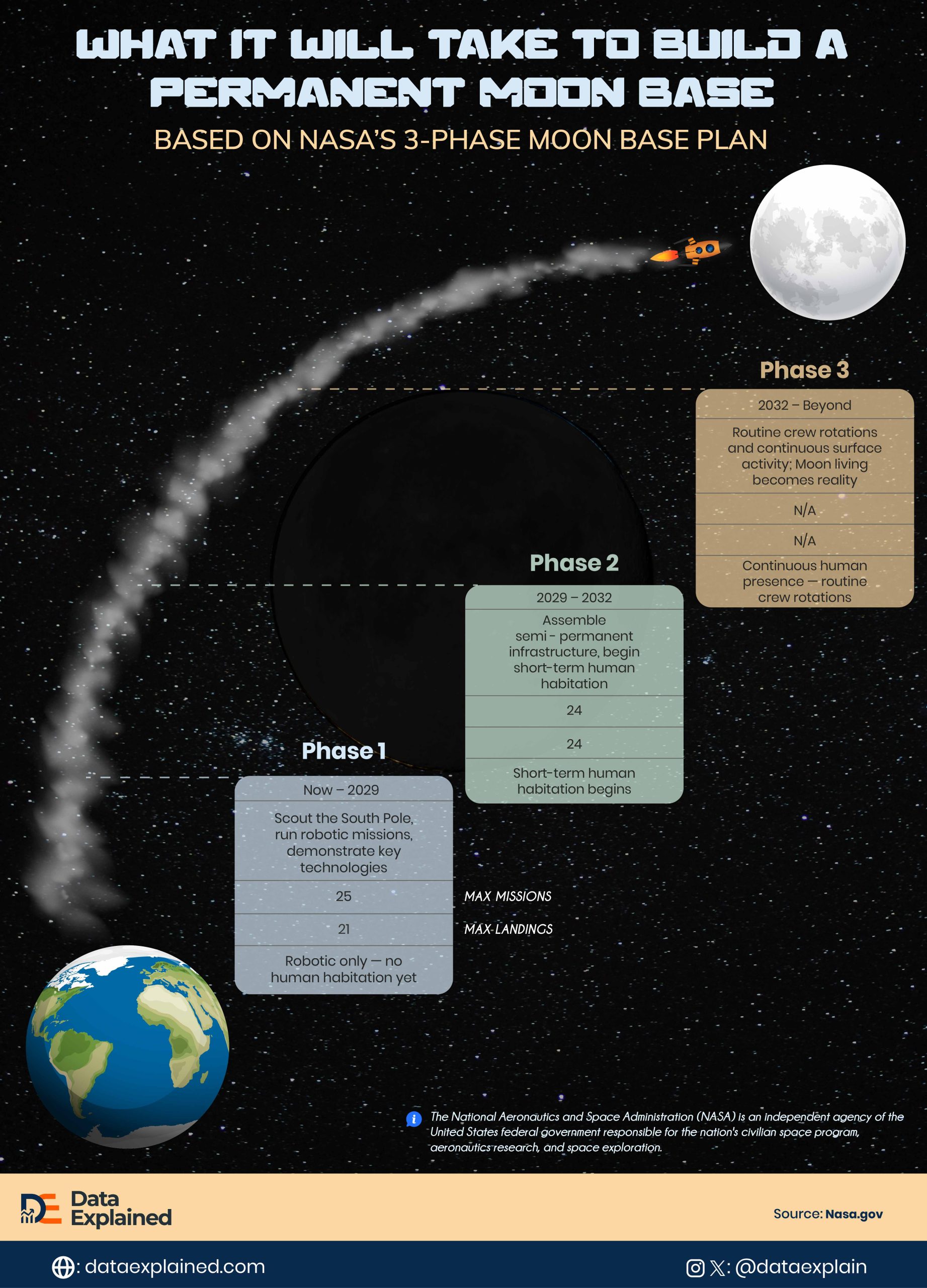
NASA has published official details on May 26, 2026, outlining a specific architecture for establishing a permanent human presence on the lunar surface.
The document divides the program into three phases spanning from now through 2032 and beyond.
Using the data, the infographic above shows a simple comparison of the three phases across 9 factors: goal, missions, landings, cargo, human presence, and key infrastructure.
TL;DR
- NASA’s official three-phase Moon Base plan calls for 25 robotic missions and 4 tons of cargo by 2029, scaling to 60 tons of delivered cargo and short-term human habitation by 2032, before transitioning to continuous human presence powered by nuclear fission beyond 2032.
- Phase 1 is entirely robotic; no human Moon landings are planned before 2029, creating a direct conflict with Trump’s stated goal of returning Americans to the Moon before he leaves office in January 2029
| wdt_ID | wdt_created_by | wdt_created_at | wdt_last_edited_by | wdt_last_edited_at | Phase | Phase Name | Timeframe | Goal | Max Missions | Max Landings | Cargo Volume | Human Presence | Key Infrastructure |
|---|---|---|---|---|---|---|---|---|---|---|---|---|---|
| 1 | emmanuel-ashemiriogwa | 28/05/2026 01:13 PM | emmanuel-ashemiriogwa | 28/05/2026 01:13 PM | Phase 1 | Learn, Test, Build | Now – 2029 | Scout the South Pole, run robotic missions, demonstrate key technologies | 25 | 21 | 4 tons total payload delivered | Robotic only — no human habitation yet | MoonFall drones, Lunar Terrain Vehicles (crewed + uncrewed), comms relay satellites, VIPER rover |
| 2 | emmanuel-ashemiriogwa | 28/05/2026 01:13 PM | emmanuel-ashemiriogwa | 28/05/2026 01:13 PM | Phase 2 | Early Habitation | 2029 – 2032 | Assemble semi-permanent infrastructure, begin short-term human habitation | 24 | 24 | Up to 60 tons cargo delivered | Short-term human habitation begins | Pressurized rover (JAXA/Toyota), nuclear RTG power demo, solar arrays (>10 kW), surface comms nodes |
| 3 | emmanuel-ashemiriogwa | 28/05/2026 01:13 PM | emmanuel-ashemiriogwa | 28/05/2026 01:13 PM | Phase 3 | Sustained Human Presence | 2032 – Beyond | Routine crew rotations and continuous surface activity; Moon living becomes reality | N/A | N/A | Up to 38 tons per year | Continuous human presence — routine crew rotations | Habitat modules, fission surface power, ISRU (extract O₂/H₂O from regolith), cargo return (up to 500 kg to Earth) |
Robots Only in the First Phase
The current phase runs from now through 2029.
Its goal is to scout the lunar South Pole, run robotic missions, and demonstrate the key technologies that human habitation will later depend on.
The plan allows for a maximum of 25 missions and 21 landings during this window (four missions that launch but do not land, almost certainly for orbital reconnaissance, communications relay, positioning, and technology testing).
President Trump has stated publicly that his goal is to land Americans on the Moon before he leaves office in January 2029.
Phase 1, which runs through 2029, contains no human landings.
Phase 2, which is when human habitation begins, starts in 2029.
The NASA architecture, as published, does not show boots on the Moon before Trump’s departure.
The political deadline and the engineering timeline are not the same document.
What Permanent Presence will Look Like
Phase 3 has no mission or landing count.
Once continuous human presence begins, counting missions becomes a logistics question rather than a program milestone.
Annual cargo delivery in Phase 3 reaches up to 38 tons, which may seem lower than Phase 2’s 60-ton total, but this is only after accounting for the framing difference.
Phase 2’s 60 tons spans three years, roughly 20 tons annually.
Phase 3’s 38 tons is a recurring annual figure, nearly double the Phase 2 annual rate.
The Moon base does not reduce its supply needs when it becomes permanent. It increases them.
One infrastructure item in Phase 3 stands out: the fission surface power.
It is a nuclear reactor that replaces the Phase 2 RTG demonstration.
The South Pole location experiences long periods of continuous sunlight at certain ridge elevations but also extended darkness in shadowed craters.
Solar panels cannot bridge those dark periods at the scale a permanent human base requires, but a nuclear fission reactor can.
ELI5
NASA published a detailed three-step plan to build a base on the Moon. First, robots will go explore and drop off supplies by 2029. Then people start visiting for short stays up to 2032. Finally, people live there full-time, powered by a nuclear reactor, and the base eventually makes its own water and oxygen from Moon dirt. One issue: Trump wants Americans on the Moon before January 2029, but the plan says humans don’t go until 2029 at the earliest.
Source: