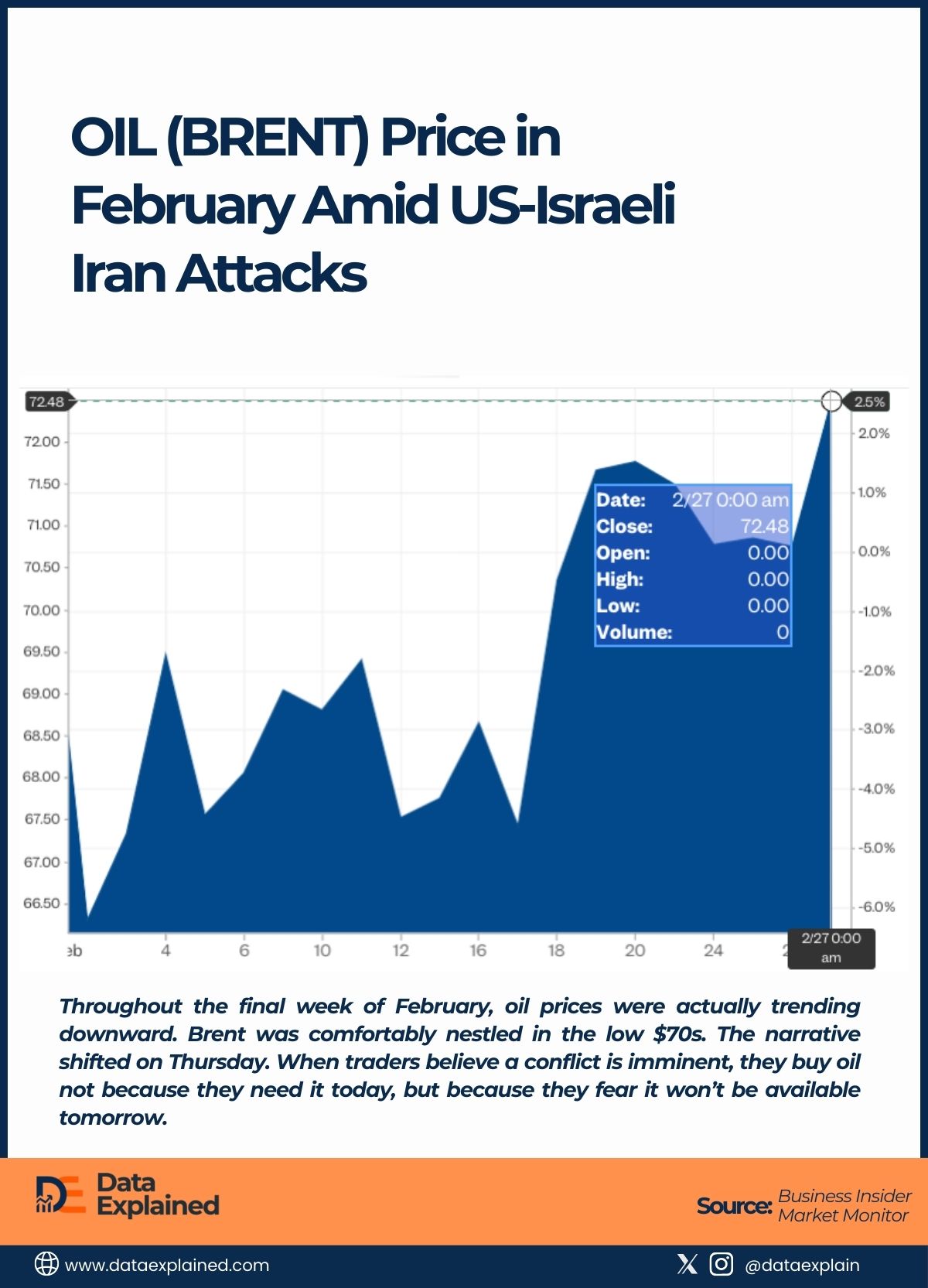
While the world woke up Saturday morning to the news of a massive joint U.S.-Israeli missile strike on Iranian nuclear facilities, the global energy markets had already “called the shot.”
According to Business Insider market charts, just before the weekend close, Brent crude, the international benchmark, surged 2.9% to settle at $72.80.
Its American counterpart, West Texas Intermediate (WTI), followed a similar trajectory, climbing 2.8% to finish above $67.
TL;DR
- Brent crude leaped 2.9% to a seven-month high on Friday, effectively “pricing in” the Saturday military escalation before it even began.
- With the U.S. seeking regime change and Iran retaliating, experts warn that a disrupted Strait of Hormuz could quickly catapult oil prices toward $100 per barrel.
On the surface, a 3% jump might seem like a standard fluctuation.
However, a deeper look at the week’s data reveals a “hockey stick” trend—a sharp, late-week reversal that suggests Wall Street knew diplomacy had failed long before the first Tomahawk missile was launched.
The “Geneva Gap”
Throughout the final week of February, oil prices were actually trending downward.
Brent was comfortably nestled in the low $70s.
The narrative shifted on Thursday.
As the Geneva diplomatic talks (led by U.S. envoys and Iranian negotiators) hit a “dead end,” the data began to decouple from reality.
While official statements remained cautiously optimistic, the price of Brent began a steady, vertical climb.
This is what analysts call a “War Premium.”
When traders believe a conflict is imminent, they buy oil not because they need it today, but because they fear it won’t be available tomorrow.
The Friday close at $70.50 seems like a lost faith in a peaceful resolution.
The Attack and the Goal: Regime Change
President Trump confirmed the Saturday morning strikes were not merely a “warning shot.” The objective was two-fold: the total “obliteration” of Iran’s remaining nuclear infrastructure and a decisive move to destabilize the current regime.
“This was a bid to remove the threat permanently,” the President stated from the White House.
From a data perspective, the market is reacting to the “regime change” variable.
Limited tactical strikes usually cause a temporary price spike that settles quickly.
However, a move toward regime change implies a long-term disruption of the Strait of Hormuz (the world’s most important oil chokepoint).
Roughly 20% of the world’s daily oil supply passes through this narrow waterway. If the conflict widens, that $72.80 figure could look like a bargain by Monday morning.
What’s Next?
As we head into the first full trading week of March, all eyes are on the $80 mark.
If the Iranian retaliation targets Saudi or Emirati oil infrastructure, analysts warn that Brent could see a “limit-up” move, potentially testing $90 to $100 per barrel within days.
For the average consumer, this data translates into a likely 15- to 25-cent jump at the gas pump by midweek.
ELI5
The data suggests that institutional investors (the “smart money”) were tracking the U.S. naval buildup in the region more closely than the diplomatic headlines.
The Friday price action shows that the market had already priced in a “high-probability conflict event.” By the time the strikes occurred, the “risk” was already bought and sold.
This is why markets often “gap up” on Monday mornings following weekend news: Friday buyers are sitting on a profit, while those who waited for the news are left scrambling.
Sources:
Finance Yahoo | Business Insider Market | Reuters | Truth Social