Kevin Warsh has been confirmed as Federal Reserve Chair, taking over from Jerome Powell with inflation running at 3.8%.
That number sounds manageable in isolation. Placed against 110 years of Fed history, it looks considerably more significant.
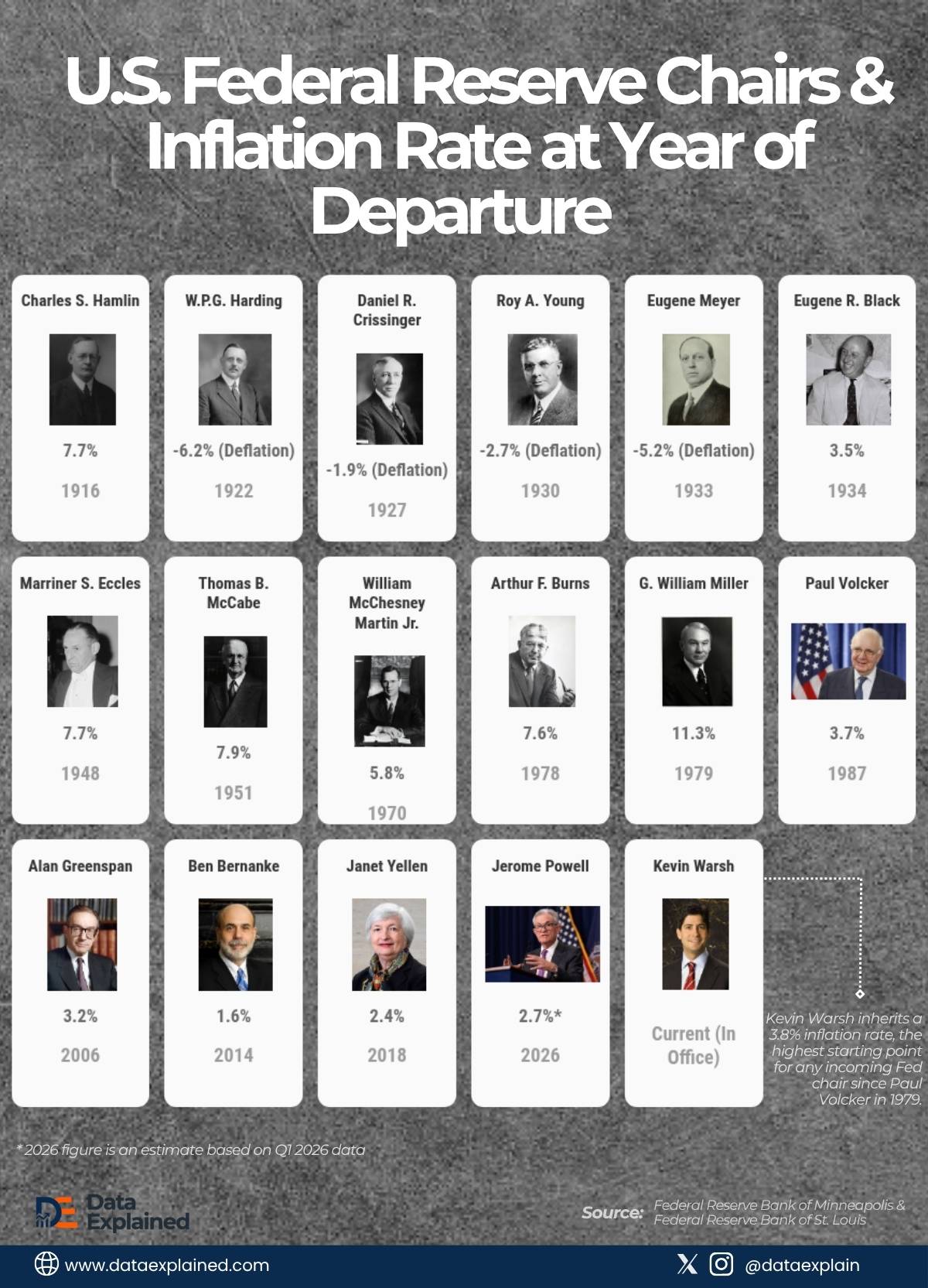
The infographic above shows the U.S. Federal Reserve Chairs and the Inflation Rate at Year of Departure.
It was gathered from CPI-U data from the Federal Reserve Bank of Minneapolis, tracking inflation in the year each of the 16 prior Fed chairs left office.
One striking realization is that no incoming chair has faced higher inflation on day one since Paul Volcker in 1979.
Warsh’s 54-45 Senate confirmation and his promise of “regime change” at the central bank arrive with a historical burden that the data makes specific.
TL;DR
- Kevin Warsh inherits a 3.8% inflation rate, the highest starting point for any incoming Fed chair since Paul Volcker in 1979.
- Jerome Powell’s departure inflation is estimated at 2.7% based on Q1 2026 data, but the current inflation rate of 3.8% suggests his actual exit rate may be higher.
- G. William Miller holds the all-time record for worst departure conditions at 11.3% in 1979, serving only 17 months.
| wdt_ID | wdt_created_by | wdt_created_at | wdt_last_edited_by | wdt_last_edited_at | Fed Reserve Chair | Year Left Office | U.S. Inflation Rate (Year Left) |
|---|---|---|---|---|---|---|---|
| 1 | emmanuel-ashemiriogwa | 24/05/2026 10:27 PM | emmanuel-ashemiriogwa | 24/05/2026 10:27 PM | Charles S. Hamlin | 1916 | 7.70% |
| 2 | emmanuel-ashemiriogwa | 24/05/2026 10:27 PM | emmanuel-ashemiriogwa | 24/05/2026 10:27 PM | W.P.G. Harding | 1922 | -6.2% (Deflation) |
| 3 | emmanuel-ashemiriogwa | 24/05/2026 10:27 PM | emmanuel-ashemiriogwa | 24/05/2026 10:27 PM | Daniel R. Crissinger | 1927 | -1.9% (Deflation) |
| 4 | emmanuel-ashemiriogwa | 24/05/2026 10:27 PM | emmanuel-ashemiriogwa | 24/05/2026 10:27 PM | Roy A. Young | 1930 | -2.7% (Deflation) |
| 5 | emmanuel-ashemiriogwa | 24/05/2026 10:27 PM | emmanuel-ashemiriogwa | 24/05/2026 10:27 PM | Eugene Meyer | 1933 | -5.2% (Deflation) |
| 6 | emmanuel-ashemiriogwa | 24/05/2026 10:27 PM | emmanuel-ashemiriogwa | 24/05/2026 10:27 PM | Eugene R. Black | 1934 | 3.50% |
| 7 | emmanuel-ashemiriogwa | 24/05/2026 10:27 PM | emmanuel-ashemiriogwa | 24/05/2026 10:27 PM | Marriner S. Eccles | 1948 | 7.70% |
| 8 | emmanuel-ashemiriogwa | 24/05/2026 10:27 PM | emmanuel-ashemiriogwa | 24/05/2026 10:27 PM | Thomas B. McCabe | 1951 | 7.90% |
| 9 | emmanuel-ashemiriogwa | 24/05/2026 10:27 PM | emmanuel-ashemiriogwa | 24/05/2026 10:27 PM | William McChesney Martin Jr. | 1970 | 5.80% |
| 10 | emmanuel-ashemiriogwa | 24/05/2026 10:27 PM | emmanuel-ashemiriogwa | 24/05/2026 10:27 PM | Arthur F. Burns | 1978 | 7.60% |
Note: 2026 Powell figure is an estimate based on Q1 2026 data.
What the Full Chart Shows
The dataset runs from Charles S. Hamlin, who left in 1916 with 7.7% inflation, through Jerome Powell’s estimated 2.7% departure rate based on Q1 2026 figures.
The post-Volcker era shows a 40-year band of relative stability.
Every chair that has departed since 1987 has left with inflation between 1.6% and 3.2%. Warsh enters above that band, at 3.8%. The modern era’s stable handoff pattern is broken.
The Powell Problem
There is a data discrepancy worth examining.
The Federal Reserve Bank of Minneapolis dataset records Powell’s departure at an estimated 2.7%, based on Q1 2026 figures compiled in May 2026.
The reported current inflation rate is 3.8%.
If the year-end 2026 figure confirms 3.8% as Powell’s actual exit rate rather than the Q1 estimate, his historical record changes materially.
At 3.8%, Powell would be leaving with the highest departure inflation of any Fed chair since Paul Volcker himself exited at 3.7% in 1987, a very different legacy than 2.7% implies, and one that will only be settled when the full-year 2026 CPI data is available.
Depression Warning
Four consecutive chairs all departed during deflation:
- W.P.G. Harding (-6.2%, 1922)
- Daniel Crissinger (-1.9%, 1927)
- Roy Young (-2.7%, 1930)
- Eugene Meyer (-5.2%, 1933)
These four documents the Fed’s most sustained institutional failure.
Aggressive monetary tightening in a weakening economy helped produce those negative numbers.
The lesson from the deflation is not that inflation should be tolerated. It is that the cure, if applied without calibration, can be as damaging as the disease.
ELI5
The Federal Reserve controls interest rates to keep prices stable. A new boss, Kevin Warsh, just took over when prices are rising at 3.8%, the highest starting point for a new Fed boss since 1979. The last person to take over in similar conditions had to raise interest rates so high that it caused a recession. A chart of every Fed boss and the inflation they left behind shows that Warsh is walking into one of the hardest starting points in 110 years.
Source:
Federal Reserve Bank of Minneapolis, Consumer Price Index, 1913–Present (CPI-U, BLS); FRASER, Federal Reserve Bank of St. Louis