
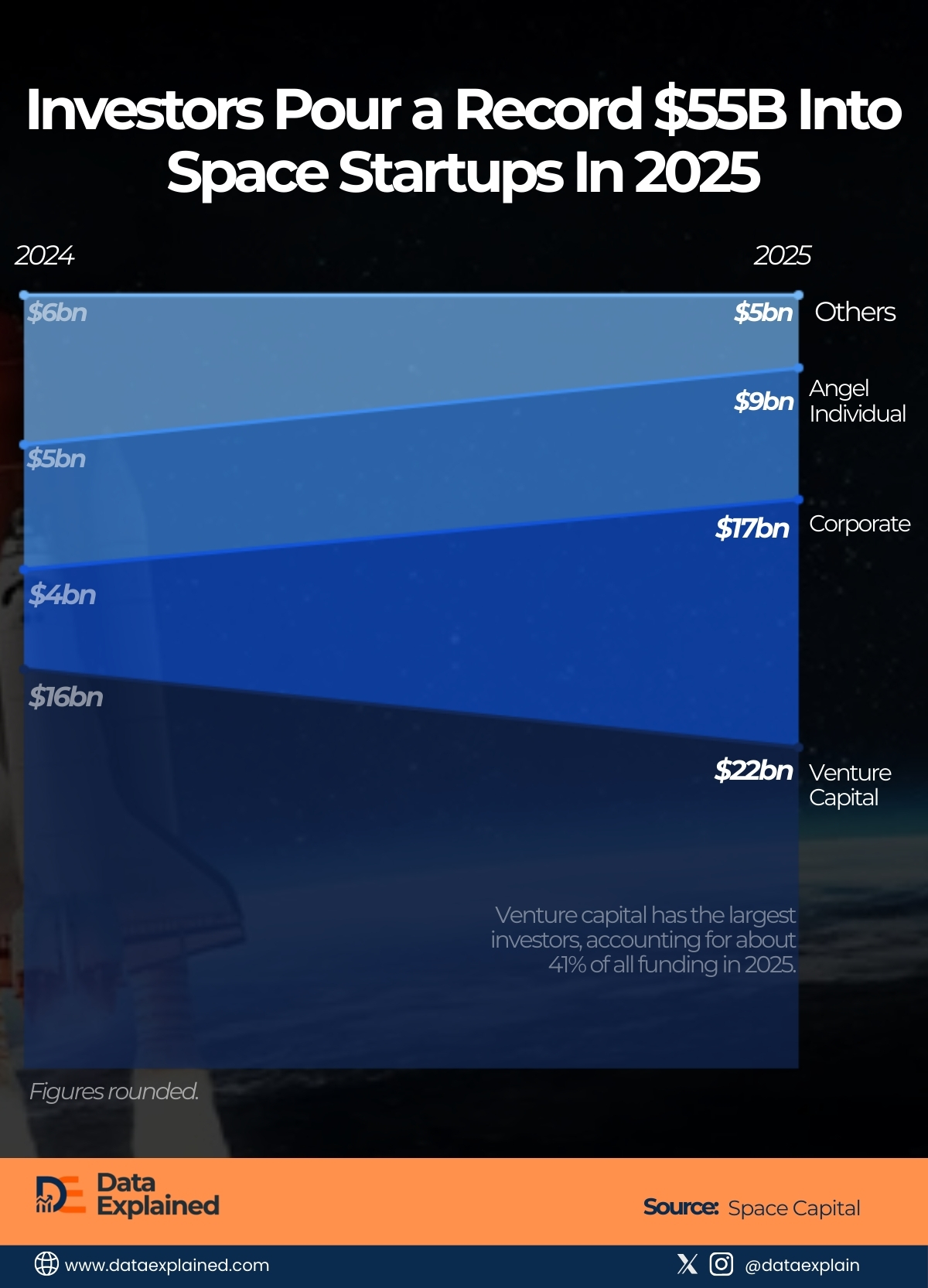
Investors poured approximately $55.3 billion into space startups in 2025, marking the industry’s biggest funding year as venture capitalists bet big on satellites and launch services while newer segments struggled to attract similar attention.
These data come from Space Capital’s Space IQ report. The visualization above compares investments in space startups in 2024 and 2025 by investor type.
TL;DR
- Venture capital has the largest investors, accounting for about 41% of all funding in 2025.
- The United States consistently has the highest private equity investment in the space economy.
- Investors concentrate most rounds in established satellite and launch sectors, while newer space segments get far fewer deals and longer-term bets.
The funding surge comes as established players in satellite communications and launch services have captured the majority of deals, while emerging sectors such as space manufacturing and in-orbit services have received far fewer investments despite their long-term potential.
| wdt_ID | wdt_created_by | wdt_created_at | wdt_last_edited_by | wdt_last_edited_at | Investor type | Amount of funding released ($ billion) |
|---|---|---|---|---|---|---|
| 1 | emmanuel-ashemiriogwa | 04/02/2026 03:02 PM | emmanuel-ashemiriogwa | 04/02/2026 03:04 PM | Venture capital | 2.20 |
| 2 | emmanuel-ashemiriogwa | 04/02/2026 03:02 PM | emmanuel-ashemiriogwa | 04/02/2026 03:05 PM | Corporate | 17.60 |
| 3 | emmanuel-ashemiriogwa | 04/02/2026 03:02 PM | emmanuel-ashemiriogwa | 04/02/2026 03:05 PM | Angel individual | 9.40 |
| 4 | emmanuel-ashemiriogwa | 04/02/2026 03:02 PM | emmanuel-ashemiriogwa | 04/02/2026 03:06 PM | Other | 5.80 |
| 5 | emmanuel-ashemiriogwa | 04/02/2026 03:02 PM | emmanuel-ashemiriogwa | 04/02/2026 03:02 PM | Number of rounds | 495.00 |
Who is Placing the Bets?
In 2025, venture capital firms were the largest investors, contributing approximately $22.3 billion, equivalent to 41% of all recorded funding.
Corporate investors came next with $17.7 billion which is about 32%, while angel investors contributed $9.4 billion, about 17%, and other sources made up the remaining 10%.
Across 495 funding rounds, venture capital led in shaping where money flowed.
This gap explains how strongly venture capital drives risk-taking and early-stage growth, and how it funds startups before profits are visible.
Corporations continue to play a major role, but they invest more strategically or later in the cycle, while angels and smaller funds fill niche opportunities rather than going to the overall market direction.
U.S. Investors Provided the Most Funding
According to the Space report, the United States has the largest share of private equity investment in the space economy.
Throughout last year,
- Investors in the U.S. allocated $236 billion to startups in this niche.
- Investors in China contributed $86 billion in total
- Singaporean investors throw in a total of $14 billion.
The lowest funding came from investors in Sri Lanka at $32 million.
Investors Appetite is on Satelite Niche
The report also tracked which industry or sector within the space economy experienced the most investment rounds.
The satellite industry has attracted the most funding rounds, accounting for over half of all deal activity over the past decade.
Emerging sectors like lunar exploration, stations, and other niche technologies have had fewer rounds, showing their early-stage status and higher technical risk when compared with core infrastructure like satellite tech and launch services.
This distribution means that investors still favor established space industry segments with clear revenue paths.
Speculative sectors are getting interest, but very few rounds.
This shapes how capital flows through the space economy.
ELI5
Venture capital firms are pushing more money into the space industry, making up about four out of every ten dollars invested in 2025.
The United States also leads the world in space startup funding, since most major space companies and investors are based there, giving it a strong advantage in attracting private money.
Additionally, investors are primarily backing proven areas such as satellites and rocket launches, where profits and demand are readily predictable.
Newer or experimental space ideas still get funding, but much less of it, because they carry higher risks and do take a long time to turn into real business returns.
Sources: