Nvidia is preparing to launch Arm-based laptop processors in the second half of 2026, with at least eight machines from Lenovo and Dell in development, the Wall Street Journal reported.
We could trace that the move sent AMD’s stock down 8.77% and Intel’s down 5.31% on Monday, February 23, as investors recognized the threat.
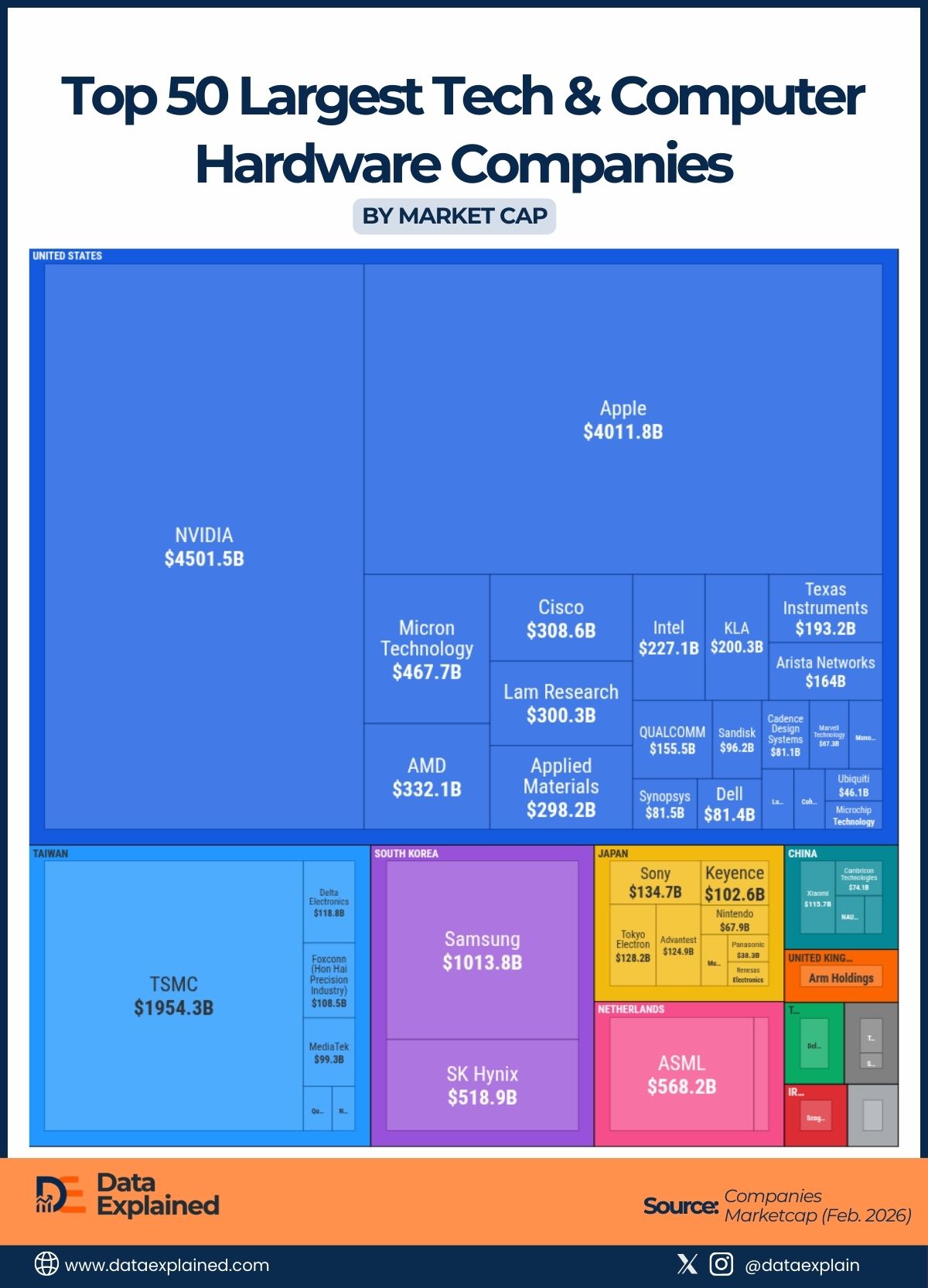
In the heat of this brewing, today’s visuals show the top 50 largest tech and computer hardware companies by market capitalization.
The data comes from Companies MarketCap, as of February 23, 2026.
TL;DR
- The tech and computer hardware market is currently worth $18.6 trillion, and Nvidia holds $4.5 trillion of that, ahead of Apple.
- Manufacturers like Dell and Lenovo partner with Nvidia due to financial power.
- Most chip designs come from the United States, but manufacturing comes from Taiwan.
Ranked Hardware Tech Companies By their Market Caps
| wdt_ID | wdt_created_by | wdt_created_at | wdt_last_edited_by | wdt_last_edited_at | Rank | Company Name | Market Cap ($ Billion) | Country |
|---|---|---|---|---|---|---|---|---|
| 1 | emmanuel-ashemiriogwa | 27/02/2026 04:43 AM | emmanuel-ashemiriogwa | 27/02/2026 04:43 AM | 1 | NVIDIA | 4,501.52 | United States |
| 2 | emmanuel-ashemiriogwa | 27/02/2026 04:43 AM | emmanuel-ashemiriogwa | 27/02/2026 04:43 AM | 2 | Apple | 4,011.80 | United States |
| 3 | emmanuel-ashemiriogwa | 27/02/2026 04:43 AM | emmanuel-ashemiriogwa | 27/02/2026 04:43 AM | 3 | TSMC | 1,954.33 | Taiwan |
| 4 | emmanuel-ashemiriogwa | 27/02/2026 04:43 AM | emmanuel-ashemiriogwa | 27/02/2026 04:43 AM | 4 | Samsung | 1,013.84 | South Korea |
| 5 | emmanuel-ashemiriogwa | 27/02/2026 04:43 AM | emmanuel-ashemiriogwa | 27/02/2026 04:43 AM | 5 | ASML | 568.17 | Netherlands |
| 6 | emmanuel-ashemiriogwa | 27/02/2026 04:43 AM | emmanuel-ashemiriogwa | 27/02/2026 04:43 AM | 6 | SK Hynix | 518.91 | South Korea |
| 7 | emmanuel-ashemiriogwa | 27/02/2026 04:43 AM | emmanuel-ashemiriogwa | 27/02/2026 04:43 AM | 7 | Micron Technology | 467.72 | United States |
| 8 | emmanuel-ashemiriogwa | 27/02/2026 04:43 AM | emmanuel-ashemiriogwa | 27/02/2026 04:43 AM | 8 | AMD | 332.08 | United States |
| 9 | emmanuel-ashemiriogwa | 27/02/2026 04:43 AM | emmanuel-ashemiriogwa | 27/02/2026 04:43 AM | 9 | Cisco | 308.58 | United States |
| 10 | emmanuel-ashemiriogwa | 27/02/2026 04:43 AM | emmanuel-ashemiriogwa | 27/02/2026 04:43 AM | 10 | Lam Research | 300.28 | United States |
The Laptop Announcement
NVIDIA, which is the world’s largest tech-hardware company, is planning to enter the consumer laptop CPU market with ARM-based chips.
It marks the company’s first meaningful push into PC processors in years.
Times of India report says that at least eight laptops from major OEMs like Lenovo and Dell are expected to launch in the second half of 2026 using Nvidia’s new Arm-based CPUs.
Industry spectators see this move as challenging the longstanding Intel-AMD duopoly in notebook processors.
This would make Nvidia one of the first major GPU-centric chip designers to break into general-purpose laptop CPUs in decades.
Why Market Cap Matters
NVIDIA’s massive market capitalization is presently the highest among tech hardware companies, and this gives it large financial firepower.
This means, its valuation and cash position allow it to outspend rivals like Intel and AMD a lot of times, especially in areas like:
- Chip design
- AI research
- Manufacturing partnerships.
That kind of scale can increase product development and ecosystem building.
For manufacturers like Lenovo and Dell, partnering with Nvidia isn’t just about technology but also about aligning with the industry’s most financially dominant player.
Large OEMs often follow long-term capital strength because it shows stability, supply chain leverage, and marketing support.
Market cap also shows investor confidence.
When investors heavily back a company like Nvidia, they’re trusting that it will shape the future of computing and influence strategic partnerships and market direction.
The Geographic Pattern
The global chip industry follows a clear geographic pattern.
The United States dominates chip design, with companies like Nvidia, AMD, Intel, and Apple leading in processor architecture, AI accelerators, and advanced silicon engineering.
But in manufacturing, Taiwan plays a central role, primarily through TSMC, the world’s leading semiconductor foundry.
Even the most advanced U.S.-designed chips are typically fabricated in Taiwan.
Nvidia’s upcoming Arm-based laptops follow this same pattern, i.e designed in the U.S., manufactured in Taiwan.
It highlights a broader reality of the tech supply chain as America leads in chip innovation, but still depends heavily on Asian manufacturing to bring those designs to life.
ELI5
NVIDIA is planning to enter the regular laptop market by making its own ARM-based processors. This means it won’t just power graphics anymore; it wants to compete directly with Intel and AMD inside everyday laptops.
This would mark a major shift, as Nvidia hasn’t produced mainstream consumer laptop CPUs in years.
Big computer brands like Dell and Lenovo are willing to work with NVIDIA largely because of its strong financial position and market influence. Partnering with a company that investors strongly back reduces risk and increases marketing momentum.
Source: