If you’re a woman who has spent years feeling inexplicably tired, struggling to focus, or watching your hair thin, this might be why.
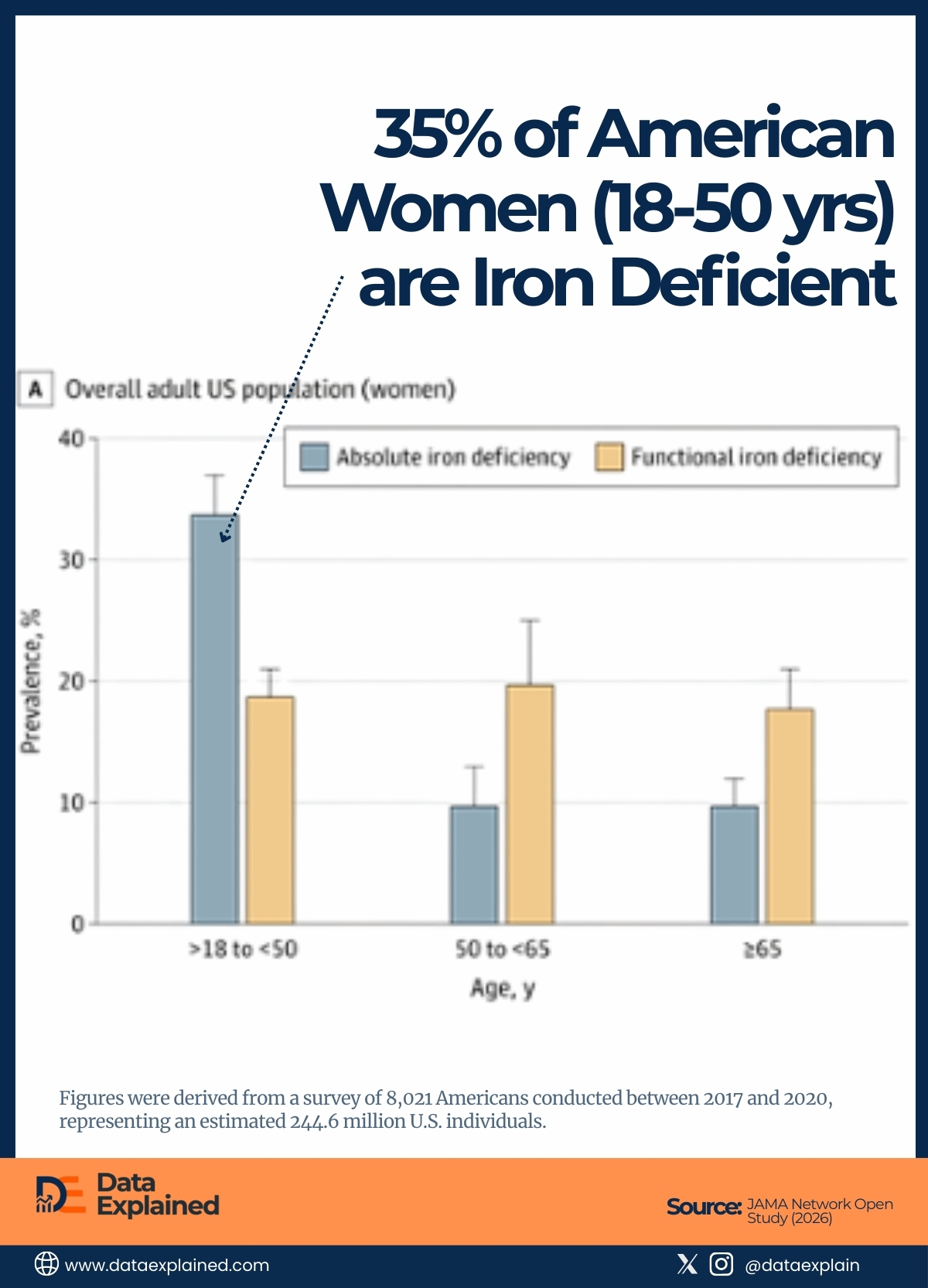
Thirty-five percent of American women between the ages of 18 and 50 are walking around with iron deficiency, and most have no idea.
The figures were derived from a survey of 8,021 Americans conducted between 2017 and 2020, representing an estimated 244.6 million US individuals.
It showed that while just 3% of men ages 18-50 are iron deficient, women in the same age group are deficient at a rate 12 times higher.
It comes from the JAMA Network Open Study. The report was published on Tuesday, February 3.
TL;DR
- 35% of women aged 18 to 50 have high iron deficiency, i.e it is very common in women of working and child-bearing age.
- A primary driver of iron deficiency in women is menstruation.
- The increase in iron deficiency among older men is associated with age-related health issues.
Today’s visualization shows the prevalence of Absolute and Functional Iron Deficiency Among Women and Men Across Age Categories in the US.
*Absolute iron deficiency means your body has run out of iron stores; Functional iron deficiency means you have iron, but your body can’t use it properly (often due to inflammation)
Overall Adult U.S. Population (Women)
| wdt_ID | wdt_created_by | wdt_created_at | wdt_last_edited_by | wdt_last_edited_at | Age | Absolute Iron Deficiency (%) | Functional Iron Deficiency (%) |
|---|---|---|---|---|---|---|---|
| 1 | emmanuel-ashemiriogwa | 07/02/2026 11:07 AM | emmanuel-ashemiriogwa | 07/02/2026 11:07 AM | >18 to <50 | 35 | 19 |
| 2 | emmanuel-ashemiriogwa | 07/02/2026 11:07 AM | emmanuel-ashemiriogwa | 07/02/2026 11:07 AM | 50 to <65 | 10 | 19 |
| 3 | emmanuel-ashemiriogwa | 07/02/2026 11:07 AM | emmanuel-ashemiriogwa | 07/02/2026 11:07 AM | 65 | 9 | 17 |
Overall Adult U.S. Population (men)
| wdt_ID | wdt_created_by | wdt_created_at | wdt_last_edited_by | wdt_last_edited_at | Age | Absolute Iron Deficiency (%) | Functional Iron Deficiency (%) |
|---|---|---|---|---|---|---|---|
| 1 | emmanuel-ashemiriogwa | 07/02/2026 11:15 AM | emmanuel-ashemiriogwa | 07/02/2026 11:15 AM | >18 to <50 | 3 | 13 |
| 2 | emmanuel-ashemiriogwa | 07/02/2026 11:15 AM | emmanuel-ashemiriogwa | 07/02/2026 11:15 AM | 50 to <65 | 4 | 11 |
| 3 | emmanuel-ashemiriogwa | 07/02/2026 11:15 AM | emmanuel-ashemiriogwa | 07/02/2026 11:15 AM | 65 | 7 | 9 |
As you can see, there’s a noticeable gender gap among adults aged 18–50.
If was are to put the data in another way, it means women are undergoing iron deficiency at about 10–12 times the rate of men in the same age range.
The difference is attributable to biological and reproductive factors, such as menstruation and pregnancy, which increase iron loss and nutritional demands.
One of the authors of the study, Leo Buckley, a clinical pharmacology specialist at Brigham and Women’s Hospital in Boston, said, “This is a common yet underappreciated public health problem.
“What’s unique about our study is we were looking at regular people who would not otherwise have been screened or tested.”
The “Menopause Effect”: Iron Deficiency Drops 70% After Age 50
There is a sharp decline in iron deficiency after women pass their typical reproductive age.
Among women aged 18–50, approximately 35% experience absolute iron deficiency; in the 50–65 age group, the rate is around 10%.
This striking reduction means that menstruation is a primary driver of iron depletion in women, as iron loss from monthly cycles often stops after menopause.
The numbers show that biological factors, not just lifestyle alone, play a key role in why younger adult women face much higher iron-deficiency risk than older women.
Men’s Iron Deficiency Increases With Age (Opposite of Women)
Among men aged 18–50, only about 3% meet the criteria for absolute iron deficiency, whereas this increases to around 7% in men aged 65 and older.
This means that the rate doubles with age.
So, unlike women, where deficiency drops after menopause, the increase in older men is seen in age-related health issues like gastrointestinal bleeding, ulcers, colon conditions, or chronic diseases that usually affect nutrient absorption.
This pattern indicates that iron deficiency in men is not primarily due to biology but rather to underlying medical conditions that become more common later in life.
Even “Healthy” Women Are Iron Deficient
The study’s subgroup analysis (Panel C) indicates that iron deficiency remains high even among women who are otherwise considered healthy, which means they do not have anemia, heart failure, kidney disease, or pregnancy.
In this “healthy” population of women aged 18–50, approximately 29% continue to exhibit absolute iron deficiency, only slightly lower than the overall average for that age group.
The findings make it clear that iron deficiency is not merely a condition associated with illness or medical complications.
Instead, it is more prevalent among women who appear healthy.
It shows that routine diet, monthly iron loss, and everyday nutritional gaps play a much larger role than many people realize.
ELI5
Iron deficiency is very common among women aged 18-50; approximately one in three women in this age group has low iron levels.
For men, the pattern is different.
Younger men rarely have iron deficiency, but the prevalence increases with age. In many cases, this isn’t due to normal biology, but age-related health problems that affect how the body absorbs nutrients.
Source:
jamanetwork | NBC | Yale Medicine