

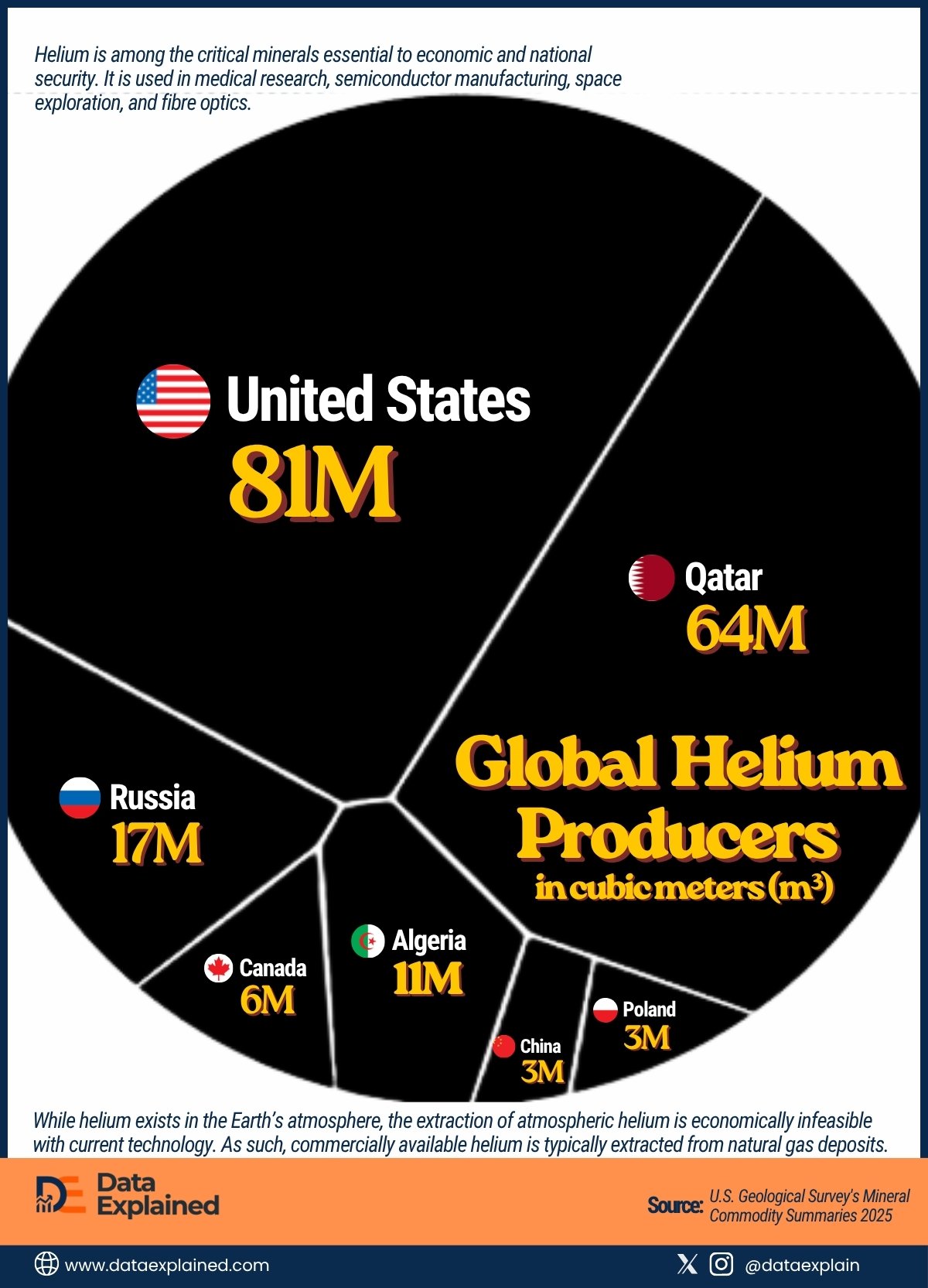
Seven countries produced all of the world’s commercially available helium in 2024.
Helium is among the critical minerals essential to economic and national security. It is used in medical research, semiconductor manufacturing, space exploration, and fibre optics.
Using the data from the U.S. Geological Survey’s Mineral Commodity Summaries 2025, the visualization above shows the top producers of this mineral in millions of cubic meters (m³).
TL;DR
- Seven countries produced a combined 185 million cubic meters of helium as of 2024
- Two of them (the United States at 81 million cubic meters and Qatar at 64 million cubic meters) accounted for 78.4% of everything.
One of those two has now been knocked offline.
QatarEnergy’s Ras Laffan Industrial City, the world’s largest liquefied natural gas export facility and the origin point of Qatar’s entire 64 million cubic metre helium output, was first struck by an Iranian drone early in the conflict.
Iranian missiles then crippled the plant.
Qatar’s 34.6% share of global helium supply (a third of everything the world produces) has been halted at a single industrial complex on the Qatari coast.
Ranked: Helium Production by Country
| wdt_ID | wdt_created_by | wdt_created_at | wdt_last_edited_by | wdt_last_edited_at | Country | Helium production (million m³) |
|---|---|---|---|---|---|---|
| 1 | emmanuel-ashemiriogwa | 30/03/2026 02:15 AM | emmanuel-ashemiriogwa | 30/03/2026 02:15 AM | United States | 81.00 |
| 2 | emmanuel-ashemiriogwa | 30/03/2026 02:15 AM | emmanuel-ashemiriogwa | 30/03/2026 02:15 AM | Qatar | 64.00 |
| 3 | emmanuel-ashemiriogwa | 30/03/2026 02:15 AM | emmanuel-ashemiriogwa | 30/03/2026 02:15 AM | Russia | 17.00 |
| 4 | emmanuel-ashemiriogwa | 30/03/2026 02:15 AM | emmanuel-ashemiriogwa | 30/03/2026 02:15 AM | Algeria | 11.00 |
| 5 | emmanuel-ashemiriogwa | 30/03/2026 02:15 AM | emmanuel-ashemiriogwa | 30/03/2026 02:15 AM | Canada | 6.00 |
| 6 | emmanuel-ashemiriogwa | 30/03/2026 02:15 AM | emmanuel-ashemiriogwa | 30/03/2026 02:15 AM | China | 3.00 |
| 7 | emmanuel-ashemiriogwa | 30/03/2026 02:15 AM | emmanuel-ashemiriogwa | 30/03/2026 02:15 AM | Poland | 3.00 |
| 8 | emmanuel-ashemiriogwa | 30/03/2026 02:15 AM | emmanuel-ashemiriogwa | 30/03/2026 02:15 AM | Total | 185.00 |
Qatar’s helium does not come from a helium facility. It never did.
Helium is extracted at Ras Laffan as a byproduct of natural gas liquefaction, a secondary output of the LNG processing operation that is Qatar’s primary industrial and export activity.
The helium extraction infrastructure is co-located with and entirely dependent on the LNG plant.
When Iranian missiles disabled the primary facility, the helium supply vanished automatically.
This did not happen because it was targeted, but because the infrastructure it depends on was taken out.
That dependency is the structural vulnerability the USGS data makes visible.
The world’s second-largest helium source has no dedicated production facility. It rides piggyback on natural gas. And the natural gas plant is now offline.
What the Supply Numbers Actually Mean
The headline figure of 185 million cubic metres overstates the supply available to Western industrial buyers in the current environment.
Two adjustments bring it closer to reality.
- Qatar’s 64 million cubic metres is disrupted.
- Russia’s 17 million cubic metres, the third-largest national output in the USGS dataset, is largely inaccessible to Western buyers under the sanctions regime imposed following the invasion of Ukraine.
Russia’s Amur Gas Processing Plant in Siberia, which came online in the early 2020s and was designed to make Russia a significant global helium exporter, is producing helium it cannot readily sell to its largest potential markets.
The Industries That Have No Alternative
Helium’s industrial criticality derives from properties that no other element can replicate at a commercially viable cost.
It is chemically inert, meaning it does not react with the materials it contacts in manufacturing environments.
It has the lowest boiling point of any element (4.2 degrees Kelvin above absolute zero), making it the only practical coolant for applications that require near-absolute-zero temperatures.
And it can be produced at sufficient purity for semiconductor-grade applications through natural gas processing.
That explains why the Ras Laffan facility became so central to global supply.
- Semiconductor fabrication plants use helium throughout the chip manufacturing process.
- When helium supply tightens, fabs cannot substitute another gas. They slow down the output or stop.
- MRI machines use liquid helium to cool the superconducting magnets that generate the magnetic fields on which diagnostic imaging depends. A global helium supply shock threatens hospital imaging capacity across all countries simultaneously.
The Timing Could Not Be Worse
The Ras Laffan disruption has arrived at the moment of peak growth in helium demand from a single sector: artificial intelligence infrastructure.
The rapid build-out of data centres, GPU clusters, and advanced node semiconductor manufacturing for AI applications has been driving accelerating helium consumption from chip fabs globally.
Data Eplained reported last week that global smartphone shipments are projected to fall by 0.9% to 5.2% in 2026 due to heavy demand for memory chips from AI data centers.
The supply shock has materialized precisely when demand from the fastest-growing segment of the global economy was at its highest point.
The depleted U.S. Federal Helium Reserve (the Bureau of Land Management’s Cliffside storage facility in Texas that once served as the global buffer against exactly this kind of disruption) offers limited relief.
Congress mandated its sale under the Helium Stewardship Act, and the reserve has been substantially drawn down over the past decade.
The 81 million cubic metres the United States produced in 2024, per the USGS, represents active field extraction from natural gas deposits in Texas, Kansas, and Wyoming. It is not reserved releases.
The buffer that existed for prior disruptions is largely gone.
Sources:
U.S. Geological Survey, Mineral Commodity Summaries 2025