

The European Union plans to spend up to €16 million on private jet travel for its top officials over the next four years.
This is according to a tender document published last week.
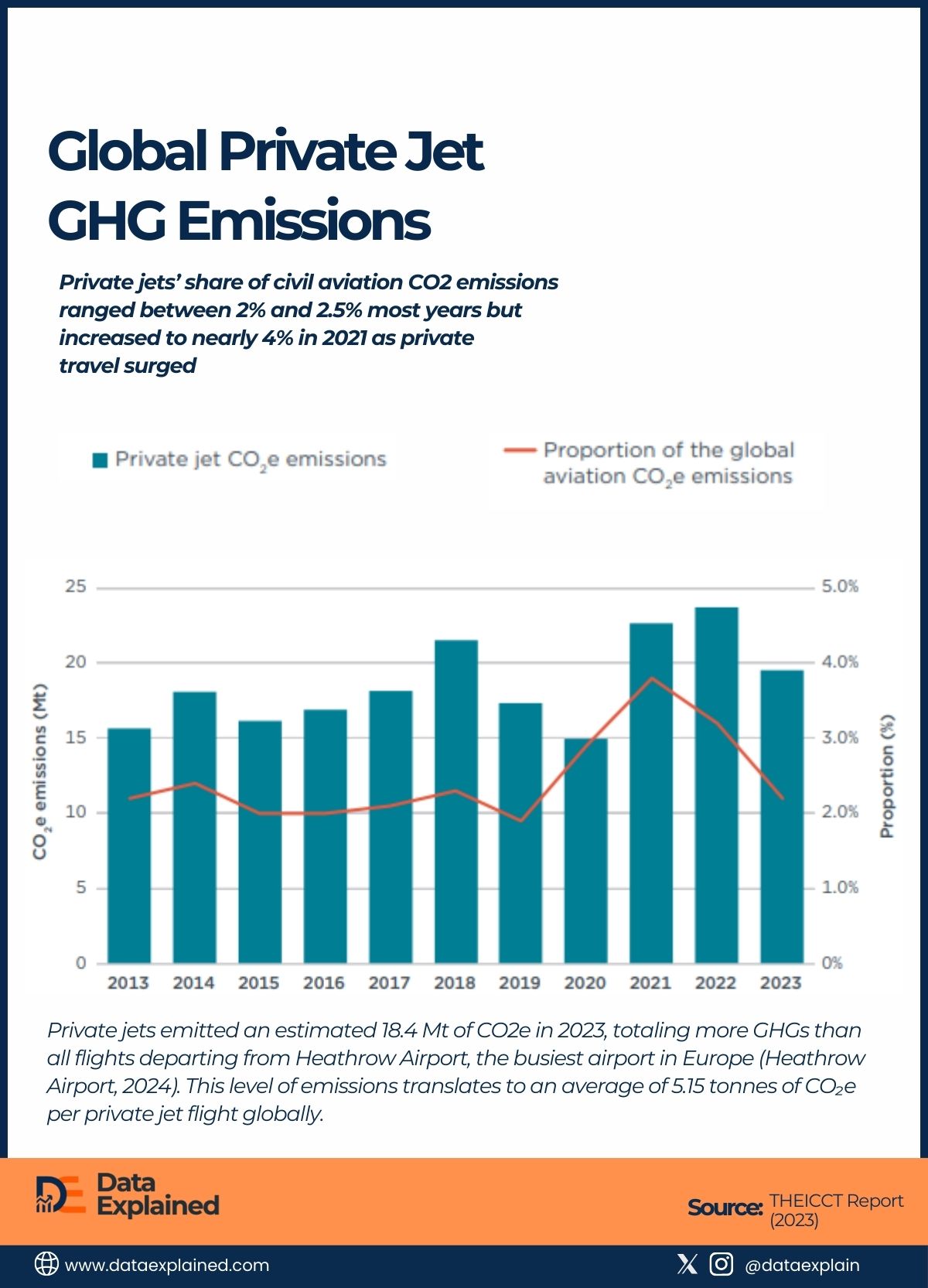
The spending is a 50% increase from the previous period, which comes as global emissions from luxury aviation have surged 46% since 2019.
That’s why the visualization above shows the trend of global private jet GHG emissions.
It comes from the International Council on Clean Transportation (ICCT), comparing private jet CO2e emissions and the proportion of the global aviation CO2e emissions
TL;DR
- EU private jet spending increased 50% to €16 million (2025-2029)
- Global private jet emissions surged 46% since 2019
- European flights jumped 381% between 2020 and 2022
The contract, shared among four major EU institutions including the European Commission and European Parliament, will provide “non-scheduled air-taxi transport services” using chartered jets starting in 2025.
The spending amounts to nearly €4 million per year, or roughly €10,685 every single day.
The timing could hardly be more awkward for a bloc that lectures the world about climate sacrifice.
The numbers don’t add up
Private jets are the most polluting form of transport in existence.
A single hour of flight produces two tonnes of CO2 (equivalent to 24% of what the average European emits over an entire year).
Studies show that private aviation is 5 to 14 times more polluting per passenger than commercial flights and 50 times worse than trains.
Yet European private jet use has exploded.
Between 2020 and 2022, the number of private flights in Europe skyrocketed from 119,000 to 573,000 (a 381% increase).
Over those three years, European private jets emitted 5.3 million tonnes of CO2, more than the entire nation of Uganda produces annually, despite having 46 million people.
The EU’s spending increase tracks almost perfectly with this emissions surge.
From 2017 to 2021, the bloc spent €10.67 million on private jets.
That jumped to €13 million for 2021-2025 and now stands at €16 million for 2025-2029. Each four-year period costs more than the last.
A double standard on climate
The contradiction between the EU climate policy for citizens and the EU travel policy for officials is stark.
- France has banned short-haul flights for the public when train alternatives are available within two and a half hours.
- The EU recently watered down its tough car emission rules that would have forced ordinary drivers to switch to electric vehicles.
- Brussels constantly pushes citizens to fly and drive less and to pay more in carbon taxes.
Meanwhile, EU officials are exempt from the bloc’s own Emissions Trading System because private jets fall below the 1,000-tonne CO2 threshold.
Private jet fuel is taxed at lower rates than commercial aviation or car fuel.
And most private jet flights in Europe cover distances of under 750 kilometers (trips that can be made by high-speed rail).
The tender document even lists “conflict zones” as potential destinations, suggesting that officials need private jets to reach them.
But commercial airlines serve most conflict-adjacent regions, and diplomats from other countries manage to fly commercially.
What the money buys
The four-year contract is renewable twice, meaning it could stretch to six years and potentially €24 million if all options are exercised.
The participating institutions are:
- The European Commission
- European Parliament
- European External Action Service
- Council of the European Union.
They will all share access to the jets.
For context, €16 million could fund 130 average EU salaries for four years. It could buy tens of thousands of train tickets that produce 50 times less pollution.
It could fund green energy research or climate adaptation programs in vulnerable countries.
The tender deadline was December 9, 2024. The contract is expected to begin in 2025 and run through 2029, with potential extensions until 2031.
Sources:
Official EU Site | THEICCT | Euro News |