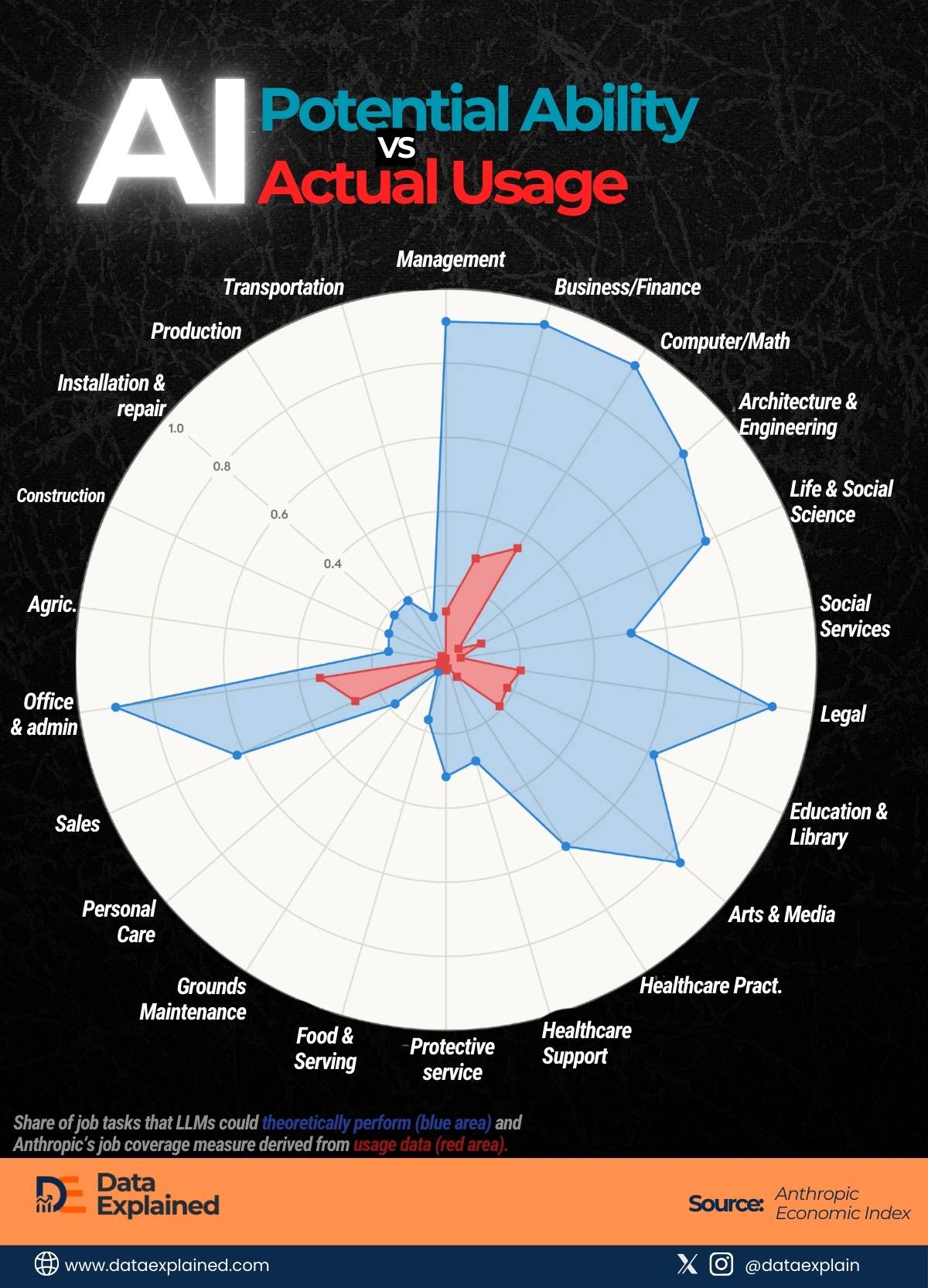
Artificial intelligence could potentially handle at least 80% of tasks in legal and office administration, but lawyers and office workers currently use AI for only 10-20% of their daily activities.
This is based on data gathered by Anthropic, the umbrella company of leading AI chatbot Claude.
The company conducted an analysis to illustrate the difference between theoretical and actual use on the Claude AI platform, grouped by broad occupational categories.
That’s exactly what today’s visualization shows.
TL;DR
- Office and administrative roles face the highest risk of automation, with a large gap between AI potential and actual use, while physical jobs like construction are largely unaffected.
- Business and finance professionals adopt AI at about 40-50% faster, but trust issues, regulations, and workflow barriers limit the productivity gains it delivers.
Office, Admin Work at Risk
Office and administrative roles are among the highest-risk for AI automation.
According to Anthropic’s charts, the potential for automation (shown in blue) ranges from 0.8 to 1.0, indicating that 80–100% of these tasks could be automated today.
However, actual usage (shown in red) is only around 0.1–0.2, meaning just 10–20% of admin tasks currently leverage AI. This makes the office and admin support the profession most vulnerable to automation, with the largest gap between capability and adoption.
Physical Jobs Are Protected
Blue bars for construction, agriculture, installation, and other manual trades remain small at just 10–30% theoretical AI exposure.
Unlike desk jobs, these positions demand real-world physical skills, movement in unpredictable settings, and hands-on tasks that current AI cannot replicate.
Actual or observed usage (shown in red bars) is even lower at 5–15%, indicating minimal AI adoption in blue-collar jobs today.
This situation keeps traditional physical roles relatively protected from automation, giving workers more time as office and administrative roles face immediate disruption.
Business, Finance Close Behind Management
Observed usage in business and finance roles is around 40–50%, ranking just below management and significantly higher than most other white-collar fields.
Notably, finance professionals are already using AI daily for tasks such as complex analysis, financial modeling, report creation, and detailed market research.
Hence, adoption is quickly nearing the limits of the technology’s capabilities, as shown in Anthropic’s blue bars.
This rapid growth indicates that white-collar jobs involving analysis are among the first to experience tangible productivity improvements from AI, with the pace of take-over surpassing that of other non-management sectors.
Why the Gap Exists
Several deeply rooted barriers explain why AI adoption is stuck at only 10-20%, despite 80-100% theoretical exposure in office, admin, and legal tasks.
- Awareness: Many professionals are unaware that current models can handle significant parts of their workflows, while others lack the prompting skills to achieve meaningful results.
- Trust: Trust issues also play a role. Here, lawyers and analysts hesitate to rely on outputs that may contain subtle errors or hallucinations.
- Regulation: Also, strict regulation and ethical concerns in fields like law and finance add another layer of caution, often requiring human oversight, which slows integration.
- Culture: Professional culture often resists change, and most AI tools still operate outside existing workflows, forcing workers to switch apps or manually double-check.
ELI5
AI can do a lot of work for lawyers, secretaries, and office workers, up to 80-100% of their tasks, but they actually only use it for about 10-20%. This means there’s a big gap between what AI can do and how much it actually helps in real life.
Office jobs and secretarial work are most at risk of being replaced by AI, while jobs that involve physical work, like building things, aren’t affected much yet.
Sources: