When discussing the speed at which humans can run, the answer depends less on a single number than on context.
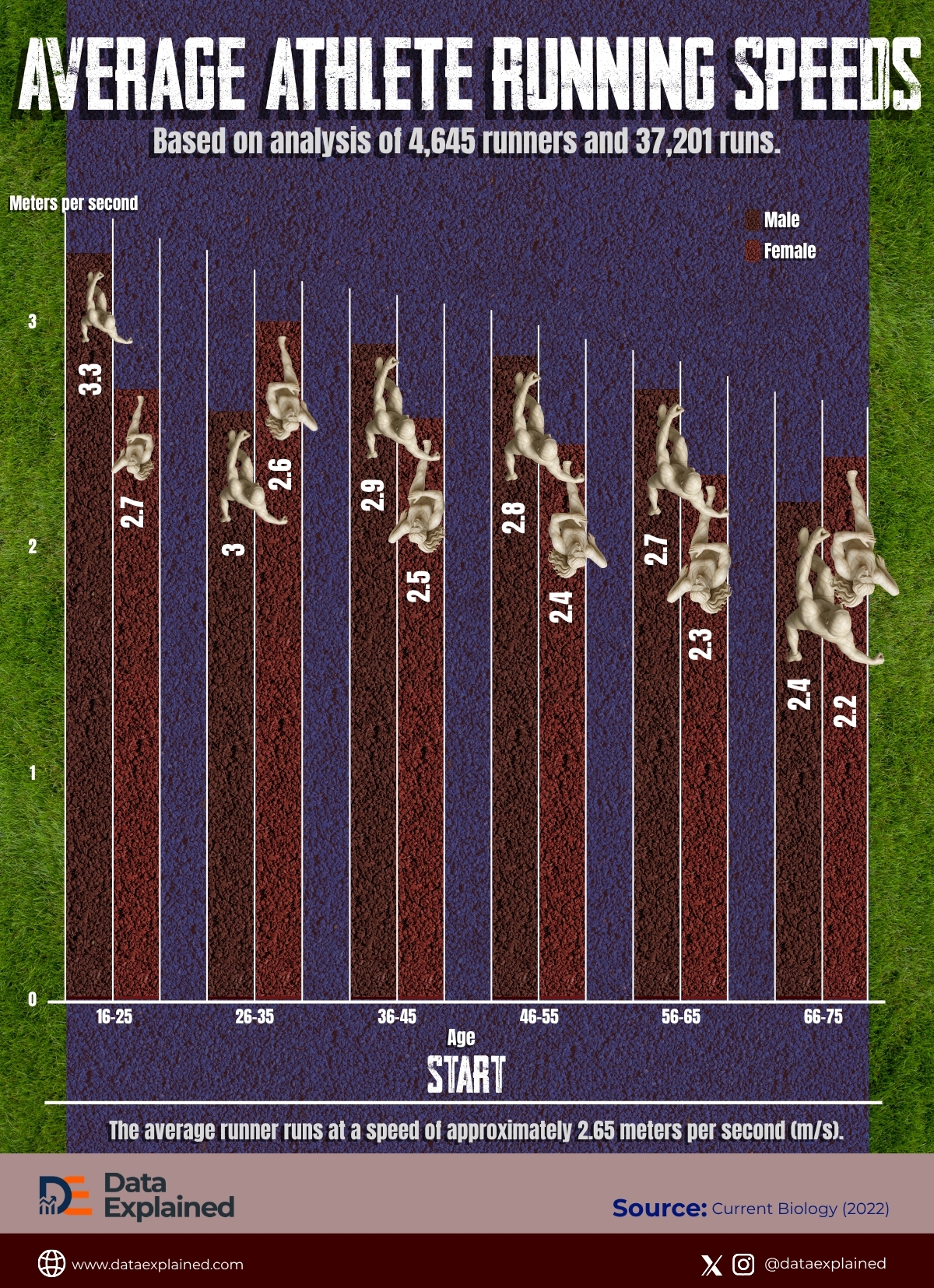
In today’s visualization, we show how fast the average athlete or runner runs.
This information was gathered from a 2022 study published in Current Biology, a biweekly peer-reviewed scientific journal. It analyzed 4,645 runners and 37,201 runs.
TL;DR
- The average female runner runs at approximately 2.65 meters per second (m/s) at energy-optimal speed.
- Male runners tend to run faster than females, but the average margin is small.
Average Human Running Speeds
| wdt_ID | wdt_created_by | wdt_created_at | wdt_last_edited_by | wdt_last_edited_at | Age | Male (m/s) | Female (m/s) |
|---|---|---|---|---|---|---|---|
| 1 | Monica Ebunoluwa | 10/04/2026 12:04 PM | Monica Ebunoluwa | 10/04/2026 12:04 PM | 16-25 | 3.3 | 2.7 |
| 2 | Monica Ebunoluwa | 10/04/2026 12:04 PM | Monica Ebunoluwa | 10/04/2026 12:04 PM | 26-35 | 3.0 | 2.6 |
| 3 | Monica Ebunoluwa | 10/04/2026 12:04 PM | Monica Ebunoluwa | 10/04/2026 12:04 PM | 36-45 | 2.9 | 2.5 |
| 4 | Monica Ebunoluwa | 10/04/2026 12:04 PM | Monica Ebunoluwa | 10/04/2026 12:04 PM | 46-55 | 2.8 | 2.4 |
| 5 | Monica Ebunoluwa | 10/04/2026 12:04 PM | Monica Ebunoluwa | 10/04/2026 12:04 PM | 56-65 | 2.7 | 2.3 |
| 6 | Monica Ebunoluwa | 10/04/2026 12:04 PM | Monica Ebunoluwa | 10/04/2026 12:04 PM | 66-75 | 2.4 | 2.2 |
On Average, Males Run Faster Than Females
The study breaks the data down by sex, and the differences are telling.
This gap is consistent across distances and can be primarily explained by physiological factors.
Men tend to have greater muscle mass, higher hemoglobin levels, and larger lung capacity, all of which translate into higher running speeds.
In this context, endurance running is not about bursts of speed but about holding an astonishingly high pace for hours on end.
Age Impacts Running Speeds
According to the data, young runners aged 16 to 25 run at an average speed of 3.3 and 2.7 meters per second (male and female, respectively).
By adulthood, speeds peak, before beginning to decline again in later life.
Older adult runners hover around 65 years old and average only 2.5 meters per second, as muscle mass, cardiovascular efficiency, and bone strength all decline with age.
This means that running speed is a moving target through the human lifespan, shaped as much by time as by training.
What is Other Research Saying?
In an attempt to align with this data, we cross-referenced it with other sources, such as SimTK-associated datasets and musculoskeletal simulations.
It covered 4,600 runners using Lumo Run sensors and analyzed ecological running speeds and energetics.
This is especially relevant to free-living environments, generally within the 1.5-5.5 m/s range for recreational runners.
The study found that the average preferred running speeds for athletes in free-living conditions are 3.25 to 3.42 m/s for males and 2.74 to 2.87 m/s for females.
Sources: