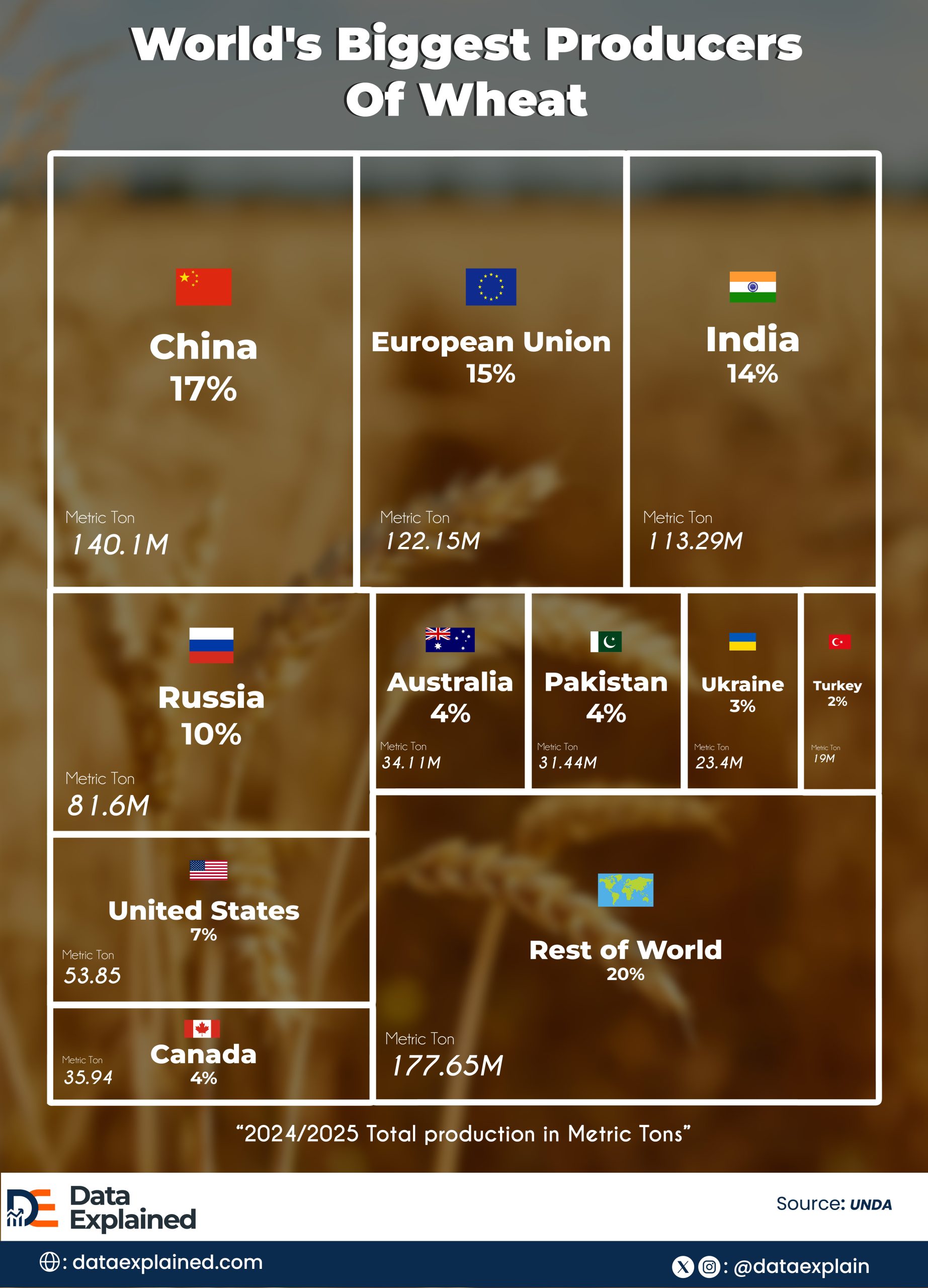
Globally, wheat production in 2025 was 800.79 million metric tons, a mere 1% increase from the previous year.
This grain supports jobs in rural communities and in mills, bakeries, grocery stores, and restaurants. But who produces the most wheat globally?
Data shows that China leads.
TL;DR
- China produces 17% of global wheat (140.1 million metric tons) yet consumes 150 million tons annually.
- Generally, Asia produces 45% of global wheat, but it is not the largest exporter.
- Climate volatility in just 3-4 export regions threatens the livelihoods of billions who depend on imports.
The data for this visualisation comes from the U.S Department of Agriculture.
Wheat Production Volume By Country (2025)
| wdt_ID | wdt_created_by | wdt_created_at | wdt_last_edited_by | wdt_last_edited_at | Country | % of Global Production | Total Production (Metric Tons in Millions) |
|---|---|---|---|---|---|---|---|
| 1 | Monica Ebunoluwa | 23/01/2026 12:46 PM | Monica Ebunoluwa | 23/01/2026 12:46 PM | China | 17 | 140.10 |
| 2 | Monica Ebunoluwa | 23/01/2026 12:46 PM | Monica Ebunoluwa | 23/01/2026 12:46 PM | European Union | 15 | 122.15 |
| 3 | Monica Ebunoluwa | 23/01/2026 12:46 PM | Monica Ebunoluwa | 23/01/2026 12:46 PM | India | 14 | 113.29 |
| 4 | Monica Ebunoluwa | 23/01/2026 12:46 PM | Monica Ebunoluwa | 23/01/2026 12:46 PM | Russia | 10 | 81.60 |
| 5 | Monica Ebunoluwa | 23/01/2026 12:46 PM | Monica Ebunoluwa | 23/01/2026 12:46 PM | United States | 7 | 53.85 |
| 6 | Monica Ebunoluwa | 23/01/2026 12:46 PM | Monica Ebunoluwa | 23/01/2026 12:46 PM | Canada | 4 | 35.94 |
| 7 | Monica Ebunoluwa | 23/01/2026 12:46 PM | Monica Ebunoluwa | 23/01/2026 12:46 PM | Australia | 4 | 34.11 |
| 8 | Monica Ebunoluwa | 23/01/2026 12:46 PM | Monica Ebunoluwa | 23/01/2026 12:46 PM | Pakistan | 4 | 31.44 |
| 9 | Monica Ebunoluwa | 23/01/2026 12:46 PM | Monica Ebunoluwa | 23/01/2026 12:46 PM | Ukraine | 3 | 23.40 |
| 10 | Monica Ebunoluwa | 23/01/2026 12:46 PM | Monica Ebunoluwa | 23/01/2026 12:46 PM | Turkey | 2 | 19.00 |
Why China Leads by Such a Wide Margin
This massive lead exists because China has set a target to increase grain production by 50 million metric tons by 2030.
It’s backed by government support for higher-yielding crops, improved irrigation, and agricultural technology, including drones and data analytics.
Despite being the world’s largest producer, China maintains large stockpiles to ensure food security for its vast population, with wheat a dietary staple driving high domestic consumption.
China’s dominance is about feeding 1.4 billion people, not global trade power.
The country’s wheat yields have risen from 3.7 tonnes per hectare (t/ha) in 2000 to 5.9 tonnes currently, with the potential to reach 9 t/ha.
Yet China is reducing wheat imports due to increased domestic capacity, with recent attractive pricing prompting purchases from Australia and Canada after avoiding them.
Asia Dominates Production but Not Exports
Asia produces 45% of global wheat.
To put it in context, China, India, Pakistan, and Turkey are responsible for 37% of global wheat production.
Yet Russia exported 31.59 million metric tons in the previous year, making it the largest wheat exporter, while Australia exported 29.29 million metric tons.
India and China are consumption giants, not export powerhouses.
In other words, big producers feed themselves while smaller producers (by volume) dominate trade.
Developing Nations Pay the Price
This market share says a lot more about dependency than dominance.
For example, Egypt imports 80% of its wheat from Russia and Ukraine. North Africa (Algeria, Morocco, Tunisia) relies heavily on exports to the EU and the Black Sea.
On the other hand, Southeast Asia (Indonesia, the Philippines, and Bangladesh) depends on Australia, Canada, and the U.S.
About 65% of wheat exported through the Black Sea Grain Initiative reached developing countries, with 8% bought by the UN World Food Programme for Afghanistan, Ethiopia, Kenya, Somalia, Sudan, and Yemen.
So, Russia’s exit from the initiative weaponised food access.
ELI5: Biggest Wheat Producers Worldwide
China grows a huge amount of wheat, 140 million tons (or 17% of the world’s supply), but it still eats even more than it produces, about 150 million tons a year.
Across the continent, Asia grows nearly half of the world’s wheat, yet most Asian countries don’t export much because they rely heavily on their own supply.
The real risk is that the world depends on just a few major wheat-exporting regions. If bad weather hits those areas (even for a single season), billions of people who rely on wheat imports could feel the impact.
Sources:
UNDA | Wheat Outlook July ‘25 | Council of Foreign Relations