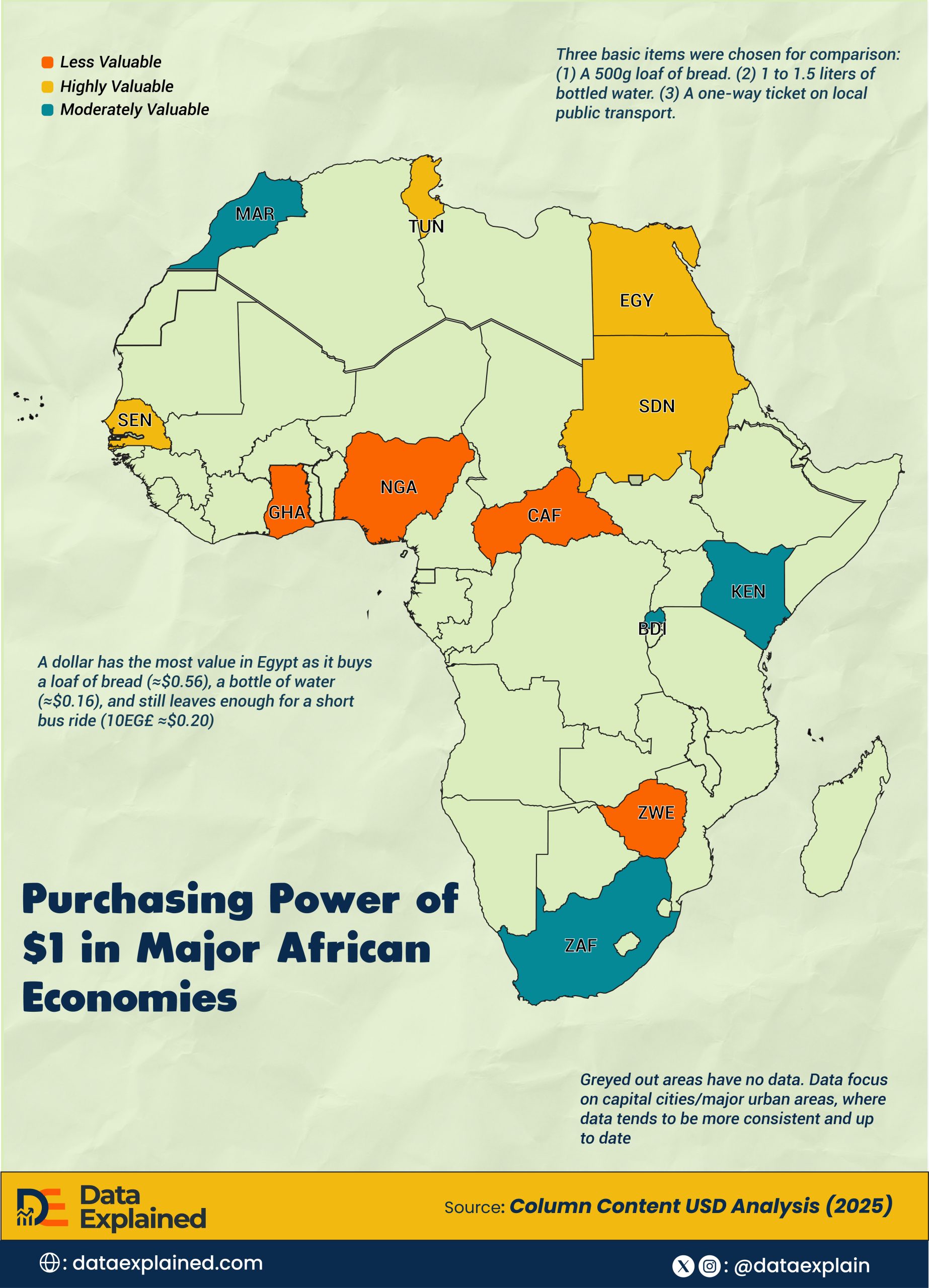
Across the African continent, the value of a dollar varies widely.
In some parts of Africa, you can walk away with a loaf of bread, a bottle of water, and even cover your bus fare. In others, that single dollar might not get you any of those.
Using the analysis on Column Content, this visualisation shows the value of $1 across African cities, based on prices in June 2025.
TL;DR
- A dollar has the most value in Egypt as it buys a loaf of bread (≈$0.56), a bottle of water (≈$0.16), and still leaves enough for a short bus ride (10EG£ ≈$0.20).
- In many West African countries, especially those outside the CFA franc zone, $1 appears not to stretch very far. Nigeria and Ghana stand out.
How the Purchasing Power of $1 Was Measured
Column Content compiled cost-of-living prices gathered from Numbeo, Wise, Prices World, Expatistan, and official government or telecom reports.
The focus was on capital cities or major urban areas, where data tends to be more consistent and up to date.
Three basic items were chosen for comparison:
- A 500g loaf of bread
- 1 to 1.5 liters of bottled water
- A one-way ticket on local public transport
Where $1 Buys More in Africa, Ranked
| wdt_ID | wdt_created_by | wdt_created_at | wdt_last_edited_by | wdt_last_edited_at | Countries | Value of $1 |
|---|---|---|---|---|---|---|
| 1 | Monica Ebunoluwa | 09/03/2026 02:33 PM | Monica Ebunoluwa | 09/03/2026 02:33 PM | Egypt | Highly valuable |
| 2 | Monica Ebunoluwa | 09/03/2026 02:33 PM | Monica Ebunoluwa | 09/03/2026 02:33 PM | Sudan | Highly valuable |
| 3 | Monica Ebunoluwa | 09/03/2026 02:33 PM | Monica Ebunoluwa | 09/03/2026 02:33 PM | Tunisia | Highly valuable |
| 4 | Monica Ebunoluwa | 09/03/2026 02:33 PM | Monica Ebunoluwa | 09/03/2026 02:33 PM | Senegal | Highly valuable |
| 5 | Monica Ebunoluwa | 09/03/2026 02:33 PM | Monica Ebunoluwa | 09/03/2026 02:33 PM | Côte d’Ivoire | Moderately Valuable |
| 6 | Monica Ebunoluwa | 09/03/2026 02:33 PM | Monica Ebunoluwa | 09/03/2026 02:33 PM | South Africa | Moderately Valuable |
| 7 | Monica Ebunoluwa | 09/03/2026 02:33 PM | Monica Ebunoluwa | 09/03/2026 02:33 PM | Kenya | Moderately Valuable |
| 8 | Monica Ebunoluwa | 09/03/2026 02:33 PM | Monica Ebunoluwa | 09/03/2026 02:33 PM | Morocco | Moderately Valuable |
| 9 | Monica Ebunoluwa | 09/03/2026 02:33 PM | Monica Ebunoluwa | 09/03/2026 02:33 PM | Rwanda | Moderately Valuable |
| 10 | Monica Ebunoluwa | 09/03/2026 02:33 PM | Monica Ebunoluwa | 09/03/2026 02:33 PM | Nigeria | Less Valuable |
As you can see, North African countries like Egypt, Tunisia, and Morocco generally offer more purchasing power for $1.
- In Egypt, $1 buys a loaf of bread (≈$0.56), a bottle of water (≈$0.16), and still leaves enough for a short bus ride (10EG£ ≈$0.20).
- In Sudan, you can get each item — bread, water, and a bus fare — for just about $1.
- In Tunisia, water and bread are even lower, each costing around $0.40.
In these countries, food and public services are often subsidized, helping to keep prices low.
These lower prices can also be tied to more stable exchange rates and stronger government control over key sectors such as bread production and public transport.
Where $1 Do Not Go A Long Way
Tourism-heavy countries like Seychelles or import-dependent nations like Mauritius tend to be more expensive.
- In Nigeria, a loaf of bread costs about $1.40, and a one-way bus fare is around $0.67.
- In Ghana, bread costs more than $1.34, and public transport costs about $1.00
- In Seychelles, the prices are the highest: bread averages $1.67, water $1.84, and transport $0.85.
In countries like Nigeria, currency devaluation and rising food prices have pushed even staple goods beyond the reach of the average dollar.
What This Means for You
In places where one dollar can stretch across several everyday necessities, people often find it easier to manage their day-to-day expenses.
But in countries where that same amount barely pays for part of a single item, living costs quickly become overwhelming.
When essentials like food and transport are expensive, it affects more than spending power.
It shapes health, education, access to work, and quality of life.
In countries such as Nigeria and Ghana, a larger portion of daily earnings now goes toward basic survival.
Sources: