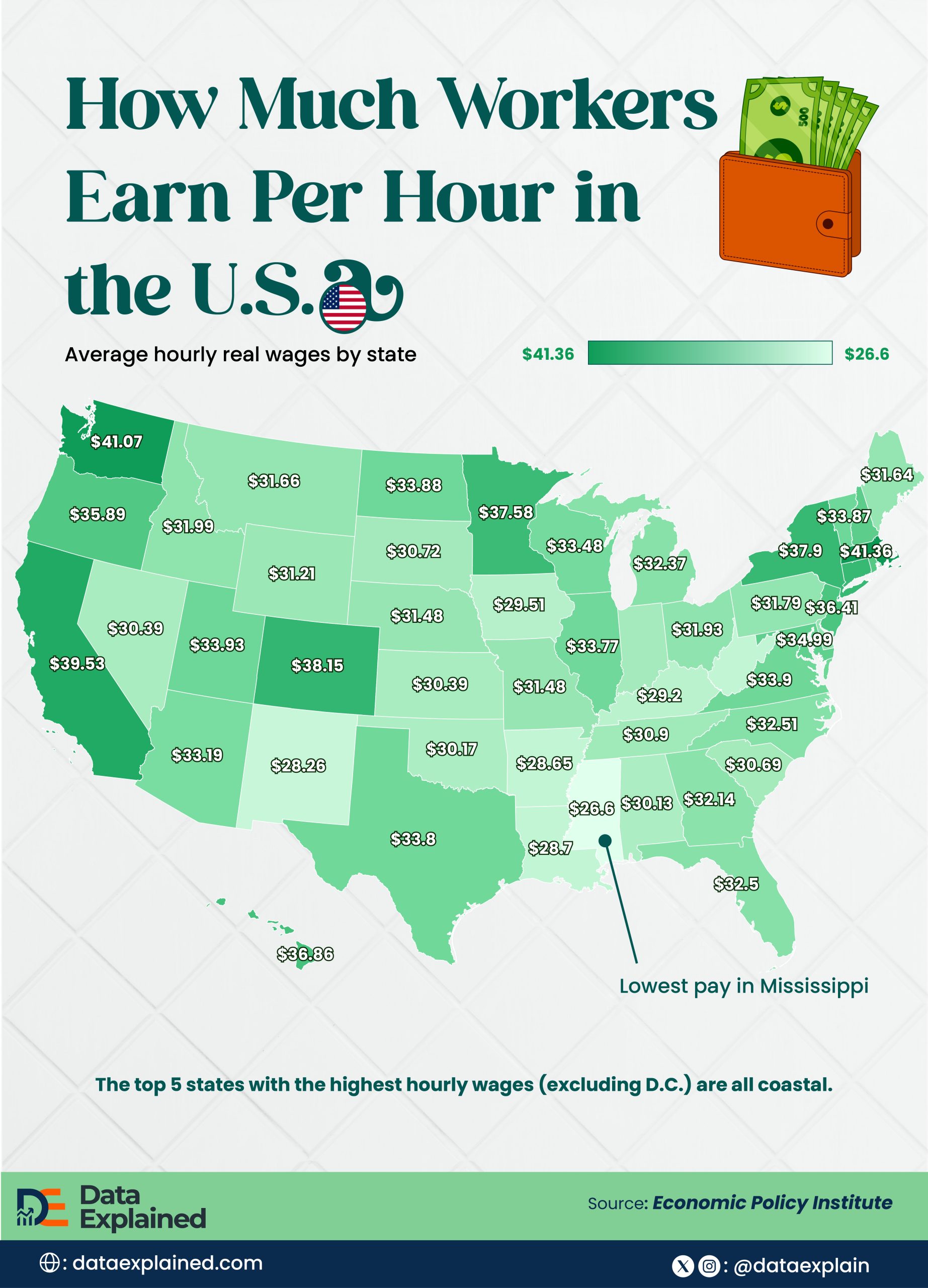
U.S. workers earned an average of $35.06 per hour in 2024, an 8.8% rise in real terms since 2015.
Many people argue that where you live determines your economic fate more than your talent, work ethic, or education.
This graphic shows average hourly real wages by state, based on data from the Economic Policy Institute.
TL;DR
- Washington, D.C., has the highest average hourly wage in the U.S., standing at $51.27.
- The top five states with the highest hourly wages (excluding D.C.) are mostly coastal, except for Colorado, which is landlocked.
The Average Hourly Wage by U.S. State
| wdt_ID | wdt_created_by | wdt_created_at | wdt_last_edited_by | wdt_last_edited_at | U.S States | Average Hourly Wage (USD) | Remark |
|---|---|---|---|---|---|---|---|
| 1 | Monica Ebunoluwa | 22/02/2026 10:49 AM | Monica Ebunoluwa | 22/02/2026 10:49 AM | Washington | 41.07 | Nearly High |
| 2 | Monica Ebunoluwa | 22/02/2026 10:49 AM | Monica Ebunoluwa | 22/02/2026 10:49 AM | Idaho | 31.99 | Nearly low |
| 3 | Monica Ebunoluwa | 22/02/2026 10:49 AM | Monica Ebunoluwa | 22/02/2026 10:49 AM | Montana | 31.66 | Nearly low |
| 4 | Monica Ebunoluwa | 22/02/2026 10:49 AM | Monica Ebunoluwa | 22/02/2026 10:49 AM | North Dakota | 33.88 | Nearly low |
| 5 | Monica Ebunoluwa | 22/02/2026 10:49 AM | Monica Ebunoluwa | 22/02/2026 10:49 AM | Minnesota | 37.58 | Moderate |
| 6 | Monica Ebunoluwa | 22/02/2026 10:49 AM | Monica Ebunoluwa | 22/02/2026 10:49 AM | Illinois | 33.77 | Nearly low |
| 7 | Monica Ebunoluwa | 22/02/2026 10:49 AM | Monica Ebunoluwa | 22/02/2026 10:49 AM | Wisconsin | 33.48 | Nearly low |
| 8 | Monica Ebunoluwa | 22/02/2026 10:49 AM | Monica Ebunoluwa | 22/02/2026 10:49 AM | Michigan | 32.37 | Nearly low |
| 9 | Monica Ebunoluwa | 22/02/2026 10:49 AM | Monica Ebunoluwa | 22/02/2026 10:49 AM | New York | 37.90 | Moderate |
| 10 | Monica Ebunoluwa | 22/02/2026 10:49 AM | Monica Ebunoluwa | 22/02/2026 10:49 AM | Rhode Island | 35.79 | Moderate |
As we can see, Washington, D.C. ranks first, boosted by its share of government employees.
In 2024, federal employees accounted for 25% of the workforce, with the Department of Homeland Security and the Department of Justice employing the most workers.
Meanwhile, D.C. is not a typical state. It’s a 68-square-mile city with:
- Lobbying industry: K Street lobbyists, lawyers, and consultants earn from $100,000 to over $500,000
- No rural areas: Unlike states with rural populations dragging down averages, D.C. is entirely urban or professional
- High cost of living: $51.27 per hour ($106,000 per year) sounds rich, but D.C. housing costs are the 2nd highest nationally.
“Great Migration” to Low-Wage States
Despite lower wages, people are moving from high-wage coastal states to lower-wage Sun Belt states (Texas, Florida, Tennessee, Arizona, North Carolina).
Why?
- Housing costs: California housing is 3-4x Texas housing
- Remote work: Tech workers earning San Francisco salaries ($150,000+) moved to Austin/Miami (2020-2024), arbitrage cost-of-living
- Taxes: No state income tax in Texas/Florida/Tennessee
But the pace of this migration has slowed in 2024–2025 due to rising housing costs in Sun Belt metros and companies encouraging employees to return to the office, while overall movement toward these states continues.
For workers, the “arbitrage opportunity” of 2020-2023 is closing.
Sun Belt housing is no longer cheap, and coastal employers are cutting the pay of remote workers.
ELI5: Average Hourly Wage in the U.S
For the average American, where you live determines your economic fate more than your talent, work ethic, or education.
For example, a nurse in Massachusetts earns $45 per hour; the same nurse in Mississippi earns $28 per hour. It’s the same job, but 60% wage gap.
This creates pressure to move to high-wage states, but housing costs (around $2,500 per month in Boston vs. $800 per month in Mississippi) eat up the wage premium.
Sources: