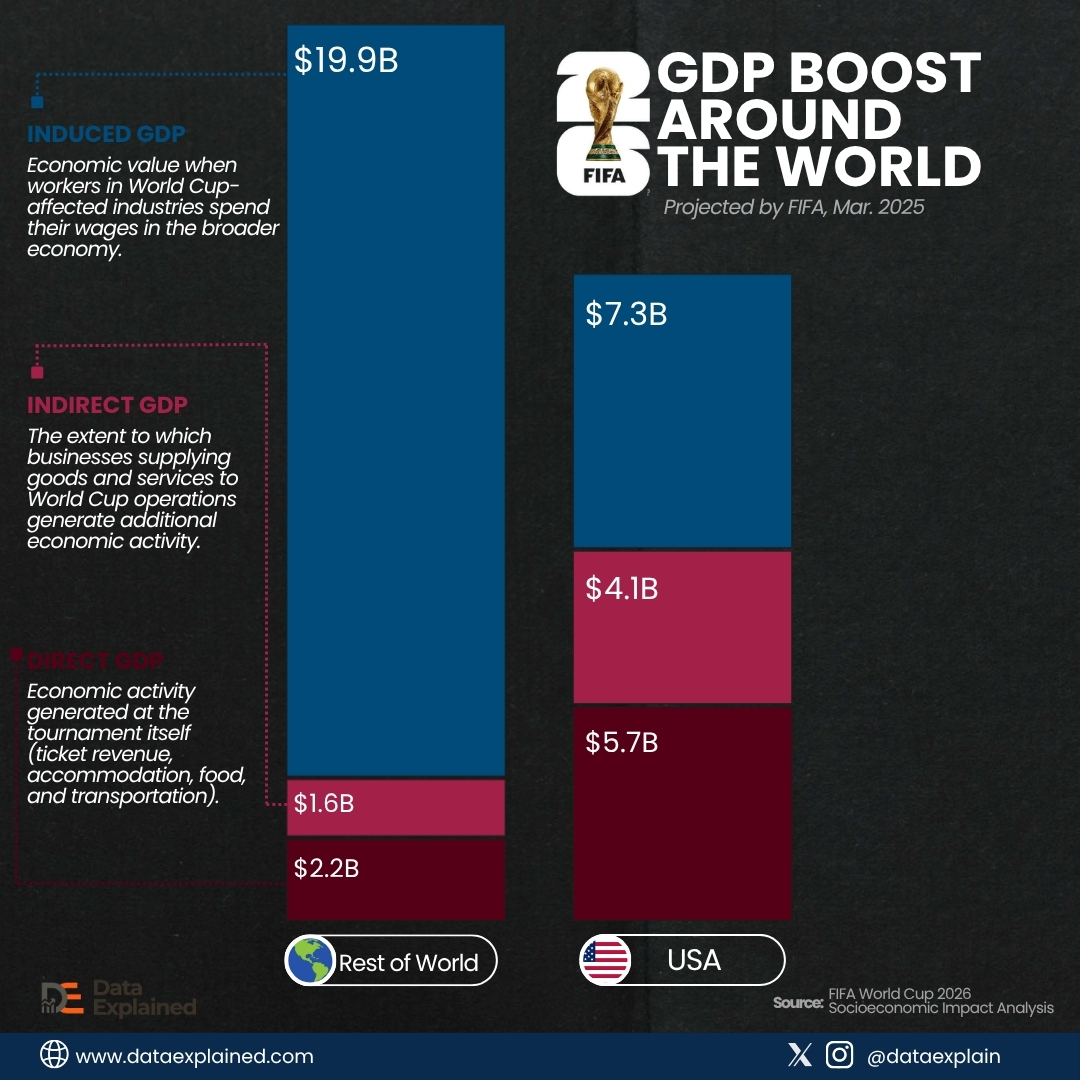
The United States is hosting the majority of the 2026 FIFA World Cup. FIFA’s own data shows the U.S. is not the majority economic beneficiary of doing so.
According to the FIFA World Cup 2026 Socioeconomic Impact Analysis, published in March 2025, the Rest of World economies will generate $23.7 billion of value in gross domestic product (GDP) from the tournament.
That is $6.6 billion more than the United States’ $17.2 billion.
TL;DR
- The Rest of the World’s GDP multiplier (1.71) is 39% higher than the USA’s (1.23).
- It means non-host economies generate more economic return per dollar of World Cup activity than the country that built the stadiums, trained the security forces, and absorbed the infrastructure costs.
ALSO READ: World Cup To Create More Jobs Outside US Than Inside It, FIFA Analysis Shows
How the Economic Impact Breaks Down
| wdt_ID | wdt_created_by | wdt_created_at | wdt_last_edited_by | wdt_last_edited_at | Impact | USA ($M) | Rest of the World ($M) |
|---|---|---|---|---|---|---|---|
| 1 | emmanuel-ashemiriogwa | 24/06/2026 02:42 PM | emmanuel-ashemiriogwa | 24/06/2026 02:42 PM | Direct GDP | 5,707 | 2,201 |
| 2 | emmanuel-ashemiriogwa | 24/06/2026 02:42 PM | emmanuel-ashemiriogwa | 24/06/2026 02:42 PM | Indirect GDP | 4,139 | 1,586 |
| 3 | emmanuel-ashemiriogwa | 24/06/2026 02:42 PM | emmanuel-ashemiriogwa | 24/06/2026 02:42 PM | Induced GDP | 7,302 | 19,983 |
| 4 | emmanuel-ashemiriogwa | 24/06/2026 02:42 PM | emmanuel-ashemiriogwa | 24/06/2026 02:42 PM | Total | 17,148 | 23,770 |
The analysis divides economic impact into three layers: Direct, Indirect, and Induced.
Direct impact is the most immediate. That is, the economic activity generated at the tournament itself.
This includes ticket revenue, accommodation, food, and transportation.
The U.S. captures more Direct GDP than the Rest of the world at $5.7 billion.
This is expected and logical. The matches and fans are in the U.S.; Therefore, the first-contact economic activity is concentrated where the event is held.
However, the Indirect impact, which is the supply chain effect, is the extent to which businesses supplying goods and services to World Cup operations generate additional economic activity.
In that segment, U.S. Indirect GDP is $4.1 billion, from $13.4 billion in gross output.
The Induced category captures what happens when workers in World Cup-affected industries spend their wages in the broader economy.
The Rest of the world figure is enormous because the merchandise, broadcasting equipment, licensed products, and manufactured goods consumed during a tournament staged in American stadiums are predominantly produced outside the United States.
FIFA’s Position in the Map
FIFA projects approximately $14 billion in revenues from the 2026 World Cup.
As a non-profit organization registered in Switzerland, FIFA does not pay U.S. corporate income tax on revenues generated from operations on American soil.
The U.S. GDP impact from the tournament is $17.2 billion. FIFA’s projected untaxed take is approximately $14 billion.
If a standard 21% U.S. corporate tax rate applied to FIFA’s American revenues, the U.S. federal government would collect approximately $2.94 billion.
That is a fund that could partially offset the costs of public infrastructure, security, and services borne by host cities across the United States.
That offset does not exist.
Host cities in Dallas, Atlanta, Los Angeles, New York/New Jersey, Houston, and Miami contributed public funds to stadium upgrades, law enforcement deployments, transportation improvements, and public services.
Those costs appear nowhere in the FIFA socioeconomic analysis as a deduction from the benefit figure.
ALSO READ: Over $1.8B Staked For 2026 World Cup Winner: Spain, France Lead With 16%
There’s a Projection Caveat
The analysis was published 15 months before the tournament started.
It means that all figures are pre-event projections based on economic modeling, not measured outcomes.
FIFA commissioned the study, the same organization whose $14 billion in revenues is the primary financial stake in the analysis’s conclusions.
Independent post-tournament assessments, typically published 12-24 months after conclusion, will measure the actual U.S. and global GDP outcomes against which FIFA’s projections can be evaluated.
The historical record of event-organizer-commissioned impact studies finding lower actual benefits than projected is the context in which the $17.2 billion and $23.8 billion figures should be held.
ELI5 (Explain It Like I’m 5)
The U.S. is hosting most of the 2026 World Cup, but FIFA’s own report shows other countries will actually earn more money from it ($24B) than the U.S. does ($17B). That’s because most World Cup merchandise and supplies are made outside America.
FIFA itself earns about $14 billion from the event but pays no U.S. taxes because it’s registered as a charity in Switzerland. American cities paid billions for security and stadiums, but don’t get that money back in taxes from FIFA.
Source:
FIFA World Cup 2026 Socioeconomic Impact Analysis (Mar. 2025)