Does it suffice to say we are now in an era where AI does the writing and presentation of news stories in traditional media?
While this raises questions about credibility, reliability, and originality, trends suggest that more newsrooms are relying on AI, and their audience appears undeterred.
TL;DR
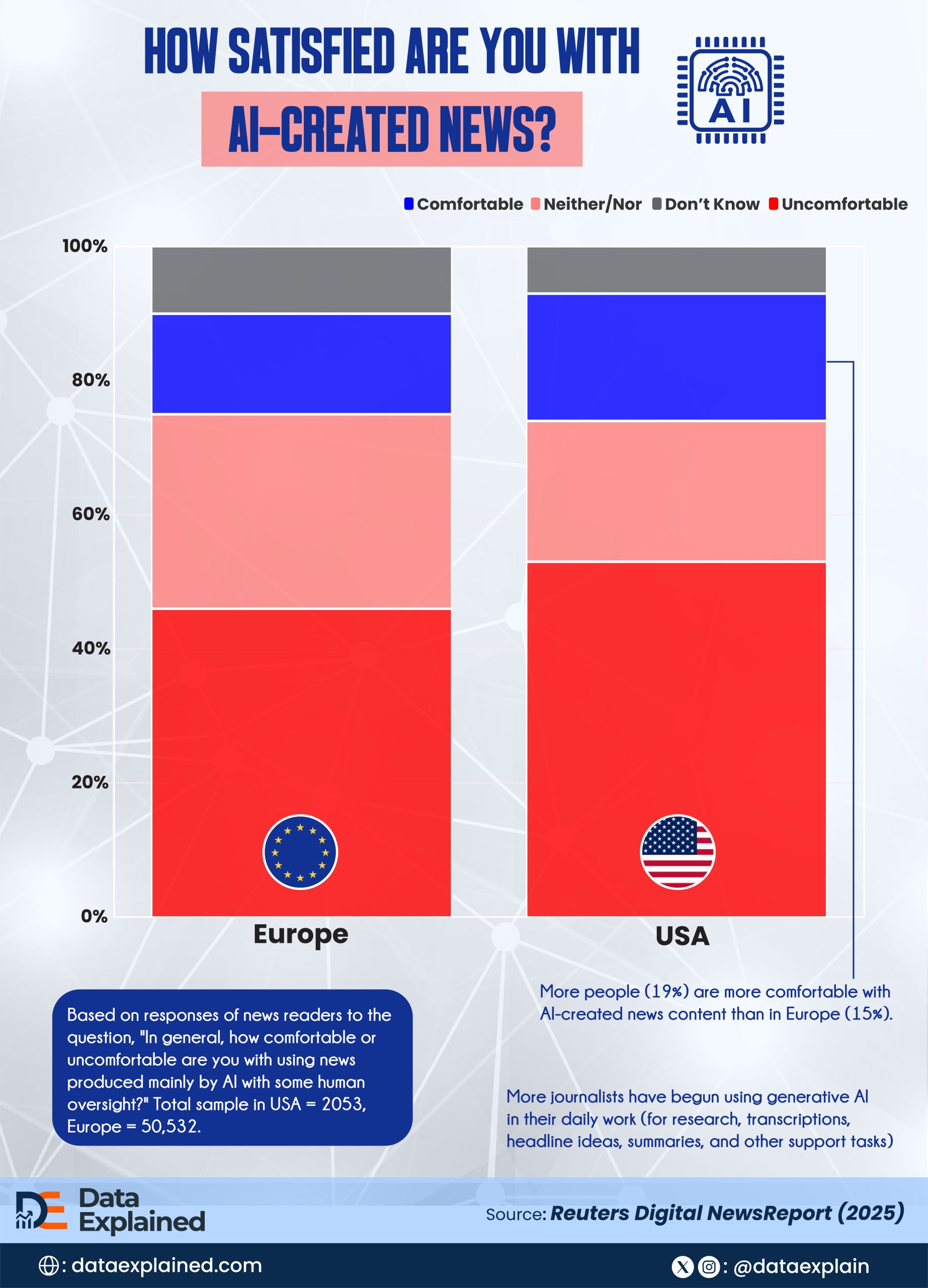
- Approximately 19% and 15% of global readers in the U.S. and Europe, respectively, are comfortable with news produced mainly by AI.
- The smartphone dominated attention as a news source over other devices and sources.
The data used in this story is based on the Reuters Digital News Report 2025. Approximately 100,000 people were surveyed worldwide.
Satisfaction with AI-created News in the U.S. vs Europe
Based on the report, the table below shows the proportion of people in America versus Europe who say they are comfortable with news being produced mainly by AI with human oversight:
| wdt_ID | wdt_created_by | wdt_created_at | wdt_last_edited_by | wdt_last_edited_at | Region | Comfortable (%) | Neither/Nor (%) | Don’t Know (%) | Uncomfortable (%) |
|---|---|---|---|---|---|---|---|---|---|
| 1 | Monica Ebunoluwa | 23/03/2026 11:21 AM | Monica Ebunoluwa | 23/03/2026 11:21 AM | USA | 19 | 21 | 7 | 53 |
| 2 | Monica Ebunoluwa | 23/03/2026 11:21 AM | Monica Ebunoluwa | 23/03/2026 11:21 AM | Europe | 15 | 29 | 10 | 46 |
From page 29 of the report
Over the past year, more journalists have begun using generative AI in their daily work (for research, transcriptions, headline ideas, summaries, and other support tasks).
Some outlets have taken it a step further by allowing AI to write stories automatically.
At Reach in the UK, an AI tool called Gutenbot helps rewrite articles for various websites. Meanwhile, the German tabloid Express.de has published many AI-written stories, accounting for approximately 11% of articles.
Traditional vs. Social Media Channels for News
If AI is changing how news is created, audience behaviour is changing where it’s consumed.
Below is a table showing the proportions who say each is the first way they come across the news in the morning (in 2025) in the UK and the USA.
People were asked. “What is the FIRST way you typically come across news in the morning?”
The result is based on a total sample in each country (2000).
| wdt_ID | wdt_created_by | wdt_created_at | wdt_last_edited_by | wdt_last_edited_at | Sources | UK audience (%) | USA audience (%) |
|---|---|---|---|---|---|---|---|
| 1 | Monica Ebunoluwa | 23/03/2026 11:25 AM | Monica Ebunoluwa | 23/03/2026 11:25 AM | TV | 20 | 28 |
| 2 | Monica Ebunoluwa | 23/03/2026 11:25 AM | Monica Ebunoluwa | 23/03/2026 11:25 AM | Radio | 18 | 6 |
| 3 | Monica Ebunoluwa | 23/03/2026 11:25 AM | Monica Ebunoluwa | 23/03/2026 11:25 AM | Smartphone | 37 | 39 |
| 4 | Monica Ebunoluwa | 23/03/2026 11:25 AM | Monica Ebunoluwa | 23/03/2026 11:25 AM | Computer | 7 | 10 |
| 5 | Monica Ebunoluwa | 23/03/2026 11:25 AM | Monica Ebunoluwa | 23/03/2026 11:25 AM | Newspaper | 2 | 1 |
From page 31 of the report
And this is not just in 2025. The report even stated that “over the last decade, the smartphone has stolen attention from other devices and sources.”
ELI5
Newsrooms are trying out robot helpers that can write and suggest news stories. Most people in the U.S. and Europe are okay with humans staying in charge, but not with robots leading on their own. Journalists utilise tools like ChatGPT and Google Gemini to work more efficiently.