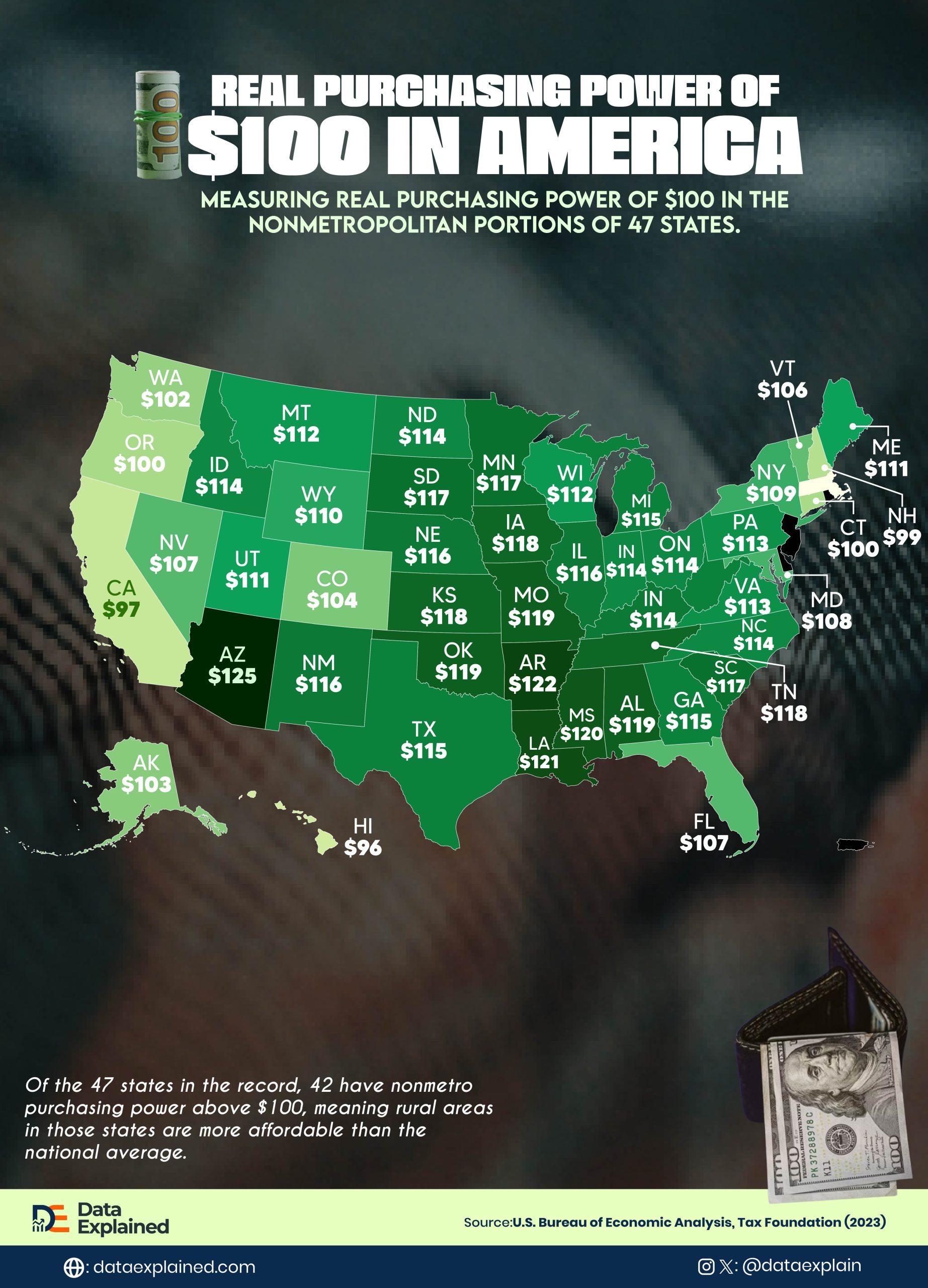
Rural America is cheaper than the national average almost everywhere.
Of the 47 states with recorded nonmetropolitan populations, 42 have rural purchasing power above $100.
This means a dollar goes further in their countryside than it does at the national baseline.
The map above is based on data harvested from the U.S. Bureau of Economic Analysis, published by the Tax Foundation for 2023.
It measures the real purchasing power of $100 in the nonmetropolitan portions of 47 states.
ALSO READ: Purchasing Power of $1 in Major African Cities
TL;DR
- In rural Massachusetts, $100 buys just $91.11 worth of goods and services (the lowest purchasing power of any state), while rural Arizona leads at $125.24
- Only five states have rural purchasing power below the national average of $100, all coastal or New England states where high urban costs extend into rural communities.
- A worker earning $50,000 in rural Arizona has the equivalent purchasing power of approximately $62,620 nationally. The same salary in rural Massachusetts is worth approximately $45,555.
| wdt_ID | wdt_created_by | wdt_created_at | wdt_last_edited_by | wdt_last_edited_at | State | Real Value of $100 (2023) |
|---|---|---|---|---|---|---|
| 1 | Monica Ebunoluwa | 17/08/2026 09:53 AM | Monica Ebunoluwa | 17/08/2026 09:53 AM | Alabama | 119 |
| 2 | Monica Ebunoluwa | 17/08/2026 09:53 AM | Monica Ebunoluwa | 17/08/2026 09:53 AM | Alaska | 103 |
| 3 | Monica Ebunoluwa | 17/08/2026 09:53 AM | Monica Ebunoluwa | 17/08/2026 09:53 AM | Arizona | 125 |
| 4 | Monica Ebunoluwa | 17/08/2026 09:53 AM | Monica Ebunoluwa | 17/08/2026 09:53 AM | Arkansas | 122 |
| 5 | Monica Ebunoluwa | 17/08/2026 09:53 AM | Monica Ebunoluwa | 17/08/2026 09:53 AM | California | 97 |
| 6 | Monica Ebunoluwa | 17/08/2026 09:53 AM | Monica Ebunoluwa | 17/08/2026 09:53 AM | Colorado | 104 |
| 7 | Monica Ebunoluwa | 17/08/2026 09:53 AM | Monica Ebunoluwa | 17/08/2026 09:53 AM | Connecticut | 100 |
| 8 | Monica Ebunoluwa | 17/08/2026 09:53 AM | Monica Ebunoluwa | 17/08/2026 09:53 AM | Florida | 107 |
| 9 | Monica Ebunoluwa | 17/08/2026 09:53 AM | Monica Ebunoluwa | 17/08/2026 09:53 AM | Georgia | 115 |
| 10 | Monica Ebunoluwa | 17/08/2026 09:53 AM | Monica Ebunoluwa | 17/08/2026 09:53 AM | Hawaii | 96 |
Five States Where Rural is Still Expensive
Of the 47 states in the record, 42 have nonmetro purchasing power above $100, meaning rural areas in those states are more affordable than the national average.
Only five do not: Massachusetts ($91.11), Hawaii ($96.28), California ($97.47), New Hampshire ($98.78), and Connecticut ($99.83).
All five are coastal or New England states.
Their shared characteristic is that high urban costs extend into rural communities, through housing demand, labor market spillovers, and service price levels that do not drop as sharply outside city limits as they do in most of the country.
California is the most practically significant of the five.
The assumption that leaving a California city for the Central Valley, the Sierra foothills, or the North Coast solves the affordability problem is not supported by the data.
Housing in rural California costs more than the national average. Rural Arkansas ($121.69), rural Mississippi ($119.50), and rural Missouri ($119.46) all offer significantly greater purchasing power than California’s countryside.
Where Rural Dollars Go Furthest
The highest purchasing power on record clusters in the South and the Lower Midwest.
Arkansas ($121.69), Louisiana ($120.59), Mississippi ($119.50), Missouri ($119.46), and Oklahoma ($119.28) all sit above $119.
Lower land, labor, and service costs in rural communities across this geographic band produce genuine affordability.
Iowa leads the Midwest at $117.68 (above Illinois ($116.40), Minnesota ($116.54), Wisconsin ($112.35), Michigan ($115.40), and Ohio ($114.36)).
Iowa’s agricultural rural economy produces the highest real purchasing power of any Midwestern state’s countryside.
And that’s with well-developed small-town infrastructure and lower housing costs than its more industrialized neighbors,
ELI5
In most of rural America, $100 goes further than it does nationally.
This means everyday things cost less than in cities.
But in five states (Massachusetts, Hawaii, California, New Hampshire, and Connecticut) even rural areas are more expensive than the U.S. average.
The biggest gap is between rural Massachusetts, where $100 is only worth about $91, and rural Arizona, where it buys about $125 worth of goods.
Source: