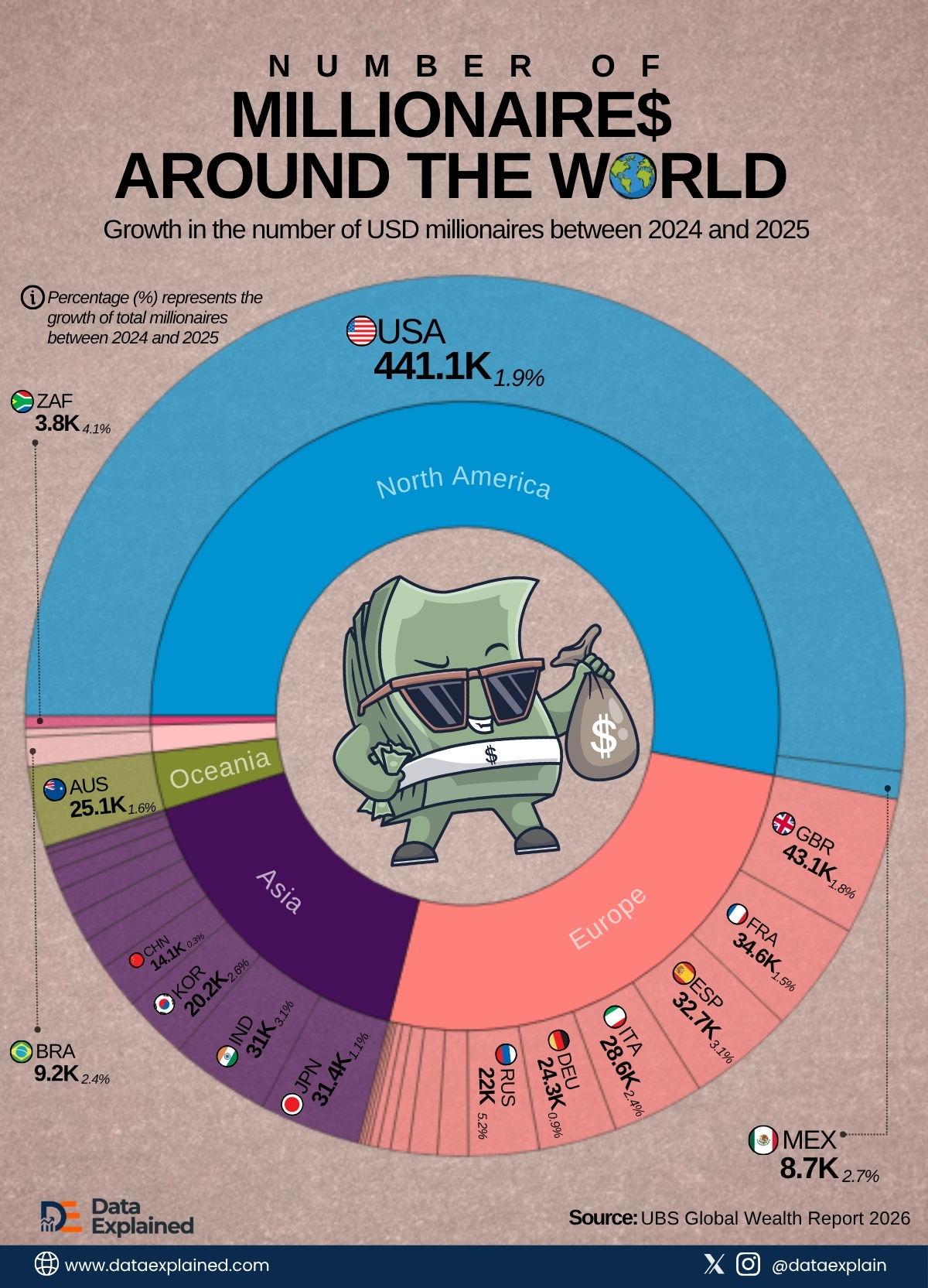
Nearly a million new millionaires were created worldwide in the year from 2024 to 2025.
That works out to more than 2,600 every single day. Almost half of them live in one country.
The visualization above shows growth in the number of USD millionaires by country between the years mentioned earlier.
It is based on data from the UBS Global Wealth Report 2026, published July 1.
The United States added 441,078 new dollar millionaires in the period, representing approximately 46.6% of the tracked total across 31 markets.
TL;DR
- The world created approximately 2,600 new millionaires every day in 2025, with nearly 1 million new dollar millionaires added globally across 31 tracked markets.
- The United States added 441,078 new millionaires (46.6% of the tracked global total) at a growth rate of just 1.9%, demonstrating that a low percentage of a massive existing base outproduces high percentage growth in smaller economies by an enormous margin.
ALSO READ: Gold Reserves: Nations With The Most “Untouchable” Wealth
| wdt_ID | wdt_created_by | wdt_created_at | wdt_last_edited_by | wdt_last_edited_at | Market | Growth (%) | Number of people |
|---|---|---|---|---|---|---|---|
| 1 | emmanuel-ashemiriogwa | 04/07/2026 12:23 PM | emmanuel-ashemiriogwa | 04/07/2026 12:23 PM | Lithuania | 8.00 | 921 |
| 2 | emmanuel-ashemiriogwa | 04/07/2026 12:23 PM | emmanuel-ashemiriogwa | 04/07/2026 12:23 PM | Türkiye | 6.40 | 5,650 |
| 3 | emmanuel-ashemiriogwa | 04/07/2026 12:23 PM | emmanuel-ashemiriogwa | 04/07/2026 12:23 PM | Latvia | 5.70 | 1,131 |
| 4 | emmanuel-ashemiriogwa | 04/07/2026 12:23 PM | emmanuel-ashemiriogwa | 04/07/2026 12:23 PM | Hungary | 5.30 | 1,349 |
| 5 | emmanuel-ashemiriogwa | 04/07/2026 12:23 PM | emmanuel-ashemiriogwa | 04/07/2026 12:23 PM | Ireland | 5.20 | 9,491 |
| 6 | emmanuel-ashemiriogwa | 04/07/2026 12:23 PM | emmanuel-ashemiriogwa | 04/07/2026 12:23 PM | Russia | 5.20 | 21,951 |
| 7 | emmanuel-ashemiriogwa | 04/07/2026 12:23 PM | emmanuel-ashemiriogwa | 04/07/2026 12:23 PM | Israel | 4.70 | 8,803 |
| 8 | emmanuel-ashemiriogwa | 04/07/2026 12:23 PM | emmanuel-ashemiriogwa | 04/07/2026 12:23 PM | South Africa | 4.10 | 3,840 |
| 9 | emmanuel-ashemiriogwa | 04/07/2026 12:23 PM | emmanuel-ashemiriogwa | 04/07/2026 12:23 PM | Poland | 4.00 | 3,888 |
| 10 | emmanuel-ashemiriogwa | 04/07/2026 12:23 PM | emmanuel-ashemiriogwa | 04/07/2026 12:23 PM | Chile | 3.90 | 2,593 |
There’s a Percentage Paradox
The list contains a finding that looks counterintuitive until the arithmetic is examined.
Lithuania tops the global growth rate table at 8.0%, four times the United States’ 1.9%. Lithuania produced 921 new millionaires. The United States produced 441,078.
The explanation is simple: 8.0% of a small number is still a small number.
The growth rate table and the absolute creation table are measuring different things, and conflating them produces a misleading picture of where wealth is actually accumulating.
The most geopolitically significant number in the dataset belongs to the world’s second-largest economy.
Mainland China recorded 0.3% millionaire growth in 2025, joint-lowest in the entire dataset alongside Hong Kong SAR, also at 0.3%.
China produced 14,079 new millionaires. The United States, with a growth rate one-sixth the height of Lithuania’s, produced 31 times as many as China.

Russia’s Millionaires Growth at 5.2%
Russia added 21,951 new millionaires, a growth rate of 5.2%, higher than those of the United States (1.9%), the United Kingdom (1.8%), Germany (0.9%), France (1.5%), and every other G7 economy in the dataset.
Russia has been under comprehensive Western sanctions since 2022. Its banking system has been disconnected from international settlement networks.
Hundreds of billions in private assets have been targeted for seizure by Western governments.
The 5.2% growth rate does not suggest sanctions have had no effect. But it documents that Russian millionaire creation continued in 2025 at a faster pace than in most developed economies.
Oil and gas revenues flowing to China, India and other non-sanctioning markets have generated domestic wealth that the sanctions framework was designed to prevent from accumulating.
The data does not render a verdict on sanctions effectiveness broadly, but it records what happened to Russian millionaire numbers while they were in place.
ALSO READ: Older Americans Lose Twice as Much to Fraud as Any Group, FTC Data Shows
The Bottom Half of the Table
Germany, at 0.9%, is the slowest-growing millionaire market in Western Europe, below France (1.5%), Italy (2.4%), Spain (3.1%), Ireland (5.2%), and every other European economy in the dataset. The same structural crisis visible in Germany’s GDP data.
Germany’s wealth stagnation and economic stagnation tell the same story from two different angles.
Japan at 1.1% growth produced 31,428 new millionaires, a figure that partly reflects the yen’s weakness against the dollar in 2024-2025. Millionaire status in this dataset is measured in USD terms.
A Japanese individual whose wealth held constant in yen terms would appear less wealthy in USD terms as the yen depreciated.
Currency translation effects are embedded in the data for any country whose currency moved significantly against the dollar during the measurement period.
ELI5 (Explain It Like I’m 5)
In 2025, the world created about 2,600 new millionaires every single day.
Almost half of all new millionaires were American, even though America’s growth rate was quite slow, because America already has so many millionaires that even a small percentage adds up to a huge number.
China, one of the world’s largest economies, saw its millionaire count barely grow at all due to a housing crash and economic problems.
Russia surprisingly saw many new millionaires despite major economic sanctions imposed by Western countries.
Source:
UBS Global Wealth Report 2026, published July 1, 2026.
Source methodology: own calculation based on OECD data, complemented by IMF, UN, World Bank Group data, and national statistics offices data.