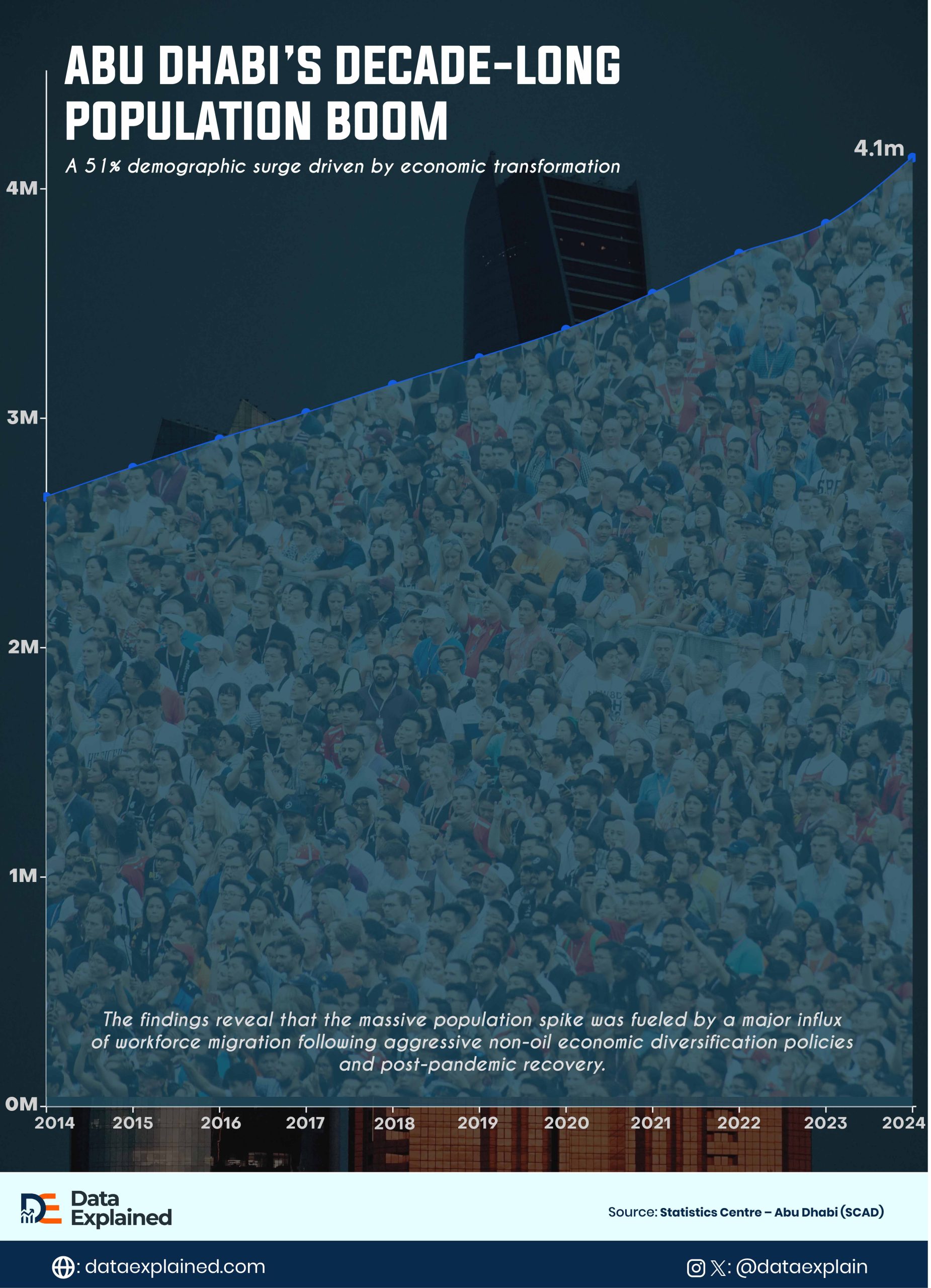
Abu Dhabi has undergone one of the fastest population surges in the Gulf over the past decade, expanding from about 2.7 million residents in 2014 to over 4.1 million by 2024.
Beneath the numbers lies a transformation driven as much by policy as by opportunity.
TL;DR
- Abu Dhabi’s population grew 56% over the past decade, moving from 2.7 million in 2014 to 4.1 million in 2024.
- Most of the growth came from immigration and economic diversification, supported by new housing and policy reforms.
- At this pace, the population could reach around 7 million by 2040.
Population figures are sourced from the Statistics Center – Abu Dhabi (SCAD) official census datasets. 2024 is the latest definitive data, as 2025 is still being captured.
Abu Dhabi’s Population in 2014 vs 2024
| wdt_ID | wdt_created_by | wdt_created_at | wdt_last_edited_by | wdt_last_edited_at | Year | Population | Cumulative Population |
|---|---|---|---|---|---|---|---|
| 1 | Monica Ebunoluwa | 16/06/2026 02:57 PM | Monica Ebunoluwa | 16/06/2026 02:57 PM | 2014 | 2,656,450 | 2,656,450 |
| 2 | Monica Ebunoluwa | 16/06/2026 02:57 PM | Monica Ebunoluwa | 16/06/2026 02:57 PM | 2015 | 2,784,490 | 5,440,940 |
| 3 | Monica Ebunoluwa | 16/06/2026 02:57 PM | Monica Ebunoluwa | 16/06/2026 02:57 PM | 2016 | 2,908,200 | 8,349,140 |
| 4 | Monica Ebunoluwa | 16/06/2026 02:57 PM | Monica Ebunoluwa | 16/06/2026 02:57 PM | 2017 | 3,022,500 | 11,371,640 |
| 5 | Monica Ebunoluwa | 16/06/2026 02:57 PM | Monica Ebunoluwa | 16/06/2026 02:57 PM | 2018 | 3,145,400 | 14,517,040 |
| 6 | Monica Ebunoluwa | 16/06/2026 02:57 PM | Monica Ebunoluwa | 16/06/2026 02:57 PM | 2019 | 3,262,600 | 17,779,640 |
| 7 | Monica Ebunoluwa | 16/06/2026 02:57 PM | Monica Ebunoluwa | 16/06/2026 02:57 PM | 2020 | 3,385,600 | 21,165,240 |
| 8 | Monica Ebunoluwa | 16/06/2026 02:57 PM | Monica Ebunoluwa | 16/06/2026 02:57 PM | 2021 | 3,543,000 | 24,708,240 |
| 9 | Monica Ebunoluwa | 16/06/2026 02:57 PM | Monica Ebunoluwa | 16/06/2026 02:57 PM | 2022 | 3,717,000 | 28,425,240 |
| 10 | Monica Ebunoluwa | 16/06/2026 02:57 PM | Monica Ebunoluwa | 16/06/2026 02:57 PM | 2023 | 3,847,585 | 32,272,825 |
Between 2014 and 2024, Abu Dhabi’s population grew by approximately 1.48 million residents, bringing the emirate’s total to over 4.1 million.
The data show steady annual growth, with sharper increases from 2021 onward, coinciding with intensified diversification efforts and migration inflows following the pandemic recovery.
The cumulative column highlights how Abu Dhabi has added the equivalent of its 2014 population more than once within a single decade, underscoring the scale and speed of its demographic transformation.
Year-by-Year Growth Rates & Key Milestones
The steady rise observed over the decade reveals a clear acceleration in recent years.
From 2014 to 2020, Abu Dhabi’s population expanded at an average annual rate of 3–4%, driven by stable job creation and controlled migration policies.
The Abu Dhabi Dialogue (ADD), an intergovernmental consultative process, was established in 2014 and has been a key initiative to improve migration governance in the region.
During this period, the UAE’s Ministry of Human Resources and Emiratisation (MOHRE) shifted from a laissez-faire approach to a more state-managed, corporatized model for migrant worker recruitment and placement.
Post-pandemic population growth
Growth intensified after 2021 as pandemic restrictions eased and diversification programs began to scale.
By 2023, the emirate’s population had climbed to approximately 3.85 million, and in 2024, it surpassed 4 million for the first time.
The Abu Dhabi Region recorded the strongest surge at 8.8%, followed by Al Dhafra (6.2%) and Al Ain (4.4%), underscoring how the capital’s urban core continues to absorb the majority of new residents.
Over the full ten-year span, the population rose by roughly 1.48 million people, equivalent to a 56% cumulative increase.
Which Abu Dhabi Region has the Highest Population Growth Rate?
Abu Dhabi Region remains the dominant population center.
In 2024, it housed about 2,823,340 people, which is approximately 68% of the emirate’s total, and saw the fastest regional growth rate at 8.8% over the year.
The sheer scale of its increase outpaces both Al Ain and Al Dhafra, reflecting continued urban concentration and higher rates of inward migration into core metropolitan zones.
Al Ain Region ranks as the second-largest region with 986,910 residents in 2024, accounting for about 24% of Abu Dhabi’s population.
Its growth rate in 2024 was more moderate, at 4.4%, indicating a more stable, incremental increase compared to that of the Abu Dhabi Region.
Growth in Al Ain appears to be driven more by internal expansion and spillover development than by the sharp migration peaks observed closer to the capital.
Al Dhafra is the smallest by population, with 325,735 people in 2024 (about 8% of the emirate’s total), yet it experienced a 6.2% growth rate (higher than Al Ain, yet lower than Abu Dhabi Region).
So, What’s Driving the Boom?
Growth rarely happens by chance.
In Abu Dhabi’s case, the surge reflects measurable factors such as migration, new economic sectors, and targeted policy reforms that together reshaped the emirate’s population landscape.
This acceleration aligns with the emirate’s ongoing economic diversification.
Non-oil sectors expanded by 6.2% in 2024, now contributing roughly 54.7% of total GDP, a notable structural shift from a decade ago.
Labor force participation also rose by 9.1%, with blue-collar employment accounting for 55.2% of that increase and professional roles making up the remaining 44.8%.
Policy also played a defining role.
The government’s shift to a register-based census system in 2024 improved the precision of population tracking, while initiatives under the Digital Strategy 2025-2027 and a new talent-first approach attracted international professionals to high-skill sectors.
These coordinated policies, together with steady non-oil expansion, form the statistical backbone of Abu Dhabi’s population boom.
ELI5
Abu Dhabi’s population jumped from 2.7 million in 2014 to over 4.1 million in 2024, mostly because more people moved in for jobs as the economy grew beyond oil.
The city built more homes and services to keep up, now approaching 300,000 buildings across its regions.
If the trend continues, Abu Dhabi could reach about 7 million people by 2040, meaning it must keep expanding housing, transport, and jobs to match its fast-growing population.
Source: