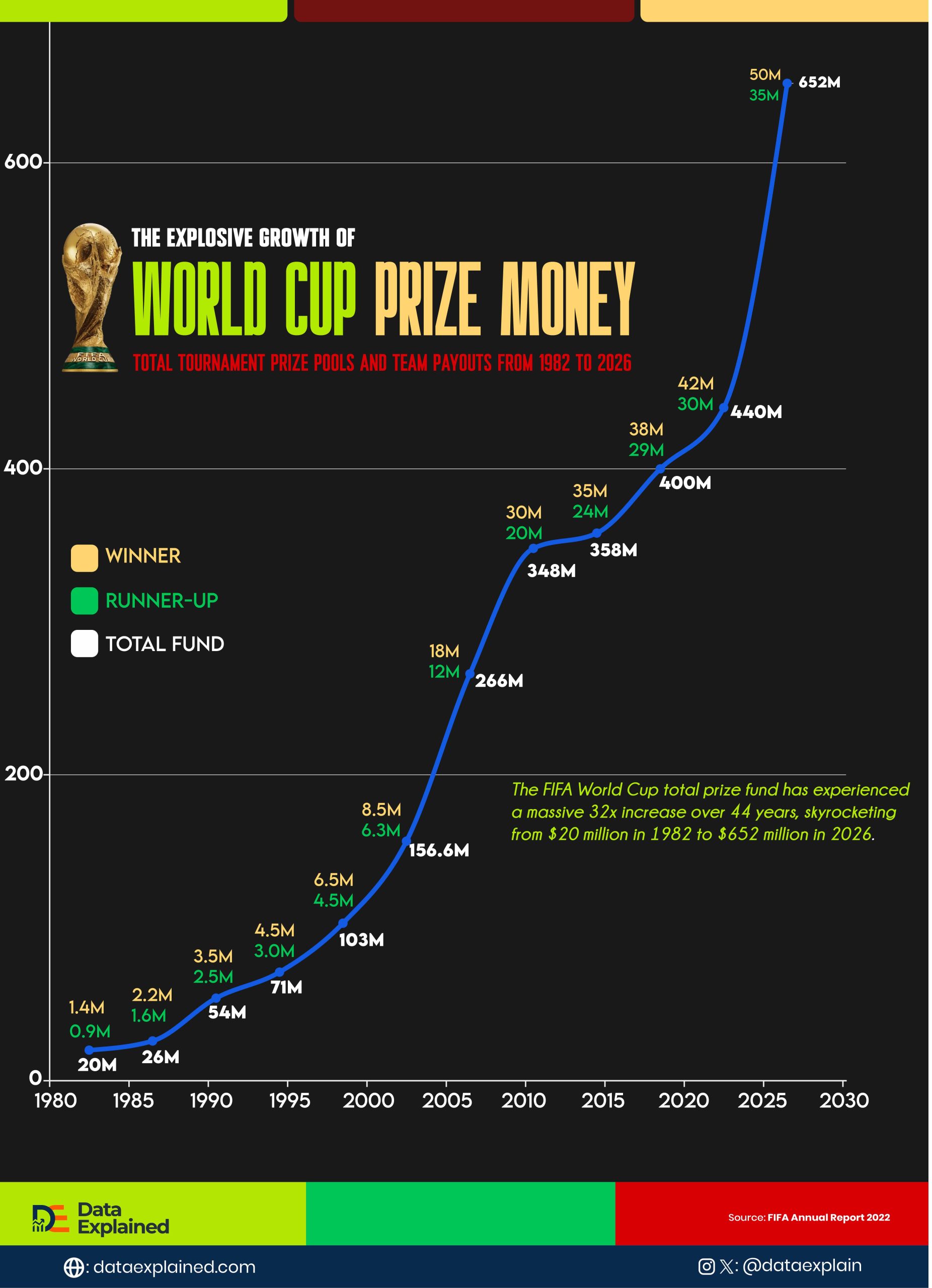
In 1982, FIFA paid the Spain World Cup winner $1.4 million. The runner-up received $900,000. The entire prize fund for all 16 competing nations totaled $20 million.
In 2026, the winner receives $50 million. The runner-up receives $35 million. The total fund for 48 nations is $652 million.
According to FIFA records covering 12 tournaments from 1982 to 2026, those two endpoints represent a 32.6x increase in total prize fund over 44 years.
The growth is not merely an inflationary adjustment.
In 1982 dollars adjusted for inflation, $20 million equates to approximately $63 million in 2026 terms.
TL;DR
- The FIFA World Cup total prize fund has grown from $20 million in 1982 to $652 million in 2026
- The 2026 fund alone exceeded the combined total of all six tournaments from 1982 through 2002
ALSO READ: Ranked: Most (and Least) Expensive Matches at 2026 World Cup
| wdt_ID | wdt_created_by | wdt_created_at | wdt_last_edited_by | wdt_last_edited_at | World Cup | Total Prize Fund | Winner's Prize | Runner-up Prize |
|---|---|---|---|---|---|---|---|---|
| 1 | emmanuel-ashemiriogwa | 16/06/2026 11:17 AM | emmanuel-ashemiriogwa | 16/06/2026 11:17 AM | 1982 - Spain | 20.0 | 1.4 | 900.0 |
| 2 | emmanuel-ashemiriogwa | 16/06/2026 11:17 AM | emmanuel-ashemiriogwa | 16/06/2026 11:17 AM | 1986 - Mexico | 26.0 | 2.2 | 1.6 |
| 3 | emmanuel-ashemiriogwa | 16/06/2026 11:17 AM | emmanuel-ashemiriogwa | 16/06/2026 11:17 AM | 1990 - Italy | 54.0 | 3.5 | 2.5 |
| 4 | emmanuel-ashemiriogwa | 16/06/2026 11:17 AM | emmanuel-ashemiriogwa | 16/06/2026 11:17 AM | 1994 - USA | 71.0 | 4.5 | 3.0 |
| 5 | emmanuel-ashemiriogwa | 16/06/2026 11:17 AM | emmanuel-ashemiriogwa | 16/06/2026 11:17 AM | 1998 - France | 103.0 | 6.5 | 4.5 |
| 6 | emmanuel-ashemiriogwa | 16/06/2026 11:17 AM | emmanuel-ashemiriogwa | 16/06/2026 11:17 AM | 2002 - Korea/Japan | 156.6 | 8.5 | 6.3 |
| 7 | emmanuel-ashemiriogwa | 16/06/2026 11:17 AM | emmanuel-ashemiriogwa | 16/06/2026 11:17 AM | 2006 - Germany | 266.0 | 18.0 | 12.0 |
| 8 | emmanuel-ashemiriogwa | 16/06/2026 11:17 AM | emmanuel-ashemiriogwa | 16/06/2026 11:17 AM | 2010 - South Africa | 348.0 | 30.0 | 20.0 |
| 9 | emmanuel-ashemiriogwa | 16/06/2026 11:17 AM | emmanuel-ashemiriogwa | 16/06/2026 11:17 AM | 2014 - Brazil | 358.0 | 35.0 | 24.0 |
| 10 | emmanuel-ashemiriogwa | 16/06/2026 11:17 AM | emmanuel-ashemiriogwa | 16/06/2026 11:17 AM | 2018 - Russia | 400.0 | 38.0 | 29.0 |
As you can see, a single tournament in 2026 pays more than the first 21 years of prize money history in this dataset.
The 2006 Inflection
The dataset has a clear turning point. From 1982 through 2002, no World Cup winner ever received more than $8.5 million.
Since 2006, no World Cup winner has received less than $18 million.
The 2006 Germany tournament produced the largest proportional increase in the winner’s prize among any two consecutive tournaments: from $8.5 million in 2002 to $18 million in 2006 (a 112% jump in four years).
The commercial factors behind that inflection included the maturation of Champions League broadcasting rights.
It created a market expectation for premium football content and intensified competition for kit sponsorship between Adidas and Nike.
ALSO READ: FIFA World Cup: 96 Years of Data Narrows to 3 Realistic Winners
The Anomaly: 2010 to 2014
Not every tournament showed significant growth.
The total fund moved from $348 million in 2010 to $358 million in 2014, a $10 million, 3% increase.
Every other consecutive tournament pair in the record shows a substantially larger absolute and proportional jump.
The European debt crisis, the broader post-2008 economic environment, and the specific sponsorship cycle FIFA had in place during that period appear to have constrained commercial revenue growth, as evidenced by the prize fund’s stagnation.
The 2026 Record Jump
The 2022-to-2026 increase of $212 million is the largest single-tournament prize fund jump in FIFA’s history by absolute value.
The previous record was $109.4 million, from 2002 to 2006. The 2026 jump nearly doubles it.
The 48-team expansion is the primary structural driver.
Adding 16 teams to the format means 104 matches instead of 64.
It results in:
- Substantially more commercial content
- More broadcasting hours and sponsorship inventory to sell.
The United States market, the world’s largest sports commercial economy, provides a premium for hosting.
The streaming rights competition that intensified after 2022, with multiple platforms bidding for World Cup content alongside traditional broadcasters, has significantly expanded FIFA’s revenue base.
ALSO READ: Which Country Has the Most FIFA World Cup Wins?
ELI5 (Explain It Like I’m 5)
In 1982, the team that won the World Cup got $1.4 million. Today, it gets $50 million, and the total prize money for all teams is $652 million (32 times what it was in 1982). The biggest jump occurred between 2022 and 2026: $212 million more than the previous period. That’s because more teams are playing, America is hosting (which brings in more money), and more streaming companies are paying huge sums to air the matches.
Source: