

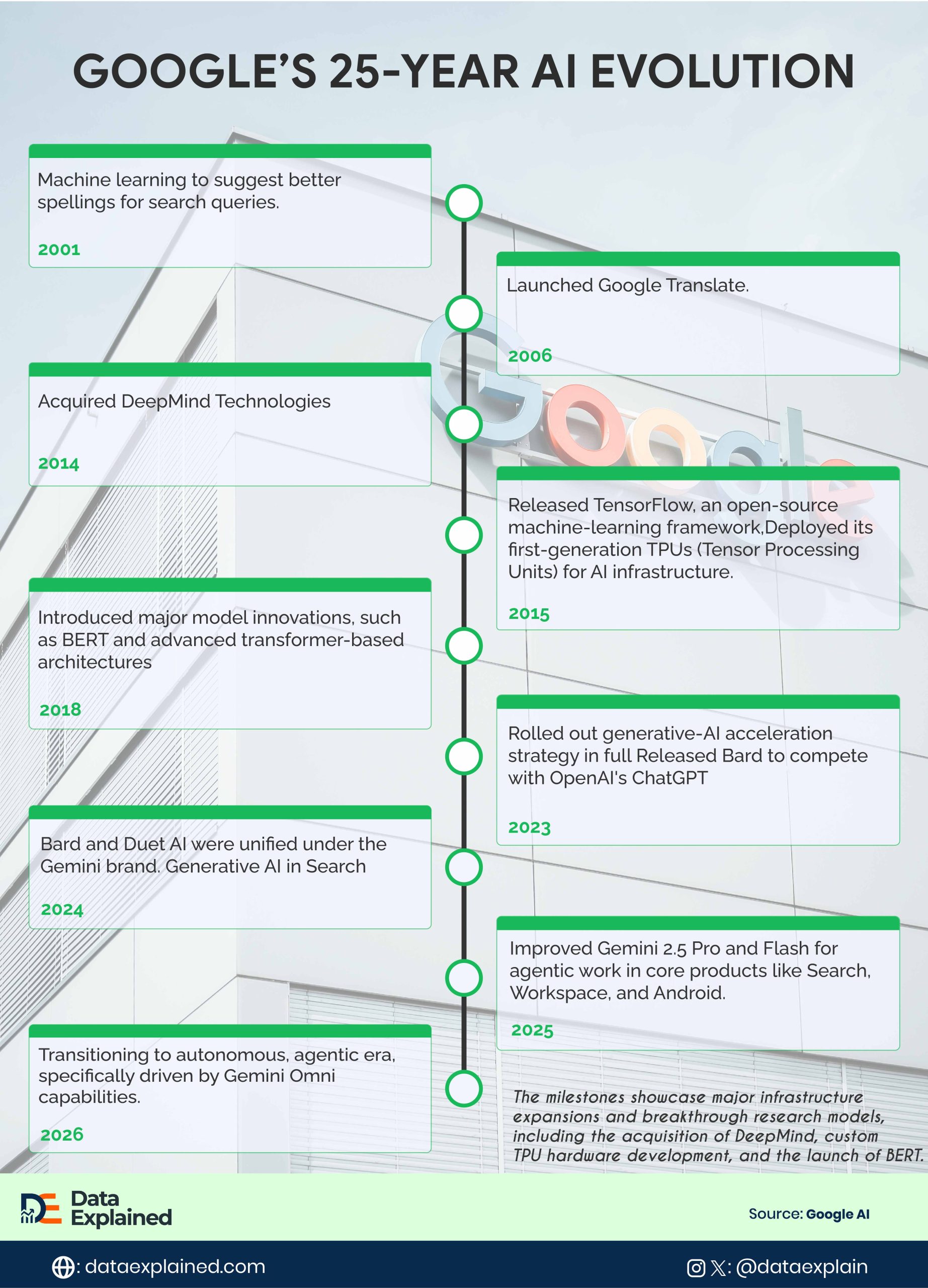
Google’s AI journey is a story of steady evolution. It began with machine learning experiments in Search and advanced to multimodal models, such as Gemini.
Here’s how the company has fared in its AI growth over the last 25 years.
TL;DR
Insights for this timeline were drawn from Google’s official written documentation on its AI journey.
Timeline of Google AI growth (2001-2025)
| wdt_ID | wdt_created_by | wdt_created_at | wdt_last_edited_by | wdt_last_edited_at | Year | What happened in that year |
|---|---|---|---|---|---|---|
| 1 | Monica Ebunoluwa | 10/06/2026 10:21 AM | Monica Ebunoluwa | 10/06/2026 10:21 AM | 2001 | Machine learning to suggest better spellings for search queries |
| 2 | Monica Ebunoluwa | 10/06/2026 10:21 AM | Monica Ebunoluwa | 10/06/2026 10:21 AM | 2006 | Launched Google Translate |
| 3 | Monica Ebunoluwa | 10/06/2026 10:21 AM | Monica Ebunoluwa | 10/06/2026 10:21 AM | 2014 | Acquired DeepMind Technologies |
| 4 | Monica Ebunoluwa | 10/06/2026 10:21 AM | Monica Ebunoluwa | 10/06/2026 10:21 AM | 2015 | Released TensorFlow, an open-source machine-learning framework, Deployed its first-generation TPUs (Tensor Processing Units) for AI infrastructure |
| 5 | Monica Ebunoluwa | 10/06/2026 10:21 AM | Monica Ebunoluwa | 10/06/2026 10:21 AM | 2018 | Introduced major model innovations, such as BERT and advanced transformer-based architectures |
| 6 | Monica Ebunoluwa | 10/06/2026 10:21 AM | Monica Ebunoluwa | 10/06/2026 10:21 AM | 2023 | Rolled out generative-AI acceleration strategy in full Released Bard to compete with OpenAI's ChatGPT |
| 7 | Monica Ebunoluwa | 10/06/2026 10:21 AM | Monica Ebunoluwa | 10/06/2026 10:21 AM | 2024 | Bard and Duet AI were unified under the Gemini brand Generative AI in Search |
| 8 | Monica Ebunoluwa | 10/06/2026 10:21 AM | Monica Ebunoluwa | 10/06/2026 10:21 AM | 2025 | Improved Gemini 2.5 Pro and Flash for agentic work in core products like Search, Workspace, and Android |
| 9 | Monica Ebunoluwa | 10/06/2026 10:21 AM | Monica Ebunoluwa | 10/06/2026 10:21 AM | 2026 | Transitioning to an autonomous, agentic era, specifically driven by Gemini Omni capabilities |
Google’s journey into AI began in 2001, when it utilized machine learning to enhance spelling correction in Search.
This breakthrough enabled the system to learn from user data, rather than relying on fixed rules, thereby enhancing accuracy across billions of queries.
Though subtle, it was a turning point that paved the way for personalized recommendations, predictive text, and a culture of AI-driven experimentation at Google.
Launch of Google Translate Changed Everything
In 2006, Google launched Translate, marking its expansion of machine learning beyond Search.
Unlike rule-based translation tools, it analyzed massive bilingual text datasets and continuously improved with user input.
As Translate evolved toward neural translation, it showcased how scalable AI could power global communication and validated Google’s research-first approach to accessible intelligence.
Model Innovations: BERT and Transformer Architectures
By 2018, Google’s AI research produced one of its most influential breakthroughs, BERT (Bidirectional Encoder Representations from Transformers).
Built on Transformer architecture, BERT enabled Search to understand context and meaning rather than just keywords. This shifted AI from recognizing words to comprehending the intent of language.
The update improved billions of queries globally, marking a leap toward natural, conversational search powered by deep learning.
AI-First Strategy
From 2023 onward, Google accelerated its generative AI strategy, embedding generative and conversational AI across Search, Workspace, and Cloud.
In 2024, Bard and Duet AI were unified under the Gemini brand, with a mobile app launched on Android and the service integrated into the Google app.
The rollout of AI Overviews in Search and model-powered tools like Duet AI signaled a new phase where AI became the core of every Google product.
Acquisition of DeepMind, Release of TPU
In 2014, Google acquired UK-based artificial intelligence company DeepMind for about $500 million.
The deal gave Google access to some of the world’s leading AI researchers and technologies.
The acquisition is widely seen as a turning point in the AI race, helping Google strengthen its position in machine learning and advanced AI development.
In 2015, Google introduced the Tensor Processing Unit (TPU), a custom-built computer chip designed specifically for AI workloads.
Unlike traditional processors, TPUs could run machine learning models faster and more efficiently.
The technology helped Google improve services such as Search, Translate, and Photos while accelerating the development of modern AI systems.
Major Recent Milestones: Gemini, AI Studio, and Global Deployment
Google’s most recent phase centers on the Gemini family of large language models, which was launched in late 2023 and expanded throughout 2025.
Gemini combines text, image, code, and reasoning capabilities into a single multimodal system, representing Google’s most advanced AI yet.
Its benchmark performance placed it among the leading models globally, strengthening Google’s competitive edge in generative AI.
To support developers and businesses, Google introduced AI Studio, a workspace for building and deploying applications using Gemini models.
Integrated with Vertex AI, AI Studio simplifies experimentation and scales AI access to enterprises and creators alike.
ELI5
Over the past two decades, Google has steadily built its AI power.
It started with simple machine learning tools to improve search and spelling, then launched Google Translate to break language barriers.
After buying DeepMind in 2014, it pushed deeper into advanced AI research. Google later released TensorFlow, created its own AI chips (TPUs), and built smarter models like BERT that made search more natural.
By 2017, it became an “AI-first” company. Then came Bard, later rebranded as Gemini, which now powers Google’s products with powerful generative and agent-like AI capabilities.
Sources: